The Lid That Floats: Nimono and the Discipline of the Quiet Simmer
A pot of simmered daikon in pale broth is the least photogenic thing in Japanese cooking. It is also where the logic of the entire cuisine becomes visible — in the order the seasonings go in, in a wooden disc resting directly on the food, and in how little is added at all.
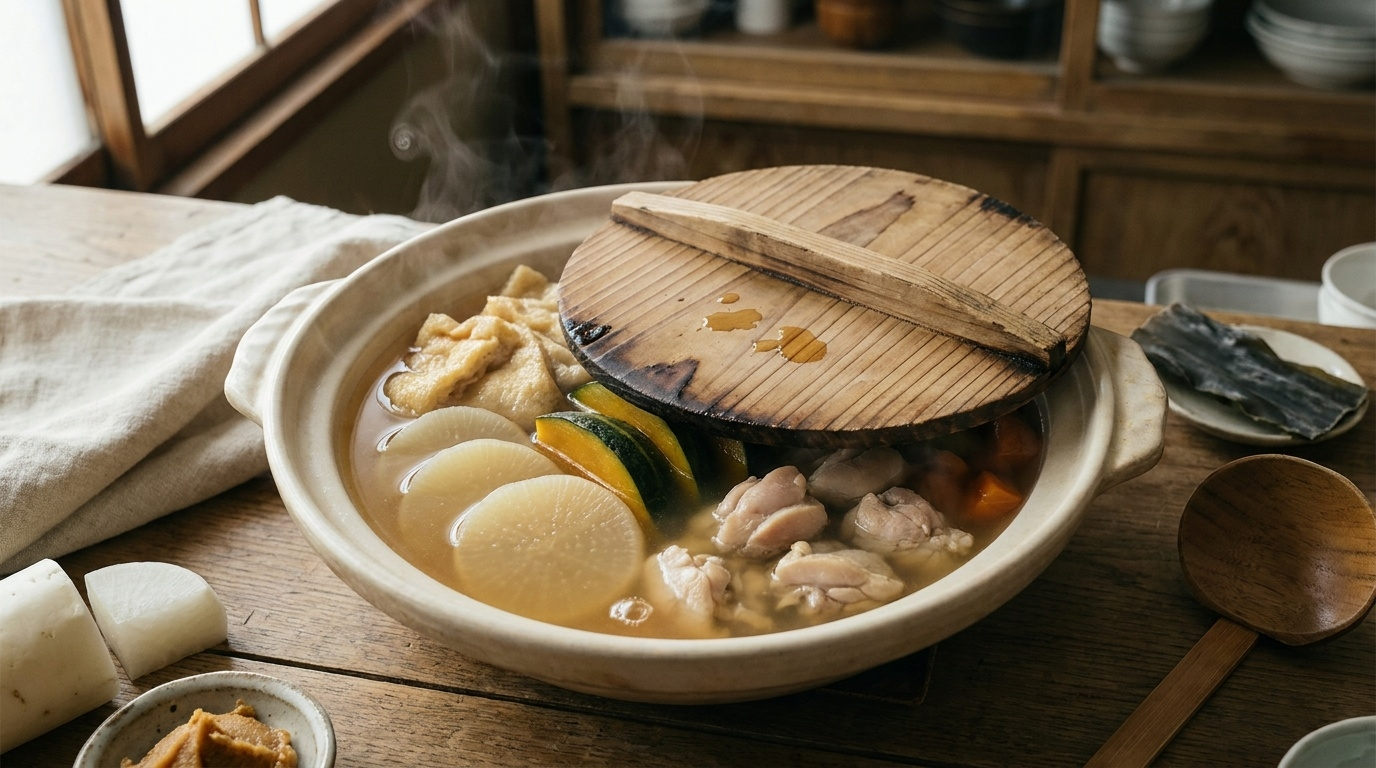
Lift the lid on a pot of simmering daikon and there is almost nothing to see. The liquid is barely coloured — closer to weak tea than to gravy. It is not boiling; it is trembling, throwing up a bubble every second or two near the edge. Floating on top of the vegetables, not on the rim of the pot, is a wooden disc slightly smaller than the pan, darkened at the edges from years of use. Nothing is browning. Nothing is reducing to a glaze. Somebody is standing nearby, mostly not doing anything.
This is nimono — Japan’s family of simmered dishes — and it is the technique that Japanese home cooking is actually built on — more than grilling, more than frying, more than any of the knife work that gets the attention. It is also the technique that translates worst. A Western braise is a story of accumulation: sear, deglaze, reduce, enrich. Nimono runs the other way. The cook’s problem is not how to build flavour into the vegetable but how to get a small amount of already-complete seasoning to travel into it evenly, without the vegetable falling apart on the way. Almost everything traditional about the technique — the order of the seasonings, the floating lid, the refusal to boil hard — is a solution to that single physical problem.
Sa-Shi-Su-Se-So, and the Part Nobody Admits
Every Japanese cook learns the sequence as a mnemonic before they learn it as a rule: sa for satō (sugar), shi for shio (salt), su for vinegar, se for seuyu — the old spelling of soy sauce — and so for miso. It is taught as the order in which seasonings enter the pot, and it is usually presented as ancient wisdom that science later confirmed. The truth is more interesting, and more partial.
The first two letters are the real ones. Sucrose has a molecular weight of about 342; sodium chloride, about 58.5 — roughly a sixth. Diffusion coefficients fall as molecular weight rises, so salt moves into a piece of food substantially faster than sugar does. The Tsuji Culinary Institute explains it with a container, softballs and marbles: fill a jar with softballs and there is still room for marbles between them, but fill it with marbles first and no softball will ever get in. Add salt first, or even add both at once, and the salt arrives first, tightens the tissue, and the sweetness never fully lands. Sugar goes in first because it is slow and needs the head start.
The rest of the sequence is a different kind of argument. Vinegar, soy sauce and miso are grouped at the end not because of molecular size but because all three are fermented, and heat drives off the volatile aromatics that fermentation spent months or years producing — the same aromatics that make a naturally brewed soy sauce worth its two years in the barrel, or that give a good rice vinegar its rounded, un-sharp edge, in the first place. Add them early and you boil away what you paid for. Among themselves, though, the order is loose. Tsuji’s own instructors say so plainly: only the sugar-then-salt part is strictly grounded, and the su-se-so tail is, in their word, something of a stretch. Their working version of the mnemonic breaks the rhythm on purpose — sa-shi, then su-se-so.
It is worth noticing what kind of rule this is. Not a recipe, not a flavour formula, but a piece of transport physics compressed into five syllables and handed down for generations by people who had no access to a diffusion coefficient and worked it out anyway.
What the Broth Can and Cannot Get Inside
Once you start thinking of nimono as diffusion, the technique’s odder habits begin to explain themselves. Sachiko Odake, who studies seasoning transport at the Nippon Veterinary and Life Science University, has measured how fast salt actually moves through different foods, and the numbers are unintuitive. In agar — almost entirely water — the effective diffusion coefficient for salt runs around 1.1–1.3 × 10⁻⁹ m²/s. Swordfish, tuna and beef, all around 70 percent water, come in near 1.0. But herring, at 64 percent water and 19 percent fat, drops to 0.232 — a quarter of the rate. Fat is not a medium salt can cross. This is the physical reason a fatty fish is simmered briefly in a strong, dark liquid while a daikon is simmered at length in a weak, pale one: in the first, seasoning was never going to penetrate, so the dish is built at the surface; in the second, it can, so the cook builds it all the way through.
The same measurements produce a startling result for soy sauce. Odake soaked cubes of hanpen fishcake in undiluted soy sauce and photographed cross-sections at intervals. Salt reaches the centre in about three hours. The colour barely moves at all — after twenty-four hours the interior is still pale, because the melanoidin pigments built up in the barrel are enormous molecules and diffuse at a crawl. Soy sauce, from the inside of a simmered vegetable, is a seasoning that arrives without its own colour.
Salt reaches the centre of a simmered piece in about three hours. The colour of the soy sauce it came in never really gets there at all.
Aroma has its own strange arithmetic. In work by Mitsuya Shimoda, a 200 mM salt solution with soy sauce aroma added to it was judged as salty as a 300 mM solution with none — the smell doing roughly a third of the work of the salt. A separate study found that adding usukuchi soy sauce to katsuo dashi lowered the salt needed to hit the same perceived seasoning. This is the quiet mechanism behind the whole style: a broth already carrying glutamate and inosinate simply needs less of everything else. That relationship — why good stock reduces the amount of seasoning a dish requires, rather than adding to it — is the subject of our piece on why Japanese cooks say they draw dashi rather than make it. Nimono is that idea taken out of the stockpot and applied to a vegetable.
The Lid That Sits on the Food
The otoshibuta — the dropped lid — is the piece of equipment that gives the technique away. It is a flat disc, traditionally cypress or cedar, cut a size or two smaller than the pot so it descends inside it and rests directly on the ingredients, half-submerged.
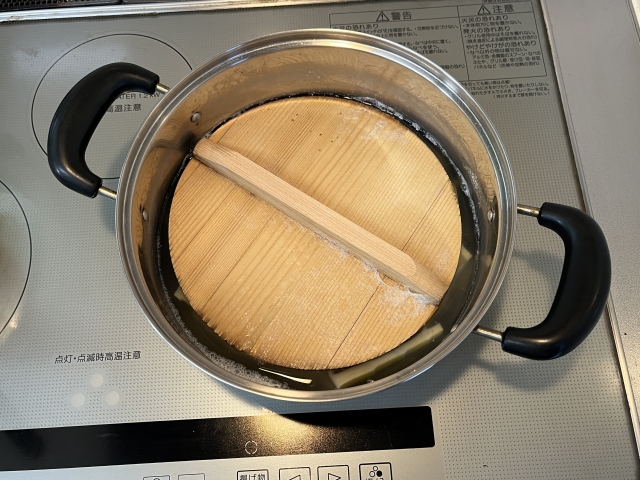
It exists because nimono uses too little liquid. A dish simmered in enough broth to cover everything would be a soup, and would leach flavour out of the food as readily as into it, so the cook works with liquid that comes only partway up. The dropped lid solves what that creates. Simmering liquid rising under it is deflected sideways and back down, so the whole pot circulates and the exposed upper surfaces are continually washed with broth instead of drying out — which is why the technique produces even seasoning without stirring. It also holds pieces in place: potatoes and daikon that would knock against each other in an open pot stay put, and hold their shape. And by covering most of the surface it slows evaporation, without sealing the pot the way a fitted lid would, which lets steam and any remaining fishiness escape rather than condensing back in.
A wooden one is soaked before use so it doesn’t drink the broth or carry yesterday’s dish into today’s, and wood insulates where metal conducts, holding the pot’s temperature steadier. Silicone and stainless discs have largely replaced cedar in the modern kitchen, and a sheet of parchment with a hole cut in the middle does the same job for anyone who owns neither. The principle is what matters: the lid is not there to trap heat. It is there to make a small amount of liquid behave like a large one.
Three Words for Being Simmered
Japanese keeps separate names for what English lumps together as “simmered,” and the distinctions are about where the flavour is meant to end up.
Fukumeni — literally “simmered to contain” — is the most patient form. Ingredients are cooked in a generous quantity of lightly seasoned dashi and then left to sit in it, absorbing slowly, so that the seasoning is inside the food rather than on it. The finished piece is pale, and tastes of itself with the broth underneath it. This is the register of the nimono-wan, the lidded bowl that anchors a kaiseki meal, where the dish arrives with its liquid intact and the liquid is as much the point as the solids.
Nitsuke is the opposite instinct: less liquid, stronger seasoning, short cooking. It is the standard treatment for fish — flounder, mackerel, black cod — and the seasoning stays largely at the surface, with the broth spooned back over the fish as it cooks and served alongside it. Ratios reflect the difference. The Ministry of Agriculture’s own guide to household cooking gives dashi, soy sauce and mirin at 8:1:1 for a general nimono, but for simmered fish drops the dashi entirely in favour of sake at 6:1:1 — sake instead of stock, because the fish is making its own, and because alcohol carries off the odours that stock would only dilute.
Nishime goes furthest in the other direction: root vegetables, konnyaku and dried goods simmered until the liquid has nearly gone and the seasoning has concentrated into them. It keeps for days, which is why it fills the New Year’s osechi boxes. Same pot, same seasonings, three different answers to the question of where the flavour should live.
The Thing Everyone Believes
There is one piece of received wisdom about nimono repeated in nearly every Japanese kitchen: the flavour goes in as the dish cools. Cook it in the morning, let it stand, eat it at night.
Researchers have tried repeatedly to find it, and it does not appear. A 2009 study presented to the Japan Society of Cookery Science by Makiko Okumoto heated cubes of potato, daikon and konnyaku in salt solution, then transferred them to baths held at 0, 30, 50, 80 and 95°C and measured chloride in the outer and inner layers at intervals. The hotter the bath, the more salt had entered — at every interval, in every food. Cooling did not draw seasoning in. The authors even considered and dismissed the Soret effect, the thermal-gradient phenomenon sometimes invoked to explain it. Separate work by the molecular gastronomy researcher Shin-ichi Ishikawa, who visualised the penetration of simmering liquid using dye, found the same thing from the other side: daikon and konnyaku held at room temperature took up more liquid than those refrigerated. Diffusion coefficients rise with temperature, as the Arrhenius relationship says they must. A cooling pot is a pot in which seasoning is moving more and more slowly.
So why does everyone believe it? Ishikawa’s suggestion is that the belief is real but the mechanism is misattributed. Perception of umami and sweetness changes considerably with temperature; perception of saltiness changes far less. A nimono tasted hot and then tasted cool will genuinely seem more seasoned the second time — not because more salt went in, but because the sweetness and umami that were masking it have receded. The maxim was probably born at the moment somebody tasted the pot twice.
The seasoning was not still moving while the pot cooled. Your tongue was.
None of which makes resting a dish pointless. Standing time evens out gradients that fast cooking leaves behind, and it lets a cook get several dishes to the table at once — the actual logistics of a Japanese meal. It just isn’t magic, and knowing that changes what you do: if you want a daikon deeply seasoned, the answer is longer at temperature, not longer in the fridge.
What Is Not in the Pot
Set out everything a classic nimono contains and the list is almost embarrassing. Dashi. Soy sauce. Mirin. Sake. Sugar, sometimes. That is the dish. No aromatics sweated in fat, no browning, no reduction, no thickening — and thickening would work against it anyway; Odake’s measurements show that adding starch to a cooking liquid drops the diffusion coefficient of salt steadily as the concentration rises, from 1.12 at one percent cornstarch to 0.94 at five. A thickened sauce clings, but it stops travelling. Japanese simmering keeps its liquid thin precisely so the seasoning can keep moving.
Everything the dish needs in the way of depth has already been made somewhere else, by someone else, over a much longer period than the forty minutes it spends in the pot: a paste that turned time into flavour in a cedar vat, a soy sauce that spent two winters fermenting, a vinegar that was sake before it was sour. The cook is not building flavour. The cook is choosing which finished thing to add, in what order, and then leaving it alone. A cook in Kyoto reaching for a pale, sweet saikyō paste and one in Nagoya reaching for near-black hatchō are making very different dishes with identical technique — which is a story in itself, and the subject of how Japan’s regions turned one paste into many worlds. If the difference between the two is unfamiliar, the logic behind white, red and blended miso is worth having before you season a pot with either.
This is the discipline the technique is named for. Not the discipline of doing something difficult, but of declining to. A low flame instead of a hard boil, because boiling breaks the pieces and clouds the broth. A wooden disc instead of stirring. Salt after sugar because of a difference in molecular weight that nobody could have measured when the rule was made. And then standing near the stove, doing mostly nothing, while a physical process that cannot be hurried takes as long as it takes.
The daikon comes out the colour it went in, faintly translucent, holding its shape, tasting of daikon and of the sea and of a wooden barrel somewhere in Chiba. Nothing was added to it, exactly. Something was let in.
Read, then Taste.
This article is part of Waden’s Technique series — exploring the craft, philosophy, and practice behind Japanese culinary methods. Read more at waden.umamibako.com.
Waden is an editorial journal exploring the depth and beauty of Japanese food culture — its history, ingredients, artisans, and traditions. Story first, always. waden.umamibako.com
Comment