Inside the Soy Sauce Barrel: Japan’s Most Patient Condiment
Four ingredients. Two years. Hundreds of aromatic compounds. The story of Japanese soy sauce is a story about time — and about what happens when you give fermentation the space to do its work properly.
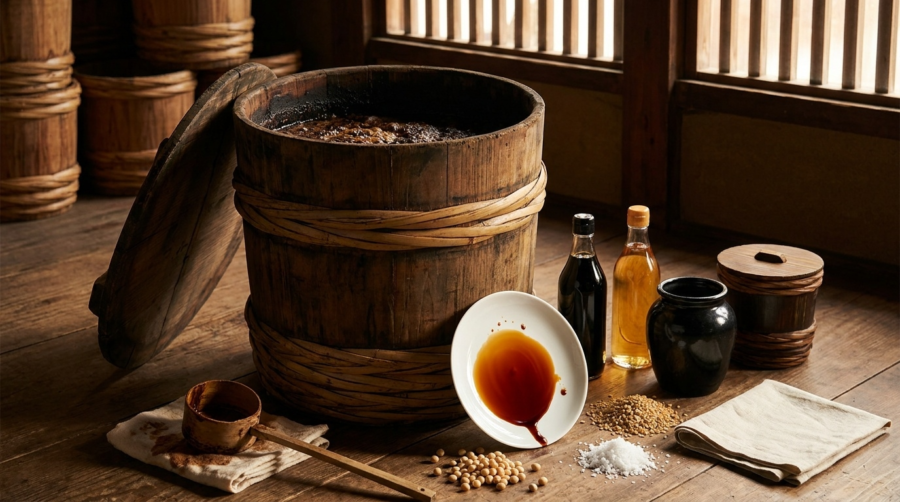
Pour a few drops of good Japanese soy sauce onto a white plate and tilt it toward the light. The colour is not simply brown — it is a deep, translucent mahogany that shifts as the light moves through it. Bring the plate close and breathe in. The aroma is at once sharp and rounded, saline and sweet, with something underneath that is harder to name: a depth that seems to come from somewhere older than the bottle.
That depth has a source. It is the accumulated result of months or years of fermentation in a large wooden barrel — a process so unhurried, so dependent on the rhythms of microorganisms and seasons, that it has no real equivalent in the modern food industry. Soy sauce, at its best, is not manufactured. It is grown.
Where Soy Sauce Began
Begin with what soy sauce replaced. For most of Japanese history the default liquid seasoning was not made from soybeans at all: it was made from fish, and in coastal communities it remained so long after the cities had moved on. The character 醤 in shōyu is the same one in gyoshō, fish sauce. The lineage is written into the name.
The conventional account of how the soybean version arrived runs like this. In 1254 a Zen monk named Kakushin returned from Song China, having learned to make kinzanji miso — a chunky fermented paste quite unlike the smooth miso most people know, eaten as a relish rather than dissolved into soup. He settled at Kōkoku-ji in Yura, in what is now Wakayama Prefecture, and taught the method to the villagers. Somewhere in the process, a batch produced more liquid than it should have. The runoff pooling at the bottom of the barrel turned out to be delicious. That liquid, the story goes, was the first tamari, and the nearby town of Yuasa became the birthplace of Japanese soy sauce.
It is a good story, and it should be handled with care. No contemporary document records the discovery; the account was written down considerably later, and Yuasa’s status as the birthplace of soy sauce is a matter of tradition and regional heritage designation rather than of documentary proof. Fermented soybean liquids of various kinds existed in Japan well before the thirteenth century, and it is unlikely that any single moment can be identified as the origin of a technique that developed incrementally across many places.
What is true, and what gives the legend its plausibility, is the mechanism. Kinzanji miso really does throw off a dark, savoury liquid as it matures, and that liquid really is the direct ancestor of tamari. The story is best read not as a report of an event but as a compressed account of a genuine relationship: soy sauce came out of miso, as a by-product before it was ever a product.
What happened afterward is much better documented. In the early 1600s, families from the Yuasa area followed the coastal shipping routes east and settled in Chōshi, a seaport town near the fast-growing city of Edo. Among them were the Hamaguchi, whose descendants founded Yamasa in 1645. By the mid-seventeenth century, Noda and Chōshi in Chiba Prefecture had become the dominant centres of production, brewing for a city that was on its way to becoming the largest in the world.
A different tradition was developing in the west. The soft water of the Ibo River at Tatsuno, in Hyōgo Prefecture, proved poorly suited to sake brewing but ideal for a lighter, more delicate soy sauce. Brewers there found that adding amazake, the sweet fermented rice drink, to the mash produced a paler colour and a milder flavour. This became usukuchi, and it has defined the cooking of the Kansai region ever since.
Four Ingredients, One Process
All Japanese soy sauce begins with the same four things: soybeans, wheat, salt, and water. Proportions and methods vary by style and by producer, but the sequence — koji cultivation, then extended fermentation — is shared across the whole tradition.
It starts with the koji. Steamed soybeans and roasted, crushed wheat are mixed and inoculated with the mould Japan declared its national fungus, Aspergillus oryzae — the organism that also makes miso, sake, mirin, and rice vinegar possible. The mixture is spread out in a temperature- and humidity-controlled room, the kōjimuro, and left for roughly three days while the mould works its way through the grain, secreting the enzymes that will later dismantle proteins into amino acids and starch into sugar. Nothing further happens in soy sauce that was not made possible in this room.
The koji is also alarmingly vulnerable. Breweries that still work traditionally maintain strict protocols around the kōjimuro, and the most famous of them is a genuine rule rather than a piece of folklore: anyone who has eaten natto in the previous day is barred from entering. Bacillus subtilis, the natto bacterium, outcompetes koji mould readily, and a single contaminated batch can be lost.
Once the koji is ready, it is mixed with salt water into a dense, wet mash called moromi, which goes into the fermentation vessel — traditionally a wooden barrel, today usually stainless steel or plastic. Fermentation and ageing then proceed together over months, driven by the koji enzymes and by lactic acid bacteria and yeasts that establish themselves in the mash. The moromi is stirred periodically. The heat it generates rises and falls with the seasons, which is one reason a full turn of the year through the barrel has traditionally been thought necessary.
When it is finished, the moromi is pressed to separate liquid from solids, and the liquid is heated — a step called hiire. This halts fermentation, stabilises the sauce for storage, and, through the Maillard reaction, generates a further layer of aroma compounds. It is the last thing that happens before bottling, and it is where a good deal of the savoury depth the whole process was aimed at finally takes its finished form.
The Barrel and Its Inhabitants
For most of Japanese history the vessel for all this was the kioke: a large barrel built from cedar staves, bound with bamboo hoops and assembled with bamboo nails, using no adhesive and no iron.
Cedar was chosen for a reason that only became fully explicable much later. Its grain is porous at a microscopic scale, and those pores are habitat. Microorganisms take up residence in the wood and stay there, becoming permanent inhabitants of the barrel and contributing to every batch fermented in it. A new steel tank is a blank surface. A kioke that has been working for eighty years is an ecosystem, specific to that barrel, in that brewery, in that valley — which is why soy sauce from wooden barrels carries something like the fingerprint of where it was made, and why the same kind of barrel is used to mature miso, for exactly the same reason.
Until the late Edo period, every drop of soy sauce in Japan came out of a kioke. After the Second World War, producers were encouraged to modernise, and stainless steel could deliver in six months what a barrel took two years or more to do. Today, roughly nine hundred of Japan’s thousand-odd soy sauce manufacturers use tanks, and barrel-brewed soy sauce accounts for around one percent of production. Something on the order of 2,500 brewing barrels remain in use nationwide.
About 1,100 of them — nearly half — are on a single island. Shōdoshima, in the Seto Inland Sea, is where the fifth-generation brewery Yamaroku Shōyu has become the most visible advocate for the kioke. When it became clear that Japan’s last barrel cooperage was about to close with no successor, Yamaroku’s Yasuo Yamamoto apprenticed himself to the coopers, and in 2012 assembled the first new barrels built in the postwar era. The Kioke Craftsmen Revival Project he founded now brings brewers from across the country to Shōdoshima each January to build barrels by hand and share the technique openly rather than guard it. Its stated goal is modest and precise: to raise kioke soy sauce from one percent of national production to two.
Five Styles, One Country
Japanese Agricultural Standards recognise five types of soy sauce, distinguished by what goes into the koji and how the brewing is managed. The production figures alone tell you a great deal about the shape of the tradition.
Koikuchi (濃口), dark soy sauce, is roughly 84 percent of everything produced. It comes from the Kantō region, developed in Noda and Chōshi for the palate of Edo. Its koji is made from approximately equal parts soybeans and wheat, and it ages for one to two years. The wheat is what gives it its aromatic lift: it is the style that smells most dramatic when it hits a hot pan. It is the default for nearly everything — dipping, drizzling, marinades, simmered dishes, the dashi-based broths beneath soba and tempura, and the tare that gives a bowl of ramen its name.
Usukuchi (淡口), light soy sauce, is about 13 percent, and comes from Tatsuno. Its koji is also roughly half soybean and half wheat; what differs is the brewing, which is managed specifically to suppress the development of colour — a shorter fermentation, and about two percentage points more salt to slow the process down, roughly 18 percent by weight against koikuchi’s 16. This is the point most often garbled in English: usukuchi is saltier than koikuchi, not milder. The name refers to colour, not strength. In a single serving the difference is small, on the order of 0.1 g of salt per 10 ml; what makes usukuchi taste sharper in practice is partly that a cook seasoning by eye reaches for more of it, precisely because it does not darken the dish. It exists because Kansai cooking wants to season a clear broth or a pale simmered vegetable without staining it brown, and it is the reason a bowl of udon looks so different depending on which side of the country you order it in.
Tamari (溜り), around 1.5 percent, is the oldest in lineage and the closest thing surviving to that liquid at the bottom of the miso barrel. Its koji is soybean with little or no wheat, and it is brewed mainly in the Chūbu region — Aichi, Gifu, Mie — the same belt of country that produces grain-free soybean miso and a distinctive brewing culture generally. Thick, very dark, and intensely savoury, it is the traditional partner for sashimi, and because it holds up under heat and reddens attractively, it is also the choice for teriyaki glazes and rice crackers. Its near-absence of wheat is why it has found an unexpected second audience abroad among gluten-free cooks — though the wheat content is not always zero, and the label is worth reading.
Saishikomi (再仕込み), about 1 percent, is the double-brewed style, originating in the Yanai area of Yamaguchi Prefecture and brewed across the San’in region and northern Kyūshū. The method is exactly what the name says: instead of mixing the koji with salt water, the brewer mixes it with already-finished soy sauce, and ferments the whole thing again. The result is dark, viscous, and concentrated enough that it is sometimes called kanro shōyu, nectar soy sauce. It is a finishing condiment rather than a cooking ingredient — a few drops on sashimi or cold tofu.
Shiro (白), white soy sauce, is the smallest at about 0.7 percent, and the one most people have never seen. It inverts tamari: its koji is mostly wheat with a small proportion of soybean, and it is brewed to be paler even than usukuchi, a clear amber closer to apple juice than to soy sauce. It was first made around 1802 in Hekinan, in the Mikawa region of what is now Aichi Prefecture, and it exists for the same reason usukuchi does, taken further— to season a clear soup or a chawanmushi with no visible trace. The flavour is light but distinctly sweet, and the aroma is unlike any of the other four.
Reading a Label
The most consequential thing on a bottle of Japanese soy sauce is not the brand or the style. It is the brewing method, and Japanese Agricultural Standards define three.
Honjōzō (本醸造), true brewing, is the process described above: koji, salt water, time. It accounts for about ninety percent of national production. The other two methods — kongō jōzō and kongō, mixed brewing and mixing — introduce amino acid liquid, produced by breaking down soy protein with hydrochloric acid rather than with koji enzymes. It is far faster than fermentation and it delivers savoury intensity, but it is a chemical shortcut around the part of the process that takes two years. Regionally, the split is dramatic: in Chiba, essentially all production is honjōzō; in several prefectures along the Sea of Japan and in southern Kyūshū, mixed-method soy sauce is the local preference and the clear majority.
Two further terms are worth knowing. Tennen jōzō (天然醸造), natural brewing, is a regulated claim: it may be used only for honjōzō soy sauce made without enzyme accelerants and without additives. Nama (生) means the sauce was not pasteurised in the usual way, retaining aromatics that heat would drive off — and requiring refrigeration in return.
The ageing period matters too, though the label will not always state it: usukuchi is a matter of months, koikuchi one to two years, saishikomi three or four. Producers committed to traditional methods tend to advertise the number, because in soy sauce the number is the argument.
One last practical matter. Soy sauce is perishable once opened. Its colour darkens and its aromatic compounds fade quickly on contact with air and light, and a bottle left on a sunny counter for six months is measurably not the thing that was bottled. Refrigerate it. The effort that went into the barrel deserves to survive the journey to the table.
What the Bottle Does Not Contain
It is easy to assume that soy sauce is the savoury foundation of Japanese cooking, full stop. It is not, and the things it sits alongside are worth naming.
It has siblings. Mirin, rice vinegar, sake, and miso all begin in the same kōjimuro, from the same organism, and diverge only in what they are fed and how long they are left — the sweet rice liquor that makes a glaze shine and the vinegar without which sushi could not exist are, in the most literal sense, soy sauce’s relatives. A cook reaching for one of them is choosing among products of a single fungal technology.
It has a predecessor that never left. Fish sauce is still made in Akita, on the Noto Peninsula, and in Kagawa, and in those places it remains the default seasoning that soy sauce is elsewhere. It is older, more concentrated, and — because it derives its glutamate from fish rather than soy — capable of a depth that soy sauce cannot quite reach.
And it has a parallel that owes it nothing at all. Dashi — kombu and katsuobushi, extracted in hot water in a matter of minutes — involves no koji, no fermentation of the brewing kind, and no salt to speak of. Most of what tastes deep in Japanese cooking is the two systems working together, and neither one is the whole story.
The Time Inside
There is something uncomfortable about the economics of traditional soy sauce. A bottle that took two years to make sells for a few dollars more than one that took six months. The barrels, the space, the maintenance, the seasonal rhythms that cannot be hurried — none of it commands much premium in a market that has largely stopped knowing what it is paying for.
The industry’s own numbers describe the squeeze plainly. The number of soy sauce makers in Japan has fallen from around 6,000 in the mid-1950s to about 1,000 today — a sixth of what it was. Shipments have roughly halved from their peak — 1.29 million tonnes in 1973 against 681,000 tonnes in 2024 — and the shelf itself has changed: around a third of the soy sauce section in a Japanese supermarket is now occupied by sweetened variants, dashi-infused blends, and soy-sauce-flavoured seasonings that are not, by the legal definition, soy sauce at all.
The one line moving upward is export. Overseas demand has grown at around four percent a year for two decades, and on current trends it is projected to overtake domestic consumption within the next decade. The paradox is difficult to miss: soy sauce is becoming less central in the country that invented it and more so everywhere else, at the same moment that the slowest and most demanding way of making it has contracted to one percent of output.
Which is what the brewers on Shōdoshima and in Tatsuno and in the surviving kioke breweries are actually doing when they refuse to accelerate. They are not making a commercial calculation. They are maintaining a body of knowledge — about fermentation, about flavour, about the relationship between time and quality — that took centuries to accumulate and could be lost inside a single generation of retirements.
So the next time you open a bottle, look for honjōzō, and then for tennen jōzō. Pour a few drops onto a white plate and tilt it toward the light. Consider what was happening in the barrel through two summers while you were doing other things. That depth you taste — that is time, made liquid.
Read, then Taste.
This article is part of Waden’s Fermentation series. For the organism behind all of it, read The National Fungus; for what Japanese kitchens tasted like before the soybean took over, read Before Soy Sauce. Read more at waden.umamibako.com.
Comment