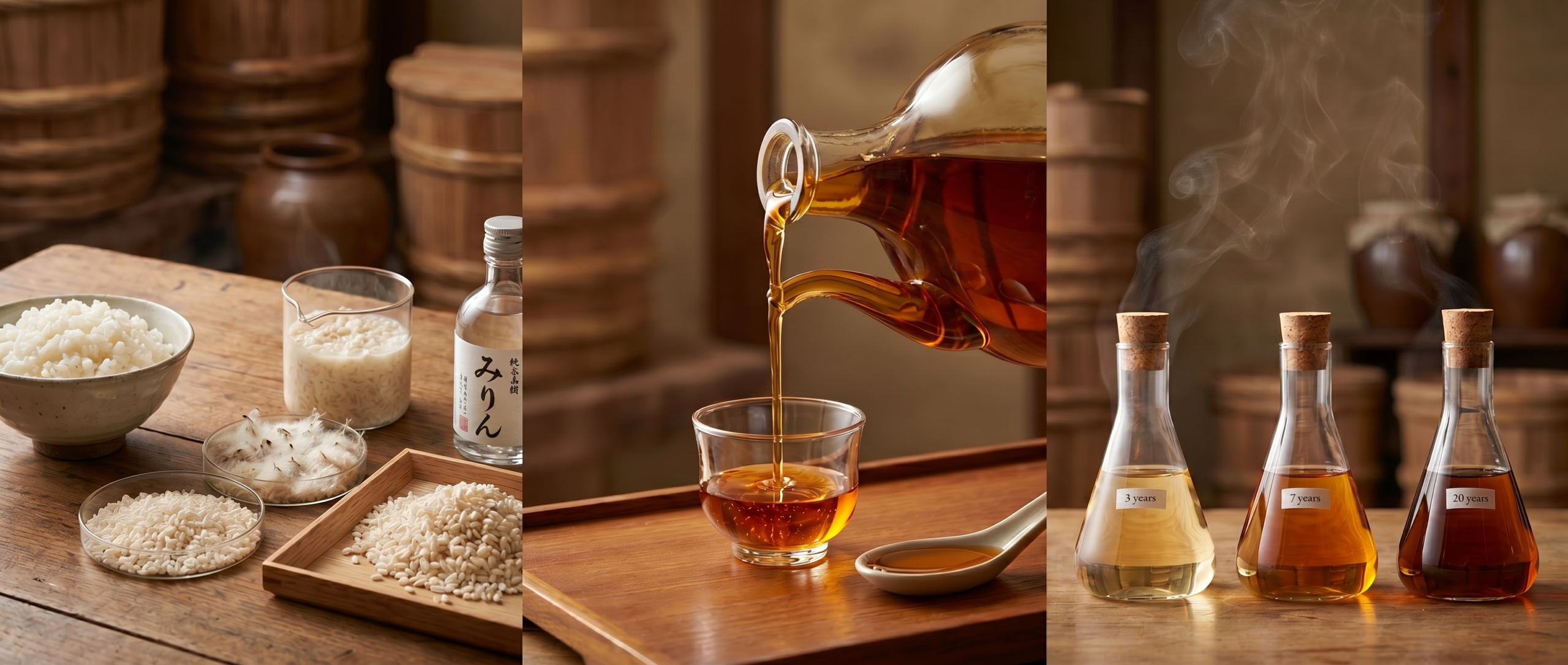
The Sweetness That Fermentation Left Behind: Mirin as a Living Thing
Every other fermented staple in the Japanese kitchen is built by letting the microbes run their course. Mirin is the one that is built by stopping them halfway — a sweetness preserved rather than produced.
There is a habit of mind that comes from cooking with mirin for a long time: you begin to think of it as a sweetener. A slightly more interesting sweetener than sugar, perhaps — thicker, glossier, a little more savory — but a sweetener all the same, a bottle you reach for when a dish needs rounding out. It sits on the counter beside the sugar and the sake, and it does a sweetener’s job.
That habit is worth unlearning, because it hides the more interesting truth. Mirin is not a sweetener that happens to be fermented. It is a fermented liquid — a rice brew, closer in family to sake and miso and soy sauce than to anything in the baking cupboard — whose sweetness is not added but survived. And the way that sweetness survives turns mirin into something quietly unlike every other fermented staple in the Japanese kitchen.
If you have already met mirin as a cook — as the third bottle beside sake and soy sauce, the source of that lacquered teri shine — you know what it does. This article is about something else: what it is, and why it belongs on the same shelf as miso and soy sauce rather than beside the sugar. For the practical side, our companion piece The Bottle That Makes Japanese Food Shine covers how to use it. Here, we go into the barrel.
The Same Fungus, a Different Instruction
Start with what mirin shares with its neighbors. Like miso, like soy sauce, like sake and rice vinegar, mirin is a product of koji — steamed rice inoculated with the mold Aspergillus oryzae, the organism the Japanese sometimes half-jokingly call the national fungus. Koji is the engine of the entire Japanese fermented pantry. Wherever you find deep savory transformation in this cuisine, you tend to find koji underneath it, its enzymes patiently dismantling starches into sugars and proteins into amino acids.
If you are new to how that engine works, our foundational piece The Living Art of Miso: How Time Becomes Flavor lays out the basic chemistry — the same enzymes are at work here. What matters for mirin is that koji does two things in parallel. It breaks starch into sugar, and it breaks protein into amino acids. In miso and soy sauce, those two processes run for months or years, and the sugars they release mostly get consumed or transformed along the way — reacting slowly with amino acids, browning, deepening, disappearing into the savory darkness of a long ferment. The sweetness is a stage the ferment passes through on its way to something else.
Mirin gives koji the same instruction — break down this rice — but then does something none of the others do. It refuses to let the sweetness go.
“In miso and soy sauce, the sugar the koji makes is a stage the ferment passes through. In mirin, that stage is the destination. The sweetness is not produced so much as caught and held.”
Fermentation, Interrupted
Here is the mechanism, and it is the whole point of the article. When you make sake, you mix steamed rice, koji, and water, and you add yeast. The koji breaks the rice starch into sugar, and the yeast immediately eats that sugar and turns it into alcohol. That is what fermentation, in its most familiar sense, means: sugar in, alcohol out. A finished sake is dry precisely because the yeast has done its job thoroughly and consumed almost all the sugar the koji produced.
Mirin is made by removing the yeast from that equation — or rather, by making its work impossible from the start. Steamed glutinous rice (mochi-gome) and rice koji are combined not with water but with a distilled spirit, traditionally shōchū, so that the mash begins its life at an alcohol content of around fourteen percent. In that environment, the koji’s enzymes can still work — they go on patiently breaking the sticky rice starch into sugar — but the yeast that would normally consume that sugar cannot survive the alcohol. There is no fermentation of sugar into more alcohol, because the alcohol is already there.
The result is a kind of arrested ferment. The half of the process that builds sweetness runs to completion; the half that would spend that sweetness never starts. Over a period of roughly thirty to forty days, and in traditional aging far longer, the koji converts the glutinous rice into a deep reservoir of sugar that simply sits there, unconsumed, suspended in spirit. When the mash is finally pressed and filtered, what runs out is a golden, viscous liquid that is close to forty-five percent sugar by content — and every gram of that sweetness was made by a microbe, not spooned in from a bag.
This is why mirin belongs in the fermentation family and not the sugar aisle. It is a ferment defined not by how far it goes but by where it is stopped.
Nine Kinds of Sweet
Because that sweetness is the work of enzymes rather than a single refined ingredient, it does not taste like sugar, and the reason is chemical. Table sugar is one molecule: sucrose, and nothing else. The sweetness of true mirin is a crowd. Roughly eighty percent of it is glucose, but the rest is a spectrum of larger sugars the koji builds as it works through the rice — disaccharides like isomaltose and nigerose, trisaccharides like panose, and longer-chain oligosaccharides beyond them. Analysts of traditional mirin routinely find nine or more distinct sugars in a single bottle.
Those larger sugars are less intensely, less sharply sweet than glucose or sucrose. They register on the palate more slowly and more softly, which is exactly why cooks describe mirin’s sweetness as rounded, layered, mellow — a sweetness with depth rather than a spike. It is the difference between a single held note and a chord. A spoon of sugar hits and fades; mirin’s sweetness arrives in stages and lingers, because it is genuinely made of many different things.
And sweetness is only part of what the ferment leaves behind. The same enzymes that free the sugars also break the rice proteins into amino acids, and true mirin carries a measurable load of them — with glutamic and aspartic acids, the amino acids most associated with umami, present in notable quantity. There are organic acids too, chiefly lactic acid produced by bacteria during the koji-making, along with citric, malic, and succinic acids. Mirin made with white koji in particular ends up rich in citric acid, which is part of why mirin is so effective at quieting the sharp odors of fish and meat. None of this is what you would expect from a “sweetener.” It is what you would expect from a ferment.
“Table sugar is one molecule. Mirin’s sweetness is a crowd of nine or more — which is why it arrives as a chord rather than a single note, and why it can never quite be replaced by anything from a bag.”
The Second Life of Aging
If the arrested ferment is the first act of mirin’s making, aging is the second — and here mirin rejoins its siblings, because it turns out that even a stopped ferment is not a still one. Set aside in the barrel for months or, in the finest traditional examples, for years, mirin keeps changing, driven now not by microbes but by slow chemistry among the compounds already present.
The sugars and amino acids sitting together in that warm, alcoholic liquid begin to react, generating carbonyl compounds; alcohol and organic acids combine into esters; those carbonyls react further with ethanol to form acetals. The upshot is an accumulating complexity of aroma and a gradual deepening of color — the same direction of travel that turns a young pale miso into an old dark one, and for related reasons. A mirin aged a decade takes on a brandy-like amber hue and a fragrance complex enough that it was, historically, drunk as a liqueur in its own right rather than cooked with at all.
There is a satisfying symmetry here with the rest of the fermented pantry. In red miso and the slow Maillard reaction, and in the long barrel-aging of naturally brewed soy sauce, color is time made visible — the darkening is a reading of how long the ferment has been left to develop. Mirin obeys the same rule. Its deepening amber is the signature of the same patient chemistry, unfolding at ordinary temperature over ordinary months, that darkens every long ferment in this cuisine. The mechanism that stopped in mirin’s first act quietly resumes, in a different form, in its second.
Three Bottles, One Honest Question
All of which reframes the question that trips up almost everyone buying mirin for the first time. The shelf usually holds three things wearing some version of the name, and the practical differences between them are covered in our companion guide. But from the fermentation point of view, the three collapse into a single, sharper distinction: is this actually fermented at all?
True mirin — hon mirin — is the real ferment described in this article: glutinous rice and koji brewed in spirit, roughly fourteen percent alcohol, its sweetness entirely the work of enzymes, its complexity the accumulation of amino acids and organic acids and slow aging. It is a brewed alcoholic product, taxed as one in Japan, and it behaves in the kitchen the way only a ferment can.
The fermented seasoning type (hakkō chōmiryō) is also genuinely fermented, made much like hon mirin, but with salt added so that it can be sold as a food rather than a taxed liquor. It is a ferment wearing a slight disguise; the salt is the only thing you must remember to account for.
The third bottle — mirin-style seasoning (mirin-fū chōmiryō) — is the one the fermentation lens exposes most plainly. It is assembled, not brewed: corn syrup, water, a little alcohol, acidulants and flavorings, mixed to imitate the taste of the real thing. It contains sugar because sugar was poured in, not because a microbe made it. It has no koji, no amino acids from broken-down rice protein, no aging, no crowd of nine sugars — none of the chemistry this article has been describing. It can stand in for background sweetness, but it cannot do what a ferment does, because it never was one.
Seen this way, choosing mirin stops being a matter of price or label-reading and becomes a single honest question. Two of the three bottles are alive with the same fungus that built the miso and the soy sauce beside them on the shelf. One of them is a picture of that liquid, drawn in sugar. Which one you want depends entirely on whether you want the thing, or the imitation of the thing.
That is the quiet argument for treating mirin as a ferment rather than a sweetener. Do it, and its whole character clicks into focus: the rounded, unhurried sweetness that no single sugar can copy; the umami hiding beneath it; the amber that deepens with the years. All of it comes from the same source as the rest of the Japanese fermented pantry — koji, patience, and rice transformed by something living. Mirin is simply the member of that family whose gift was to catch the sweetness at its peak, and hold it there, before time could carry it away.
Waden is an editorial journal exploring the depth and beauty of Japanese food culture — its history, ingredients, artisans, and traditions. Story first, always. waden.umamibako.com
Comment