The Sushi That Smells Like Cheese: Narezushi and the Thousand Years Before Vinegar
Before sushi was fast, it was slow — fish buried in rice for a year, preserved by bacteria rather than refrigeration. A handful of villages still make it. The fish they need is nearly gone.
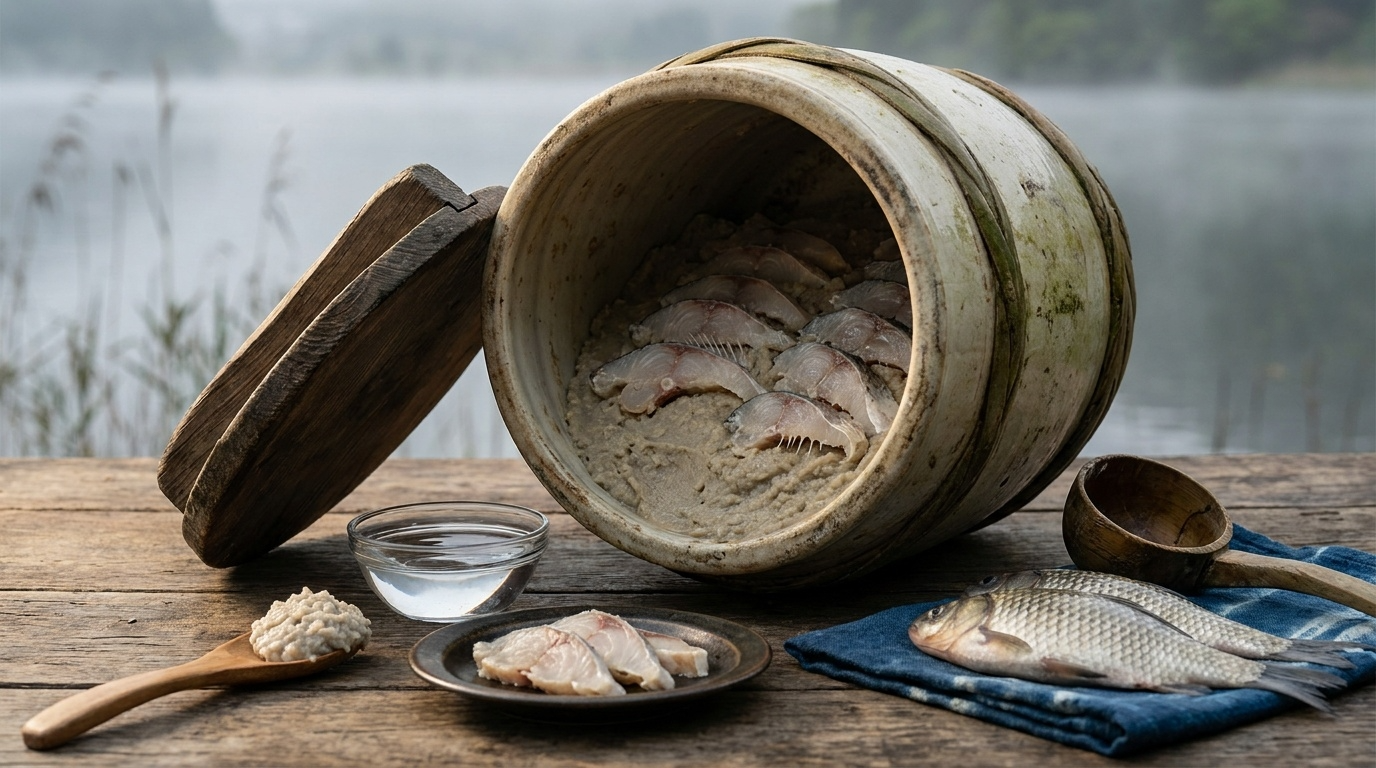
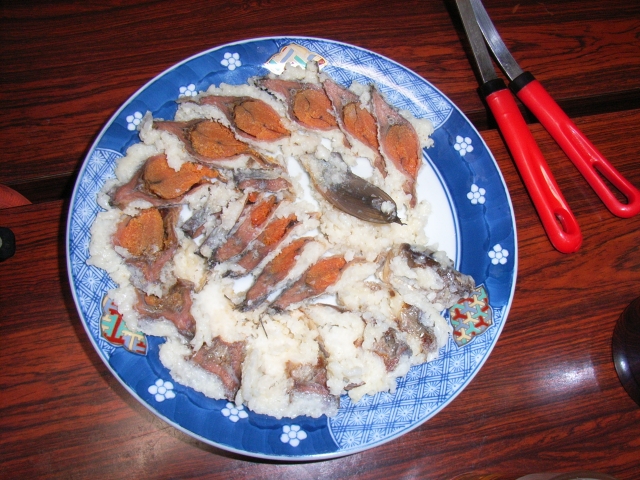
Open a jar of funazushi in a closed room and people will leave. The smell is not fishy in any way a Western nose files under fish; it is closer to a washed-rind cheese left too long in a warm car — ammoniac, sharply sour, with something barnyard underneath it. The fish inside is a whole crucian carp, sliced crosswise into pale discs, the bones still visible in cross-section but soft enough to chew through. Around it clings a grey paste that was, twelve months earlier, a pot of cooked rice.
This is sushi. Not a distant cousin of sushi, not a curiosity that shares a name — this is the thing the word originally described, and everything served across a counter in Ginza tonight descends from it. The distance between that jar and a piece of tuna nigiri is roughly the distance between a wheel of aged Comté and a glass of milk, and it was crossed by the same mechanism: somebody figured out how to get the flavour without the wait.
What the Rice Was For
Narezushi — fish salted and packed in cooked rice, then left to ferment for months or years — is the oldest surviving form of sushi. The logic of narezushi is preservation, and the rice is not food. It is fuel.
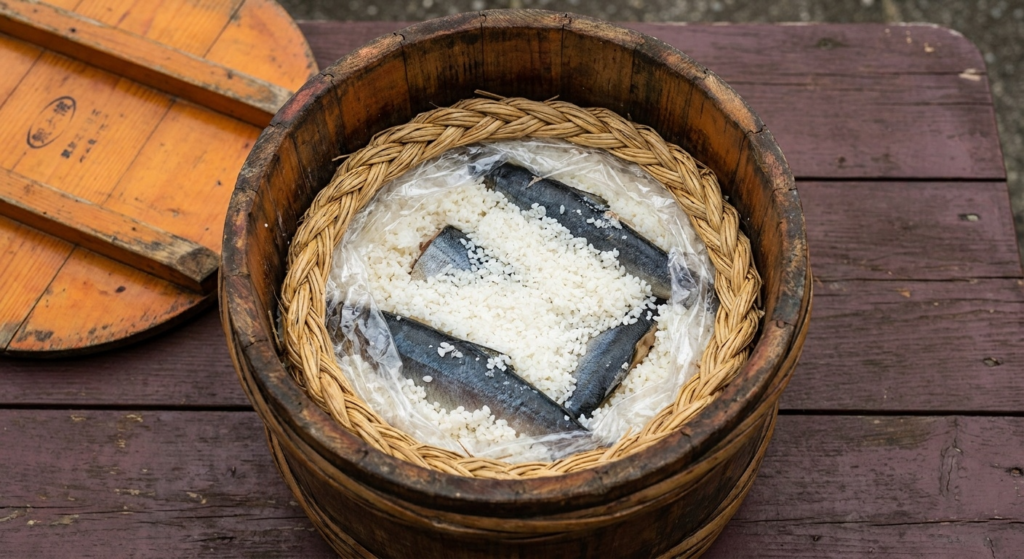
Salted fish is packed into a barrel between layers of cooked rice, weighted, sealed, and left. Lactic acid bacteria — present on the rice, on the fish, on the hands and wooden tub — metabolise the rice starch into lactic acid. The pH falls, and it keeps falling, until the environment is hostile to the putrefactive bacteria and the botulism risk that would otherwise make a barrel of wet fish a death sentence. Salt does the early work of drawing out water, firming the flesh and holding spoilage organisms at bay until the acid can take over. What remains after months in that barrel is fish that will keep for a year without ice.
The late Naomichi Ishige, the anthropologist who spent the 1980s surveying fermented fish across thirteen Asian countries for the National Museum of Ethnology, defined the category precisely along these lines: fish, sometimes bird or mammal flesh, fermented with salt and a cooked starch, preserved principally by lactic acid fermentation that lowers pH and suppresses the organisms of decay. His survey found something striking. This class of food exists in Southeast and Northeast Asia and nowhere else on earth.
In the oldest form, the rice was scraped off and thrown away. It had done its job. Whether or not you eat the rice, Ishige noted, is one of the cleanest ways to tell narezushi from everything sushi later became.
In the oldest form of sushi, the rice was not food. It was fuel for the bacteria, and it was thrown away.
The Rice Paddy It Came From
Ishige’s larger argument was about where the technique began, and his answer was not Japan. He placed the probable centre of origin in the Mekong basin and its tributaries — southwest China, Laos, northern and northeastern Thailand — where irrigated rice cultivation and rice-paddy fishing developed together. It is a landscape that produces two things simultaneously: a glut of small freshwater fish trapped in the paddies at drawdown, and a surplus of cooked glutinous rice. Salt was locally available. The technique followed the Mekong south into the Austronesian world, and it followed rice cultivation north and east.
In Japan, the distribution of narezushi overlaps with the early routes by which wet-rice farming entered the archipelago in the Yayoi period. The food arrived with the agriculture that made it possible. In China, it appears in the historical record only once Han people moved south of the Yangtze — that is, they learned it from the non-Han peoples already there.
The Japanese documentary trail is old and unusually specific. The Yōrō Code of the eighth century lists sushi of abalone and mussel among goods owed in tax. The Engishiki, the tenth-century compendium of court regulations, contains 158 references to the characters for sushi, and where the raw material is named it includes crucian carp, abalone, mussel, sea squirt, ayu, salmon, octopus — and, notably, boar and deer. Wooden tax tags excavated from the Heian capital carry the same words. Crucian carp sushi was being sent to the court from Kawachi, Settsu, Ōmi, Chikugo and Chikuzen more than a thousand years ago.
The sourness is embedded in the name. The Japanese sushi is generally traced to the classical adjective sushi — sour — which is why the word survived intact even after vinegar replaced fermentation as the source of the acidity.
Twelve Months on the Shore of Lake Biwa
Ōmi — modern Shiga Prefecture, wrapped around Lake Biwa — is where the prototype survived. Funazushi is made there still, and the method has changed less than almost anything else in the Japanese kitchen.
The fish is nigorobuna, a subspecies of crucian carp endemic to the lake. Females carrying roe, caught in the spring spawning season, are the prize. The scales come off, the gills are removed, and a wire is worked in through the gill opening to draw out the viscera while leaving the roe intact — the belly is never cut open, so the fish stays whole. Salt is packed into the cavity, and the fish are layered with more salt into a barrel under a weight, sometimes at a salt-to-fish ratio approaching one to two. They stay there for weeks to months.
Around the height of summer comes the second stage, ii-zuke — the rice packing. The salted fish are soaked to draw out some of the salt, then layered into a clean barrel with firmly cooked non-glutinous rice, rice below, fish above, rice again, sandwiched to the top. An inner lid goes on, then a stone. A day later, once things have settled, water or brine is poured over the top to seal out air. The point of that water is precise: it excludes oxygen, which prevents oxidative spoilage and forces the fermentation down an anaerobic, lactic path rather than letting other organisms take hold.
Then nothing happens for a very long time. A small carp of two or three hundred grams will be ready by New Year. A kilogram fish needs two years.
What the acid does to the bones is the detail people remember. Slice a finished funazushi and you can eat straight through the spine; the lactic acid has demineralised it to the texture of firm cartilage. Researchers at Ryūkoku University measured this directly in 2024, putting extracted backbones from twenty-seven commercial funazushi into a creep meter and recording the stress at fifty percent deformation. Bone hardness tracked with the chemistry of the surrounding rice — samples with more lactic acid and higher dissolved calcium, phosphorus and magnesium in the rice, the minerals that had migrated out of the skeleton and into the medium around it.
Twenty-Seven Barrels, Two Bacteria
That same Ryūkoku study is the most complete picture anyone has of what is actually living inside funazushi. The team bought twenty-seven whole funazushi from producers across Shiga in January 2023, surveyed the makers about their methods, and sequenced the bacterial community in the rice next to each fish.
In twenty-five of the twenty-seven, the community was overwhelmingly lactobacilli. Two species dominated: Lactobacillus acetotolerans, leading in sixteen samples, and Lentilactobacillus buchneri, leading in six. The difference between them turns out to be tasteable. L. acetotolerans is a homofermentative organism — it makes lactic acid and essentially nothing else — and those samples carried significantly more lactic acid in the rice. The L. buchneri samples carried roughly twice the acetic acid, the sharper, more volatile, vinegar-like note.
And the split had a geography. Every single funazushi made in Ōmihachiman was L. buchneri-dominant. The acetotolerans group clustered significantly further north and east. Nobody inoculates these barrels. The organisms come from the rice, the fish, the tub, the room, the hands — and they have sorted themselves into regional populations, meaning that a town’s funazushi tastes the way it does partly because of which bacteria happen to live there. It is the same principle that turns one soybean paste into dozens of regional identities, a phenomenon we trace in our piece on how Japan’s regions fermented themselves into a map.
Other narezushi have their own residents. Work at Mie University sequencing mackerel narezushi from Kihō found Lactobacillus curvatus at half the community, with Lactococcus piscium and Leuconostoc gasicomitatum behind it; saury narezushi from the same prefecture is run by Lactobacillus sakei. Different fish, different lengths, different towns, different microbes.
The Impatience That Made Modern Sushi
Everything about sushi after the sixteenth century is a story of shortening the wait.
In the Muromachi period a variant appeared called nama-nare — “raw-matured” — pulled from the barrel around the point where the rice had only just begun to sour, anywhere from three or four days to a month or two. The fish was still recognisably fresh, the rice still recognisably rice, and for the first time both were eaten. Ishige identified this as the pivot: narezushi was a preserved staple laid down in bulk during a fishing season, but nama-nare was made in small quantities for a specific occasion. Sushi stopped being a pantry item and became something you looked forward to.
Once the rice was worth eating, the rice started to matter more than the fish. Pressed forms followed, and vegetables and dried goods entered the barrel. Then, at the end of the seventeenth century, came the decisive shortcut: haya-zushi, “fast sushi,” in which vinegar was simply added to the rice to supply the sourness that bacteria had previously taken a year to produce. The acid arrived in an afternoon. Everything downstream — rolled sushi, inari, chirashi, and finally the hand-pressed nigiri that swept Edo in the early nineteenth century — was possible only after that substitution. Ishige’s summary is characteristically dry: sushi began as a preserved food and, through the course of its development, arrived at instant food.
Sushi began as a preserved food and, through the course of its development, arrived at instant food.
Something real was traded away. The lactic acid of a year-long fermentation is not the acetic acid of a vinegar bottle, and the fish that emerges from a barrel bears no resemblance to fish that has merely been sliced. But the rice — vinegared, seasoned, still the defining element — carried the old logic forward. That the word sushi refers to the rice and never to the fish is the single fact that makes the whole family tree legible; if that framing is new to you, our guide to the forms of sushi lays out how nigiri, maki, chirashi and inari all resolve into it. The acid changed source. The category did not. And the substitute acid has a fermentation history of its own, since rice vinegar is sake that was deliberately allowed to go wrong — one fermentation handed off to a second, which is precisely what narezushi does inside a single barrel.
Mackerel Wrapped in Leaves
Funazushi is the most famous survivor but not the only one. Wakayama’s narezushi, made along the Arida and Hidaka coasts, is counted among Japan’s three great narezushi and is credited locally with more than eight centuries of history.
The construction is different in an instructive way. Mackerel is salted for a month or more, then desalted over the course of a full day. The rice is old rice, chosen because it is dry and firm enough to hold a tight shape. It is pressed into a block, the mackerel laid over it, and the whole thing wrapped in a leaf — ase, a local bamboo-like plant, in Hidaka and Arida; banana leaf in the former Shimizu district; and elsewhere whatever grew nearby, chosen partly for its antibacterial properties. The bundles are tied, packed tight into a tub, weighted, and left. Within about five days the characteristic smell has filled the house.
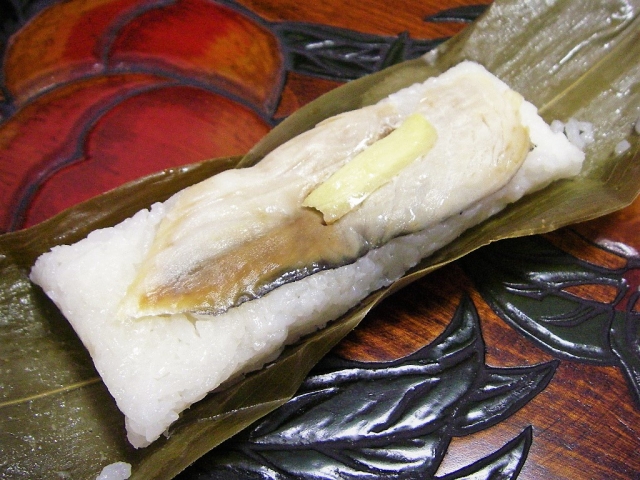
It is festival food. Along that coast the autumn shrine festivals are the occasion, and in households that still make it properly the mackerel goes into salt a month beforehand; boxes of dozens of fish arrive as Obon ends, and the finished sushi is distributed by the jūbako-load to relatives. Guests get the best of it — the well-matured ones that have turned sweet — served with ginger and amazake. Down the coast from Kushimoto to Shingū the fish changes to saury or ayu depending on what the local water gives up.
The trend, though, runs one direction. The Ministry of Agriculture’s own record of the dish notes plainly that what dominates now is haya-nare — the quick version, eaten in days rather than months, available in restaurants and roadside stalls. The same impatience that produced nigiri two centuries ago is still operating.
The Fish Is Running Out
Which brings the story to the part that has no clean resolution.
Funazushi requires nigorobuna, and nigorobuna are in trouble. Shiga Prefecture estimates the catch at around 500 tonnes in the mid-1960s. By 1989 it was 178 tonnes. By 1997 it was 18. The causes are the familiar ones stacked together: predation by introduced largemouth bass on juveniles; the loss of the reed beds in the lake’s inner bays where the fish spawn; and the operation of the Seta River weir, which can drop the lake level sharply during the spring spawning season and strand the reed beds the fry depend on, dry.
The prefecture has fought back — hatchery releases, reed bed construction, size limits protecting immature fish, and a programme raising fry in rice paddies where there are no bass, then releasing them into the lake. Estimated stock recovered to around 300 tonnes at one point before declining again from 2017. Catches in the four years to 2023 ran between 56 and 77 tonnes; 2024 came in at 45. Shiga’s agricultural and fisheries plan now targets seven million age-zero nigorobuna in the lake each winter as the threshold for stable use of the resource.
There is a second problem underneath the first, and it is more uncomfortable. The prefecture’s own analysis observes that even as stock recovered, catches lagged — partly because the recovered population skews toward large old fish rather than the two- and three-year-olds of about 300 grams that funazushi actually needs, and partly because of what the document calls, without elaboration, sluggish demand.
That is the harder threat. A fish can be restocked. A tolerance for a food that smells like that, made by a household over eighteen months, in a country where nearly everything else has gotten faster, cannot be restocked by decree. Ishige observed forty years ago that funazushi had already stopped being a preserved staple and become something else — a ritual dish, a thing to drink with, a regional specialty bought as a souvenir. It survives commercially, which is not the same as surviving culturally.
Elsewhere the losses are further along. The mackerel narezushi of Wakasa was listed by Slow Food’s Ark of Taste in 2006, the register of foods judged to be at risk of disappearing. Academic surveys of Japan’s older sushi traditions cite the same two causes over and over: no successors, and no raw materials.
What a Year in a Barrel Is Worth
It is tempting to treat narezushi as a museum piece — the ancestor you acknowledge before getting on with the descendant. But the barrel is doing something the modern dish cannot.
Twelve months of lactic fermentation does not just make fish sour. It breaks proteins down into free amino acids, softens bone into something edible, and generates a spectrum of organic acids — lactic, acetic, propionic, pyruvic — that no bottle of vinegar contains. Researchers isolating bacteria from Kishū narezushi in 2023 found bifidobacteria in it, the first time that genus had been recovered from a traditional Japanese spontaneously fermented food. There is chemistry in these barrels that nobody has finished cataloguing.
The same is true of every long fermentation Japan still practises — the soy sauce that spends two years in a cedar vat, the miso that darkens over three summers. Narezushi belongs to that family, and it is the oldest member of it. It just happens to be the one that never found a way to make itself convenient.
Sushi’s entire history is the story of getting that sourness faster. It took a thousand years to compress a year into an afternoon, and the result feeds the world. But somewhere on the shore of Lake Biwa a barrel is being weighted with a stone this summer, water poured over the top to shut out the air, to be opened around New Year. What comes out will be, in the most literal sense available, sushi — and almost nobody would recognise it.
Read, then Taste.
This article is part of Waden’s Fermentation series — exploring Japan’s living culture of miso, soy sauce, sake, and beyond. Read more at waden.umamibako.com.
Waden is an editorial journal exploring the depth and beauty of Japanese food culture — its history, ingredients, artisans, and traditions. Story first, always. waden.umamibako.com
Comment