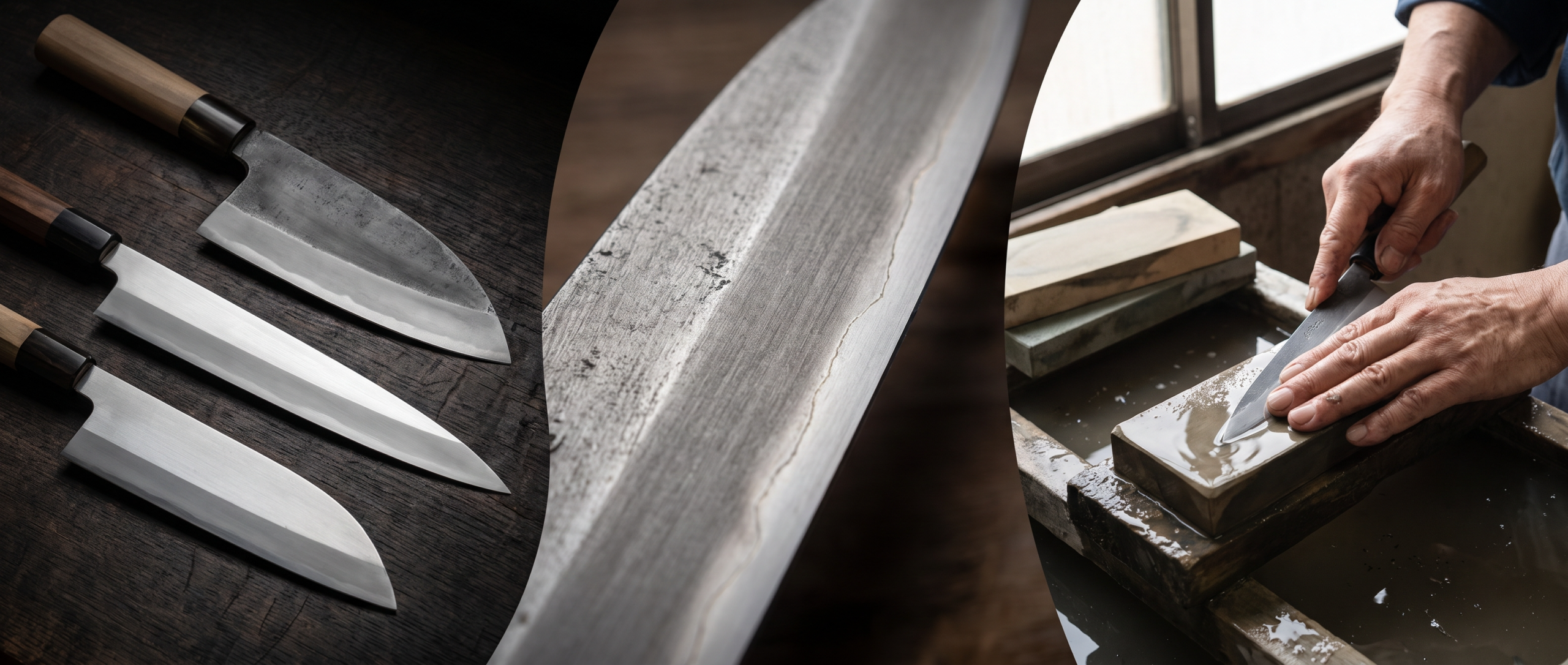
The Japanese Knife: Steel, Single Bevel, and the Soul of the Kitchen
Two metals forged into one, an edge ground on a single side, and a back that is hollowed rather than flat — the traditional Japanese knife is built on ideas most Western blades never touch.
Pick up a traditional Japanese kitchen knife and hold it to the light, and something looks wrong. The edge is sharpened on one side only. The spine is heavier than you expect. And if you turn the blade over and tilt it, you will see that the “flat” back is not flat at all — it is subtly hollowed, dished inward, so that only a thin rim of steel would ever touch a cutting board. None of this is decoration. Every one of those features is a solved problem, an answer to the question of how to cut better, worked out over centuries by people who treated the knife not as a tool bought and replaced but as an object made, maintained, and inherited.
Here is the whole of it in a sentence: a Japanese knife is usually two metals forge-welded together, frequently ground on a single bevel, and designed to be sharpened by its owner for the whole of its long life. Understanding those three ideas — the steel, the bevel, and the stone — is understanding why chefs the world over have come to regard these blades as the finest cutting instruments made.
Three Knives, Three Jobs
Before the metallurgy, the shapes. Traditional Japanese cutlery — wa-bōchō — is not one knife but a family, each member built for a specific task rather than for general use. Three form the classic core of the professional kitchen.
The deba is the heavy one: thick-spined and weighty, made for breaking down whole fish and cutting through small bones, its mass doing the work. The yanagiba — “willow blade” — is its opposite: long, slender, and drawn out to a fine point, made to slice raw fish for sashimi in a single clean pull, so that the flesh is parted rather than sawed. And the usuba — “thin blade” — is the vegetable knife, flat-profiled and delicate, the tool behind the most demanding cutting in the repertoire. If you want to see what the usuba can do in the right hands, we devoted an entire piece to it: katsuramuki, the cut that measures a cook.
The shapes even change by region — the squared-off Kantō (Edo) usuba against the rounded, sickle-shaped kamagata usuba of Kansai — a reminder that this is a tradition regional all the way down to the outline of the steel.
Two Metals, One Blade
The first great idea is hidden inside the blade. A traditional Japanese knife is usually not a single piece of steel but two metals forge-welded together — a technique called tsuigane that the knife inherited directly from the making of the Japanese sword.
A thin layer of hard, high-carbon steel — hagane — forms the cutting edge. Onto it is welded a larger body of softer iron or low-carbon steel — jigane. Each metal is chosen for what the other cannot do. Hard steel takes and holds an extraordinarily keen edge, but on its own it is brittle and prone to chipping. Soft jigane cannot hold a fine edge at all, but it is tough and forgiving, absorbing shock and resisting cracks. Bonded together in the forge, they become a blade that is keen where it needs to be and resilient everywhere else — a hard edge carried on a soft, shock-absorbing body.
Hard steel for the edge, soft iron for the body. The Japanese knife solves the oldest problem in bladesmithing — sharpness or durability — by refusing to choose, and welding both into one.
There is a practical gift in this that the user feels every time they sharpen. Because most of the blade is soft jigane, only that thin ribbon of hard steel at the very edge must actually be honed. The knife is easier to sharpen than a blade made entirely of hard steel would be, and easier to keep straight and true over years of use.
The Edge on One Side — and the Hollow on the Other
The second great idea is the most distinctively Japanese, and the katsuramuki piece introduces it: the traditional blade is kataba, single-beveled, ground to an edge on one face only. Where a Western knife meets in a symmetrical V, the deba, yanagiba, and usuba are sharpened on one side and left flat on the other. A single bevel can be taken to a far lower, finer angle than a symmetrical edge can safely hold — which is why these knives can slice with so little resistance, parting food cleanly rather than pushing through it.
But the detail most people miss is on the back. That “flat” reverse face is not truly flat: it carries a shallow concavity called the urasuki, a deliberate hollow ground into the back of the blade. Around the rim of that hollow runs a narrow, flat band — the uraoshi — and it is only this thin strip, not the whole face, that meets the sharpening stone or the food.
The urasuki does three quiet, essential things. It reduces the surface that drags against what you are cutting, so a slice of fish releases cleanly from the blade instead of clinging to it. It makes the knife far easier to sharpen, since the owner need only true up that thin rim rather than grind an entire flat face. And it lets the edge sit at its ideal geometry. It also imposes a rule that surprises newcomers: you must almost never grind the back. Flatten the uraoshi too aggressively and the hollow disappears, and with it the knife’s clean release and much of its edge. The concave back is not a flaw to be polished out. It is the point.
Where the Blades Are Born: Sakai and Seki
Two cities dominate the story of Japanese cutlery, and they represent two different faces of the craft.
Sakai, near Osaka, is the home of the traditional single-bevel professional knife, and its blade-making runs back some six hundred years. The city’s metalworking is older still — its smiths trace their lineage partly to the ironwork of the great fifth-century burial mounds nearby. In the sixteenth century Sakai made firearms, and then, famously, tobacco knives: blades for shredding tobacco leaf so superior that the Tokugawa shogunate granted them an official “Sakai kiwami” seal of quality and a monopoly on their sale, carrying Sakai’s name across the country. That reputation endures in a striking statistic — Sakai is estimated to supply the overwhelming majority, on the order of ninety percent, of the knives used by professional chefs in Japan. Its blades are recognized as a national Traditional Craft.
Seki, in Gifu Prefecture, is the other great center, with a history reaching back more than eight hundred years to Kamakura-era swordsmiths who settled the area. When the age of the sword ended, Seki’s smiths turned their metallurgy to blades of every kind, and today the city is often named alongside Solingen in Germany and Sheffield in England as one of the world’s three great cutlery towns — a producer of both traditional Japanese knives and the Western-style blades now made there at scale.
Made by Many Hands
One of the least visible but most telling features of a Sakai knife is that no single person makes it. The craft is built on a deep division of labor: the blade is forged by one specialist, the blacksmith; ground and given its edge by another, the sharpener; and fitted with its handle by a third. A finished knife is the collaboration of separate masters, each doing one thing for a lifetime and doing it better than a generalist ever could.
This is the same philosophy that runs through so much of Japanese craft — the conviction, familiar from the world of lacquer and other traditional arts, that depth comes from narrowing rather than broadening, from a lifetime spent perfecting a single step in a longer chain.
The Stone, and the Life of the Blade
The third great idea is that a Japanese knife is not finished when it is bought. It is designed to be sharpened by its owner, on a whetstone, for as long as it lasts — and in a real sense the knife is only as good as that ongoing care.
The tool for this is the toishi, the water whetstone, and serious sharpening moves through a progression of them: a coarse stone to set the shape, a medium stone to refine it, a fine finishing stone to bring up the final keenness. For a single-bevel knife the work is mostly on the front bevel, held at a consistent angle against the stone, with only the lightest attention to the uraoshi rim on the back — and, as ever, care never to touch the hollow itself. It is slow, deliberate, tactile work, read as much through the sound and feel of steel on wet stone as through the eye.

And this, finally, is why the Japanese knife is called the soul of the kitchen and not merely one of its tools. A blade built this way is not a disposable object. It is a partnership that lengthens over time: two metals chosen to complement each other, an edge shaped to a single unforgiving geometry, a back hollowed so the cook can maintain it for decades, all of it kept alive by hands returning again and again to the stone. The same ideal that runs through the rest of this cuisine is pressed into the steel — that mastery is not what you add, but the care and control you bring to something apparently simple. A knife, sharpened well, is a cook’s clearest statement of who they are.
Read, then taste.
This article is part of Waden’s Technique series — exploring the craft, philosophy, and practice behind Japanese culinary methods. Read more at waden.umamibako.com.
Comment