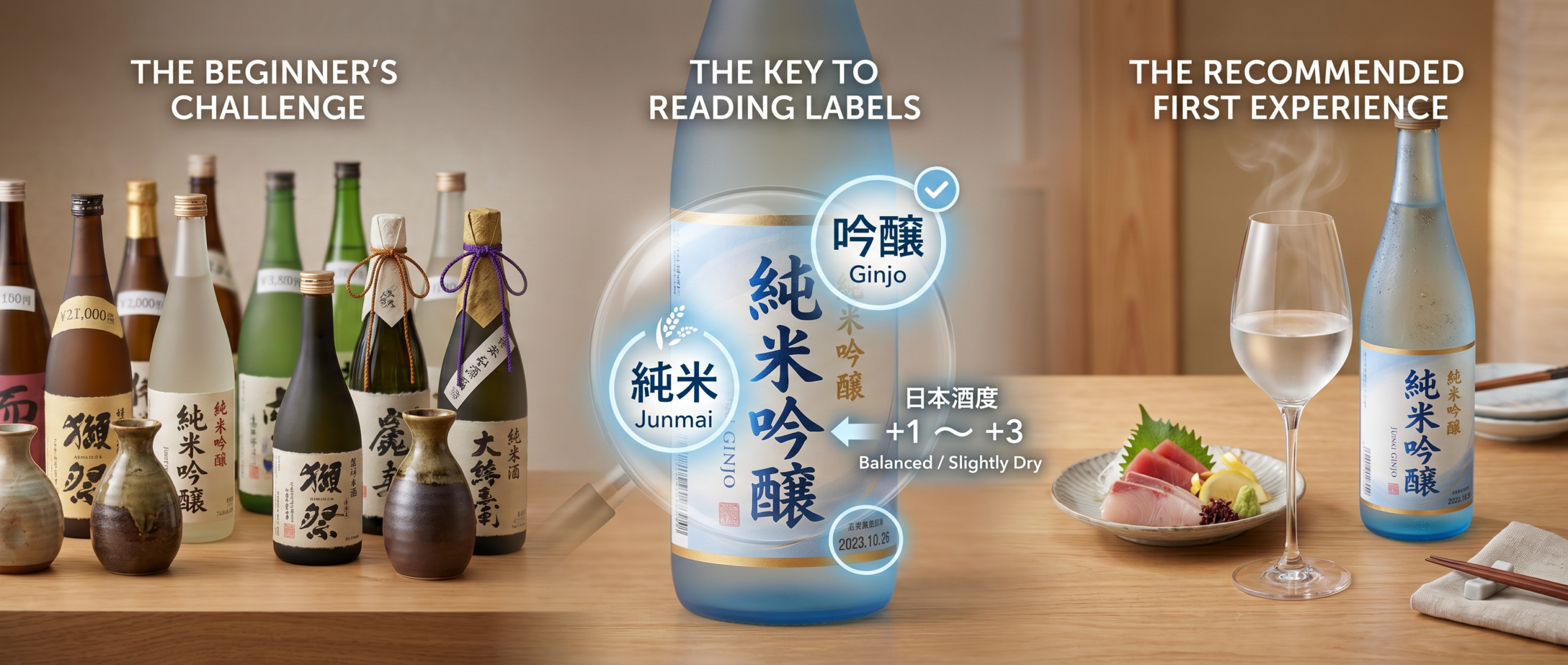
Sake for Beginners: How to Choose Your First Bottle
The hardest part of drinking sake is not drinking it — it is standing in front of a shelf of unfamiliar bottles and having no idea where to begin. The good news is that a few simple ideas will take you most of the way there.
There is a particular feeling that comes over a lot of people the first time they try to buy sake for themselves. The bottles are beautiful and completely opaque — labels in Japanese, unfamiliar words in small print, prices that range from modest to alarming, and no obvious way to tell what any of it will taste like. Wine, for all its own snobbery, at least offers grape names and regions most people half-recognize. Sake can feel like a locked door. So the beginner does one of two things: buys whatever is cheapest and nearest, or gives up and orders it warmed at a restaurant without ever choosing a bottle at all.
This is a shame, because choosing your first bottle of sake is genuinely easy once you understand what you’re actually looking at — and understanding it is far more interesting than memorizing a list of recommended brands. The difficulty is not that sake is complicated. It’s that the information on the label is written in a code nobody has taught you to read. This guide will teach you enough of that code to walk up to a shelf, or scan a menu, and choose well.
We won’t hand you a list of bottles to buy, for a simple reason: what’s on the shelf where you live will be different from what’s on ours, and a bottle you can’t find is useless advice. What travels, and what will serve you for the rest of your drinking life, is knowing how to read the two or three things that actually predict how a sake will taste.
Start with One Category: Ginjo
If you remember only one word from this article, make it ginjo (吟醸).
Sake is officially divided into categories based on how much the rice has been polished before brewing and whether a small amount of distilled alcohol was added — a system we lay out in full in our companion guide, A First Map of Sake. You don’t need to master all of it to buy your first bottle. You just need to know where beginners tend to find the easiest, most immediately pleasurable entry point, and for most people that is the ginjo family — ginjo, and its more refined sibling daiginjo.
The reason is aroma. Ginjo and daiginjo sake are made with more highly polished rice and a slow, cool fermentation that coaxes out fruity, floral aromatic compounds — notes people describe as green apple, pear, melon, or white flowers. They are typically lighter, cleaner, and more fragrant than other styles, and that fragrance is exactly what tends to charm a newcomer. A good junmai ginjo — the “junmai” simply meaning no distilled alcohol was added, so it’s made purely from rice, water, koji, and yeast — sits in a comfortable middle ground: aromatic and approachable, but with enough body and depth to be genuinely interesting rather than merely easy. It is, for many people, the single best place to start.
This is not a rule so much as a friendly on-ramp. Plenty of experienced drinkers come to prefer the subtler, drier, more savory styles over time — a robust junmai served warm can be a revelation. But those styles ask more of you as a taster, and there’s no reason to start with the difficult stuff. Begin where the pleasure is most obvious, and let your palate lead you outward from there.
Begin where the pleasure is most obvious. A fragrant ginjo charms you into caring; the subtler, drier styles are more rewarding later, once your palate has something to build on.
Sweet or Dry? Read the Number
The second useful thing to know is that many sake bottles carry a small number that hints at whether the sake leans sweet or dry — the nihonshu-do (日本酒度), often translated as the Sake Meter Value or SMV.
The scale is refreshingly simple in direction: positive numbers indicate a drier sake, negative numbers a sweeter one. A sake at +5 will read as noticeably dry; one at −5 will feel distinctly sweet; something around zero to +3 sits in a balanced middle that suits most beginners well. If you already know you tend to like drier drinks, drift toward the positive end; if you have a sweet tooth, look for a negative number or a bottle described as sweet.
One honest caveat, because it matters: the number is a guide, not a guarantee. Perceived sweetness is also shaped by a sake’s acidity — the sando (酸度) — with higher acidity making a sake taste crisper and drier than its meter value alone would suggest, and lower acidity making it taste rounder and sweeter. A fruity, aromatic sake can also read as “sweet” on the palate even when its meter value is neutral, simply because our brains associate fruit aromas with sweetness. So treat the SMV as a rough compass heading rather than a precise coordinate. For a first bottle, “balanced, slightly dry” — around zero to +3 — is a safe and rewarding place to point.
Don’t Overthink the Price
It’s tempting to assume that the more you spend, the better your first experience will be. With sake, that isn’t reliably true — and it can even work against you.
Price in sake tracks largely with how much the rice was polished, which is labor- and material-intensive: a daiginjo, milled until only half the grain or less remains, simply costs more to make than a sturdy junmai. But more polishing means a more delicate, refined, sometimes almost ethereal sake — and that subtlety can be lost on a palate that’s still learning what to notice. A very expensive daiginjo is a bit like a very expensive single-malt: wonderful, but not necessarily where you should spend your first evening. A well-made junmai ginjo at a moderate price will teach you more, more enjoyably, than a top-shelf bottle whose finer points you’re not yet equipped to catch. Save the splurge for when you know what you’re tasting.
A Note on Freshness
Two small practical points that beginners rarely hear, and that make a real difference.
First, sake is best drunk relatively young. Unlike wine, most sake is not made to age in the bottle; it’s meant to be enjoyed fresh, generally within a year or so of production. Check the bottle for a date and lean toward the more recent. This is especially true of namazake (生酒), unpasteurized sake, which is prized for its bright, lively freshness precisely because it hasn’t been heat-stabilized — but which for the same reason is perishable, needs refrigeration, and should be drunk soon after opening. It’s a wonderful thing to try, just not a bottle to forget at the back of a cupboard.
Second, once you open a bottle, keep it in the refrigerator and drink it within a week or so, especially the delicate ginjo and daiginjo styles whose aromas fade quickest on contact with air. Sake doesn’t spoil dangerously the way milk does, but its flavor dulls, and the fragrance you paid for is the first thing to go. A first bottle rewards being opened and enjoyed, not saved.
Sake is not wine. Most of it is made to be drunk fresh, not aged. Buy a recent bottle, refrigerate it once open, and enjoy it soon — the fragrance is the first thing to fade.
How to Actually Drink Your First Bottle
You’ve chosen a junmai ginjo, balanced to slightly dry, recently dated, at a sensible price. Now don’t undo that good choice at the last step.
Because you’ve chosen an aromatic style, serve it chilled — around 10°C, from the refrigerator — where its fragrance is most alive. Resist the instinct to warm it; heat is wonderful for fuller, savory sakes but tends to blow the delicate aromas of a ginjo straight off the top. And if you have one, pour it into a small wine glass rather than a tiny cup. A glass that narrows toward the rim gathers the aroma and delivers it to your nose, and with an aromatic sake, so much of the pleasure is in the smell that the vessel genuinely changes the experience. The temperatures, the cups, and why each choice matters are the whole subject of our guide How to Serve Sake: Temperature, Cups & Pairing, well worth reading once you’ve got a bottle in hand.
Then, ideally, drink it with food. Sake was made for the table, and it is at its most generous alongside something to eat — clean, delicate dishes for a delicate ginjo. A first bottle drunk with a simple meal, in the right glass, slightly chilled, is very hard to get wrong.
Choosing your first bottle of sake is really an act of translation — turning a shelf of opaque labels into a few legible signals: a category to trust, a number that hints at sweetness, a date that promises freshness, a price that needn’t be high. Once you can read those, the locked door swings open, and what’s behind it is one of the most rewarding drinking traditions in the world — a drink that has been, for over a thousand years, far more than a beverage in Japan. If that longer story interests you, it’s told in The Drink That Belongs to the Gods. But you don’t need the history to begin. You just need one good bottle, chilled, and someone to share it with.
Read, then Taste
This article is part of Waden’s Technique series — exploring the craft, philosophy, and practice behind Japanese culinary methods. Read more at waden.umamibako.com.
Comment