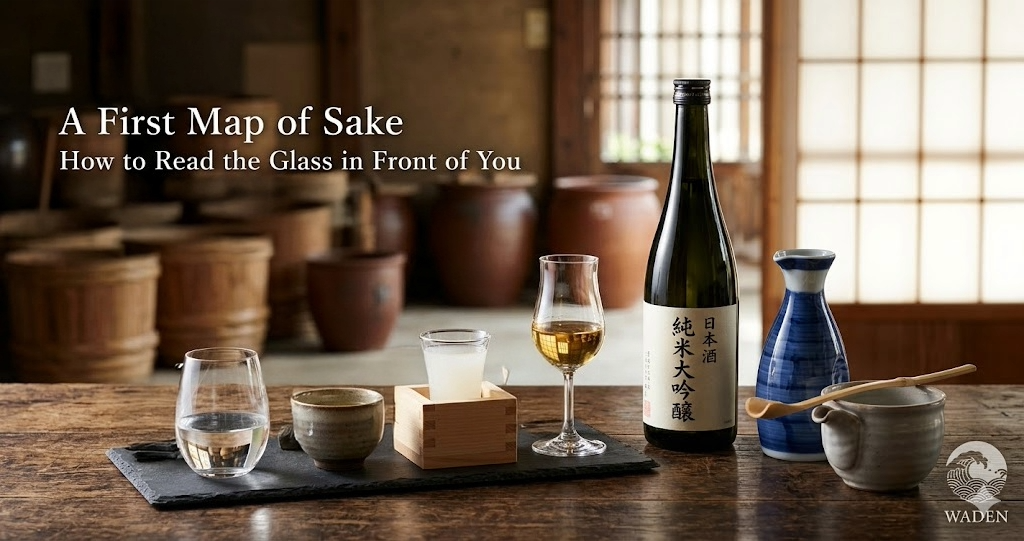
A First Map of Sake
How to Read the Glass in Front of You
Sake is one of the most misunderstood drinks in the world. Outside Japan, it is often served warm in small ceramic cups and assumed to be a single, uniform thing — like vodka, or beer. In reality, sake is as varied and nuanced as wine. There are dry sakes and sweet ones, cloudy ones and crystal-clear ones, sakes meant to be served cold and sakes that genuinely improve with gentle heat. The vocabulary can feel intimidating at first. But once you have a map, the landscape becomes navigable — and the drinks become considerably more interesting.
Sake has been part of Japanese life for more than a thousand years — offered to the gods before it was ever poured for human pleasure, refined in monastery breweries before it reached the secular table. If you want to understand why sake carries the weight it does in Japanese culture, that history is where to begin.
→ Read: The Drink That Belongs to the Gods: A Story of Sake
This article takes a different angle. Once you know what sake means, the next question is: what, exactly, are you drinking?
What Sake Actually Is
Sake (酒) — more precisely called nihonshu (日本酒, “Japanese alcohol”) — is a fermented beverage made from rice, water, koji mold (Aspergillus oryzae), and yeast. It is not distilled, which is why it is sometimes misleadingly called “rice wine,” though its fermentation process is actually closer to beer in its mechanics. The alcohol content typically falls between 14% and 16% ABV.
The character of any sake begins with two fundamental decisions: how much the rice is polished before brewing, and whether distilled alcohol is added during production. These two variables define the official classification system — and understanding them unlocks the entire vocabulary of sake types.
The First Key: Rice Polishing
Rice used for sake is not the same as table rice. It is a specific set of sake rice varieties (sakamai, 酒米) — the most famous being Yamada Nishiki, Gohyakumangoku, and Omachi — bred to have larger grains and a higher starch content. Before brewing, those grains are milled down to remove the outer layers, which contain proteins and fats that can produce off-flavors in the final drink.
The degree to which the rice is polished is expressed as the seimaibuai (精米歩合), or “rice polishing ratio.” This number tells you how much of the original grain remains after milling. A seimaibuai of 70% means 30% of the grain has been polished away, leaving 70% of the original rice. A seimaibuai of 50% means half the grain has been removed, leaving only the starch-rich core.
The lower the number, the more the rice has been polished — and generally, the more delicate, refined, and aromatic the resulting sake. A sake milled to 50% requires twice as much rice as one milled to 70%, which is part of why premium sakes command higher prices.
The Second Key: Added Alcohol
The second major variable is whether a small amount of distilled alcohol (jōzō arukōru, 醸造アルコール) is added near the end of fermentation. This practice, which became widespread in the 20th century, is not necessarily a sign of inferior quality — it was originally developed to help extract aromatic compounds from the fermenting mash, producing a lighter, more fragrant style. However, in cheaper commercial sakes, it is used primarily to increase volume, which does affect quality.
Sake made entirely from rice and koji, with no added alcohol, is called junmai (純米, “pure rice”). Sake with a small, controlled addition of distilled alcohol falls under the honjōzō or aromatically focused ginjo and daiginjo categories. The prefix junmai on any label tells you no alcohol was added.
The Main Categories, Explained
Junmai (純米)
Made only from rice, water, koji, and yeast — no added alcohol. There is no minimum polishing requirement for the base junmai designation (though in practice, most are polished to 70% or higher). Junmai sakes tend to be full-bodied, with a richer, more savory character. They often pair beautifully with umami-forward dishes — grilled fish, soy-braised meats, aged tofu.
Honjōzō (本醸造)
Rice polished to at least 70% remaining (meaning at least 30% removed), with a small, regulated addition of distilled alcohol — no more than a specific weight ratio relative to the white rice used. The added alcohol here is not about cutting corners. It produces a lighter, slightly drier sake with a clean finish. Honjōzō sakes are often excellent when served warm, which softens their edges and draws out a gentle umami depth.
Ginjo (吟醸)
Rice polished to at least 60% remaining (40% or more removed). Ginjo sakes are brewed using a slow, low-temperature fermentation process that encourages the development of fruity, floral aromatic compounds called ginjo-ka (吟醸香). Think green apple, pear, melon, white flowers. These are generally more delicate, aromatic sakes best served chilled. Junmai Ginjo follows the same polishing requirement but with no added alcohol; Ginjo (without the junmai prefix) contains a small amount of added distilled alcohol.
Daiginjo (大吟醸)
Rice polished to at least 50% remaining — half the grain removed. Daiginjo represents the pinnacle of the ginjo style: intensely aromatic, exceptionally refined, with a gossamer texture and complex fruitiness. It requires rare skill, more raw material, and significantly more time. Junmai Daiginjo applies the same standard but without any added alcohol. These are sakes to drink slowly, chilled, in a wine glass that lets the aromatics open.
Futsūshu (普通酒)
Ordinary sake. This category accounts for the majority of sake produced in Japan by volume. It has no minimum polishing requirement, and a larger amount of added alcohol is permitted. Futsūshu is the everyday sake — poured at casual izakayas, often served warm, approachable and unpretentious. It should not be dismissed; well-made futsūshu from a quality producer can be deeply satisfying, especially paired with salty, izakaya-style food.
Beyond Classification: Other Styles Worth Knowing
The official classification system above covers most of what you will encounter on a sake label. But sake’s world extends further, into styles defined not by polishing ratios but by how the sake is processed after brewing.
Nigori (にごり酒) — Cloudy Sake
Most sake is filtered through a fine mesh to produce a clear liquid. Nigori sake is only coarsely filtered, leaving rice solids in suspension — giving it a milky, opaque appearance. It is typically sweeter and creamier than clear sake, with a textural richness. Nigori is often served cold and works well with spicy food, which benefits from its softness. It should be gently shaken before pouring, as the solids settle.
Nama (生酒) — Unpasteurized Sake
Standard sake is pasteurized twice — once before storage and once before shipping — to stabilize it and extend shelf life. Namazake (生酒) is unpasteurized, which preserves a bright, fresh, slightly wild quality. It must be kept refrigerated and consumed relatively quickly. Drinking namazake is one of the more seasonal pleasures of Japanese sake culture — new-harvest namazake arrives in autumn and early winter, and its vibrancy is unlike anything aged on a shelf.
Koshu (古酒) — Aged Sake
While most sake is consumed young, a small but growing number of producers age their sake for years — sometimes decades. Aged koshu develops amber or golden tones, with flavors that shift toward caramel, dried fruit, nuts, and a pronounced umami depth. The profile can resemble aged sherry or certain oxidative wines. Koshu challenges the assumption that sake is purely a fresh, delicate drink — it is one of sake’s more surprising and complex expressions.
Sparkling Sake
A relatively modern category, sparkling sake is made either through secondary fermentation in the bottle (similar to Champagne-method wines) or by carbonation. The result is a light, effervescent sake that is easy to approach for those new to the category. It is often lower in alcohol, and pairs naturally with lighter appetizers or celebratory occasions.
Temperature: The Variable That Changes Everything
One of sake’s most distinctive qualities — and one that separates it from almost every other beverage — is its versatility across serving temperatures. Sake can be drunk anywhere from around 5°C (41°F) to 55°C (131°F), and the same sake can present very differently depending on where in that range it is served.
In Japanese, warm sake is called atsukan (熱燗) and cool sake reishu (冷酒). There is an entire vocabulary of temperature gradations: hinata-kan (日向燗, around 30°C, “sunwarmed”), nuru-kan (ぬる燗, around 40°C, “lukewarm”), jo-kan (上燗, around 45°C, “upper warm”), and atsukan (熱燗, around 50°C, “hot”).
As a general guide: delicate, aromatic sakes like ginjo and daiginjo are best served chilled (8–12°C), where their fragrance is most pronounced. Fuller, richer junmai sakes can be interesting at room temperature or gently warmed, where their savory depth expands. Honjōzō warms particularly well. Nigori is almost always best cold. Warming sake should be done gently — ideally by placing a tokkuri (sake carafe) in hot water, not microwaving it. Overheating destroys aromatics and produces harshness.
How to Read a Sake Label
Japanese sake labels are dense with information, but a few key terms will orient you quickly. Look for the category name (junmai, ginjo, daiginjo, honjōzō) — this is the most important signal of style. Look for the seimaibuai (精米歩合) if it is listed — the lower the number, the more refined. Look for junmai as a prefix — it tells you no alcohol was added.
Two additional numbers often appear. The Sake Meter Value (nihonshu-do, 日本酒度) measures sweetness versus dryness on a scale where positive numbers indicate dryness and negative numbers indicate sweetness: a +5 is noticeably dry; a −5 is on the sweeter side. The acidity level (sando, 酸度) indicates how tart or clean the sake feels — higher acidity tends to make sake feel crisper and more food-friendly.
Where Sake Comes From
Sake is brewed across Japan, but certain regions have developed distinctive identities. Nada (灘) in Hyogo Prefecture — close to Osaka — is Japan’s most famous sake-producing region, known for its miyamizu mineral-rich water that produces drier, more assertive styles. Fushimi (伏見) in Kyoto is known for softer water and more gentle, refined sake. Niigata Prefecture in the north has a reputation for tanrei karakuchi (淡麗辛口) — light, dry, clean sake — shaped by its cold winters and famously pure snowmelt water.
Beyond these classic regions, a new generation of craft producers has emerged across Japan, experimenting with natural fermentation, heritage rice varieties, and unconventional aging methods. The sake world is currently in one of its most creative periods in decades.
Quick Reference: Sake Categories at a Glance
| Category | Polishing Ratio | Added Alcohol | Character | Best Served |
|---|---|---|---|---|
| Futsūshu | No minimum | Yes (larger amount) | Everyday, casual | Warm or room temp |
| Honjōzō | ≤70% remaining | Yes (small amount) | Light, clean, dry | Warm or chilled |
| Junmai | No minimum (typically ≤70%) | No | Rich, full-bodied, savory | Room temp or warm |
| Ginjo | ≤60% remaining | Yes (small amount) | Fruity, floral, aromatic | Chilled |
| Junmai Ginjo | ≤60% remaining | No | Fruity, full, aromatic | Chilled |
| Daiginjo | ≤50% remaining | Yes (small amount) | Refined, intensely aromatic | Well chilled |
| Junmai Daiginjo | ≤50% remaining | No | Refined, complex, pure | Well chilled |
Sake is a drink that rewards attention. The more you bring to it — curiosity about the rice, the water, the region, the season — the more it gives back. A bottle of junmai daiginjo from Niigata and a glass of warm honjōzō at a neighborhood izakaya are made from the same four ingredients. What sits between them is craft, intention, and centuries of accumulated knowledge. That distance is worth exploring.
Comment