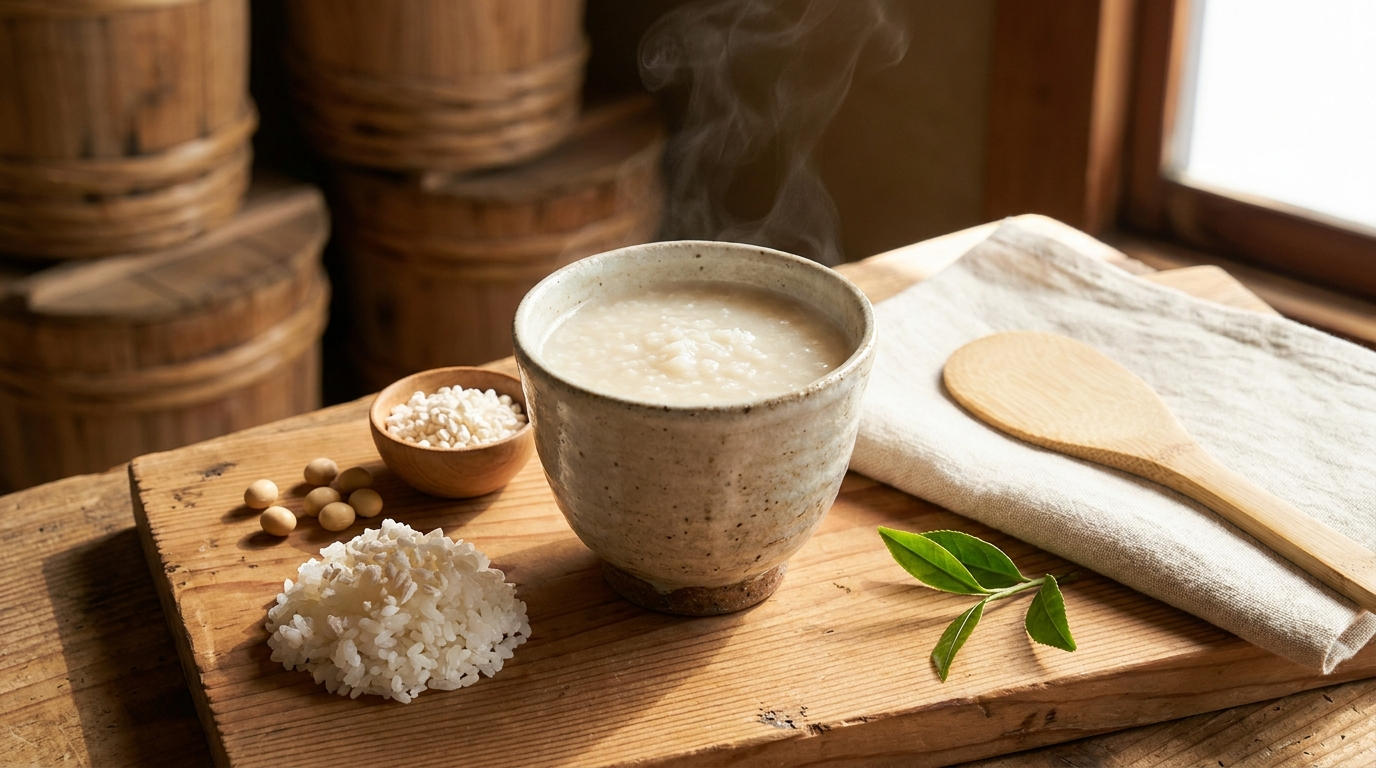
Amazake: The Drink Between Food and Medicine
It is sweet, and nobody sweetened it. It is called sake, and it is usually not alcoholic. It is drunk hot at New Year shrines, and in classical poetry it is a word that means summer. Almost everything obvious about amazake turns out to be the opposite of what it looks like.
Pour a cup of amazake and the first thing you notice is that it is not really a drink. It is thicker than that — cloudy, faintly grainy, closer to a thin porridge than a beverage, with soft flecks of collapsed rice suspended in it. The second thing you notice is the sweetness. It arrives immediately and without edge, rounder than sugar and less insistent, and it lingers in a way that sugar does not.
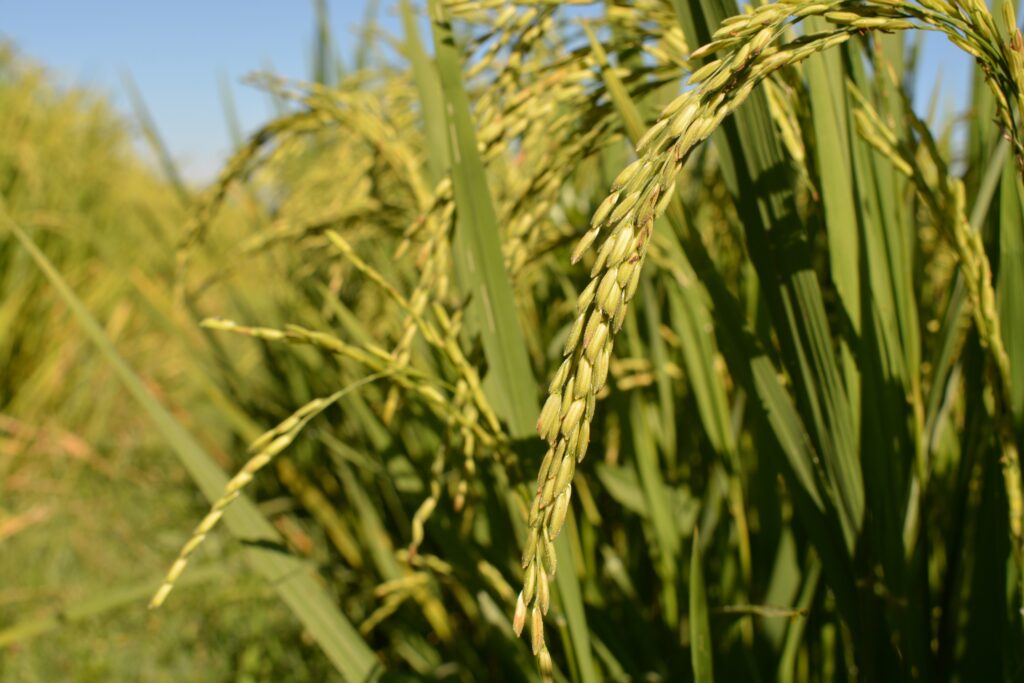
Read the label and there is no sugar listed. There is rice, there is water, and there is kome-kōji — rice on which a mold has been grown. That is the entire ingredient list. Somewhere between those three things, starch became sugar, and it happened in about eight hours, in a pot, at a temperature you could hold your hand near.
That transformation is the whole subject. But before we get to it, there is a complication in the name.
Two Drinks, One Word
“Amazake” refers to two different products made by two different processes, and Japanese does not reliably distinguish them. Most people discover this only when they buy the wrong one.
The first is kome-kōji amazake, made from rice and rice koji alone. There is no yeast, so there is no alcoholic fermentation, so it contains essentially no alcohol. All of its sweetness comes from enzymes breaking rice starch apart.
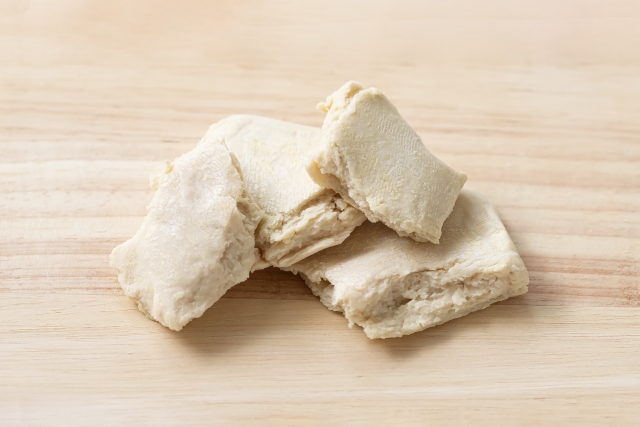
The second is sake-kasu amazake, made from the pressed lees left over after brewing sake. The lees have no sweetness of their own, so sugar is added — which is why kasu amazake is generally the more caloric of the two. And because the lees themselves retain alcohol, the finished drink retains a little. Commercial products are held below one percent, the threshold at which Japan’s Liquor Tax Act would classify a beverage as liquor; under that line it is legally a soft drink. Under it or not, it is not nothing, and it is not the version to hand a child.
Which of the two you grew up with is largely a matter of geography. Regions dense with sake breweries drink kasu amazake, because the lees are there. Regions with strong koji industries — miso country — drink koji amazake, because the koji is there. Both have been called amazake for centuries. Neither has a better claim to the name.
(A third drink is regularly confused with both: shirozake, the cloudy white drink of the Doll’s Festival in March. That one is genuinely alcoholic, sold as a liqueur, and not amazake at all.)
The Sweetness Nobody Added
The koji version is the one that repays understanding, because it is a piece of biochemistry performed in a domestic kitchen.
Rice koji is steamed rice colonised by Aspergillus oryzae, the mold that Japan formally recognised as its kokkin, or national fungus, at the Brewing Society of Japan’s annual meeting on 12 October 2006, following a proposal by the Tohoku University professor emeritus Ichishima Eiji two years earlier. As the mold’s hyphae spread through the grain, they secrete enzymes to digest their way forward — among them α-amylase, glucoamylase, α-glucosidase, protease, and lipase. The mold is feeding itself. What it leaves behind is a block of rice loaded with molecular tools.
Making amazake means putting those tools to work on more rice. You combine koji with cooked rice and water and hold the mixture warm — in practice somewhere around 55 to 60°C — for several hours. The amylases cut the long starch chains into shorter ones; glucoamylase clips glucose off the ends. What was tasteless starch becomes glucose, and a well-saccharified koji amazake ends up on the order of twenty percent sugar by weight, essentially all of it glucose, none of it added.
The temperature is the whole craft, and it is a narrow window for a specific reason. Push much above it and the enzymes denature — and denatured enzymes do not recover when the pot cools, so the batch is simply finished, thin and bland. Let it drift too far below and lactic acid bacteria, which are perfectly happy at lower temperatures, get to work alongside the enzymes and the drink turns sour. Sweet amazake is what you get by holding a pot precisely between two kinds of failure.
Held overnight, the rice sweetens itself. The old name for the drink says so: hitoyozake — one-night sake.
If this sounds familiar, it should. It is the same organism and the same enzymatic toolkit described in our piece on shio koji, simply pointed at a different target. In shio koji, protease is the star, cutting proteins into amino acids to make meat taste savory. In amazake, amylase is the star, cutting starch into sugar. One jar, two enzymes, two completely different foods — which is a reasonable summary of why this particular mold underpins so much of the Japanese pantry.
Even the writing carries the distinction. Kōji is normally written 麹, a character imported from China. But there is a second character, 糀 — rice radical plus “flower,” a Japanese coinage said to date from the Edo period or later, describing the way koji mold blooms white across a bed of steamed rice. It is used almost exclusively for the rice version. The language grew a new character just to name what this mold looks like on Japanese rice.
What Is Left in the Press
The other amazake has a humbler origin: it is made from what remains when sake is squeezed.
Brewing sake produces, by weight, roughly a quarter as much sake-kasu as the rice that went in — a pale, firm cake of pressed lees that is around half water, with something like twenty-three percent carbohydrate and thirteen percent protein, plus peptides, amino acids, vitamins, and residual yeast. It is a by-product with real nutritional density and no sweetness, and for most of Japanese history it was cheap.
Which is precisely why it appears in one of the bleakest poems in the Japanese canon. In the eighth-century Man’yōshū, Yamanoue no Okura’s “Dialogue on Poverty” describes a man on a night of wind and sleet, nibbling at a lump of hard salt and sipping kasuyuzake — sake lees dissolved in hot water — coughing, sniffling, wrapped in a coarse hemp quilt, insisting on his own dignity. That is amazake’s other ancestor: not a sacred sweet drink but the cheapest possible way to get warmth and calories out of something a brewery threw away. Twelve centuries later, the logic of the drink has not changed. It is still lees, hot water, and whatever sweetness you can afford to add.
Heavenly Sweet Sake
The koji line begins somewhere much loftier. The Nihon Shoki, completed in 720, contains in its age-of-the-gods chapters a brief passage about rice from a divinely designated field being brewed into ame-no-tamuzake — “heavenly sweet sake” — a rite traditionally associated with the goddess Konohanasakuya-hime and generally read as the earliest written trace of amazake. Later texts call it reishu (醴) or hitoyozake, the one-night sake, the name recording the fact that unlike real brewing it was finished by morning.
That is the drink’s founding tension, and it never resolves. Amazake descends simultaneously from an offering made to the gods and from the poorest thing a poor man could drink. It has been both ever since — which is roughly what you would expect of something positioned, as this drink is, between food and medicine. It shares that ambiguity with sake itself, whose oldest role was also ritual before it was recreational.
The Season Everybody Gets Wrong
Ask a Japanese person when amazake is drunk and most will say New Year — a paper cup pressed into your hands in the cold at a shrine, steam rising off it, the first warm thing of the year.
In the classical poetic calendar, amazake is a summer word. Not loosely: the saijiki place it in sanka, all three months of summer, alongside the fans and the mosquito coils.
The reason is Edo commerce. Kitagawa Morisada’s Morisada Mankō, the great mid-nineteenth-century survey of urban customs, records the amazake seller precisely: in Kyoto and Osaka he worked summer nights only, at six mon a bowl, while in Edo he sold in all four seasons at eight mon. Sweet, salty, thick with glucose and amino acids, sold cold or lukewarm through the worst weeks of a humid Japanese summer, amazake was functionally a rehydration drink for a city with no ice and a great deal of manual labor. It was also, conveniently, something breweries could make in the off-season, since real sake brewing stopped when the weather turned warm.
The poets recorded it as they found it. Issa: hitoyozake / tonari no ko made / kitarikeri — one-night sake, and even the neighbor’s child has turned up. Buson, on the Hakone road: amazake no / jigoku mo chikashi / Hakone-yama. Kikaku wrote of the peasant’s pressing oil and the one-night sake in the same breath. These are summer poems, all of them, and to a modern reader they scan as winter ones. Somewhere between the Edo street stall and the shrine forecourt, the season flipped, and only the dictionary of poetry kept the older record.
“A Drip You Can Drink”
The phrase attached to amazake in modern Japan is nomu tenteki — an intravenous drip you drink. It is a marketing coinage rather than a medical description, but the reasoning behind it is not baseless: a clinical glucose drip delivers water, glucose, and small amounts of amino acids and vitamins, and koji amazake delivers water, glucose, amino acids, and B vitamins. The resemblance is real at the level of the ingredient list.
Whether it does anything a drip does is a separate question, and here the honest answer is: partly studied, mostly not settled. Japan’s Standard Tables of Food Composition put amazake at 76 kcal per 100 g, with 18.3 g of carbohydrate and 1.7 g of protein — a modest, carbohydrate-dominant drink rather than a nutritional marvel. Morinaga, working with the National Research Institute of Brewing, analysed seventeen commercial amazake products and found the antioxidant p-coumaric acid and the UV-absorbing compound ferulic acid in every one; ergothioneine appeared in products containing koji but was not detected in lees-only amazake. The same company has run a series of small human trials — typically ten to fifty participants, often women in their forties to sixties — reporting effects on bowel regularity, gut bifidobacteria proportion, skin elasticity and pore appearance, and subjective fatigue. Those results are published in peer-reviewed journals, and they are also small, short, and funded by a company that sells amazake. They are a reason to be interested, not a reason to be confident.
What is beyond dispute is the glucose. Amazake is sweet because it is roughly a fifth sugar, and sugar that has already been broken down to its simplest form is absorbed fast. That is exactly what made it useful to a laborer in an Edo summer, and it is also why anyone managing their blood sugar should treat a cup of amazake as what it is — a sweet drink — rather than as a health tonic that happens to taste good. The interesting claim about amazake was never that it is medicine. It is that the line between food and medicine, in this particular cup, was never drawn.
The Boom, and What Stayed
For most of the twentieth century amazake was a seasonal nostalgia product. Then, in the 2010s, it became a category. Industry estimates put the market at roughly ¥11.9 billion in 2009, about ¥20.2 billion by 2016 after seven consecutive years of double-digit growth, and something near ¥24.6 billion at the 2017 peak. Older buyers drove the first wave; koji amazake then pulled in women in their twenties to forties, arriving on the same tide of interest in gut health and fermentation that had lifted shio koji a few years earlier.
Booms subside, and this one did. What it left behind is a permanently wider shelf: concentrates in pouches, ready-to-drink cartons and cans, freeze-dried sachets, powders meant for cooking rather than drinking, and — a small engineering triumph — hot vending machines holding cans at around 60°C, a temperature at which the amino acids and sugars in amazake will happily brown themselves via the Maillard reaction if the formulation is not designed to resist it. Overseas, the koji version has begun to travel on the strength of the two words that describe it best in English: naturally sweet, and alcohol-free.
Both descriptions are accurate, and both undersell it. The sweetness is natural in a stricter sense than the phrase usually means — not “from fruit” but from a fungus dismantling rice on your behalf, an act of external digestion performed in a warm pot overnight. The absence of alcohol is not a modern reformulation but the original design; the yeast was never invited. What is in the cup is rice, taken apart into the form the body was going to reduce it to anyway, and handed over already done.
A drink for the gods, and for the man with nothing but hard salt and hot water. A summer drink that became a winter one. A sake with no sake in it. Amazake has spent thirteen hundred years refusing to be one thing, which may be the most reliable sign that it was always useful.
Read, then Taste.
This article is part of Waden’s Fermentation series — exploring Japan’s living culture of miso, soy sauce, sake, and beyond. Read more at waden.umamibako.com.
Waden is an editorial journal exploring the depth and beauty of Japanese food culture — its history, ingredients, artisans, and traditions. Story first, always. waden.umamibako.com
Comment