Shio Koji: The Fermented Seasoning That Quietly Rewired Modern Kitchens
A cloudy paste of rice mold, salt, and water — old enough to predate refrigeration, new enough to sit on the pass at some of the best restaurants on earth.
Spoon a little shio koji from the jar and it does not look like much. A pale, cloudy porridge, faintly sweet-smelling, flecked with softened grains of rice. It is not a sauce you would pour over anything. It has no drama on the plate. And yet chefs who have used it once tend to keep a container of it within arm’s reach for the rest of their careers — because shio koji does something that salt alone cannot. It seasons, and it transforms.
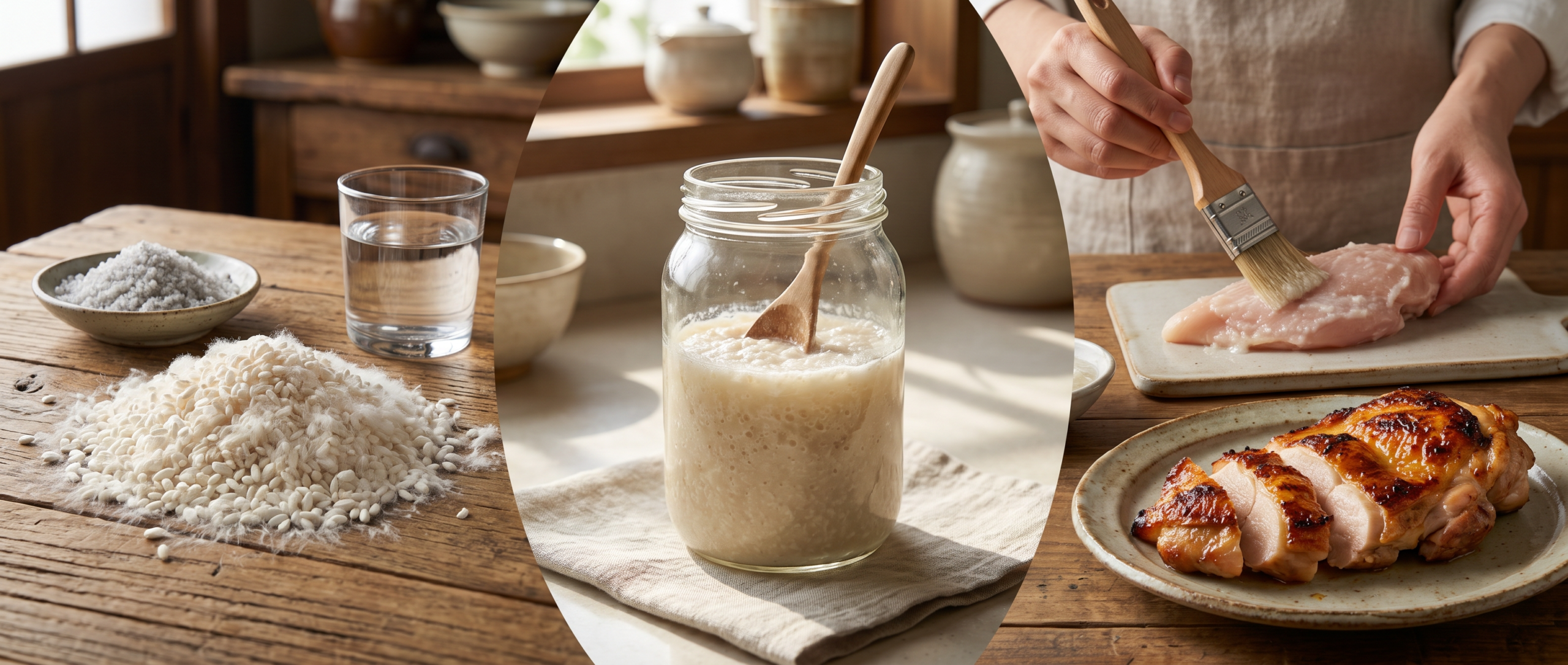
Rub it onto a raw chicken breast and leave it overnight. The next day the meat is more tender, more deeply savory, browning faster in the pan and staying juicier inside. Nothing was added but salt, water, and a spoonful of fermented rice. What happened in between is the whole story.
To understand it, you have to meet the same organism that makes miso, soy sauce, sake, and mirin — and watch it do its work without the years of patience those foods usually demand.
The Same Fungus, Set Loose in a Jar
Shio koji is made from three humble things: kome-koji (steamed rice cultivated with the mold Aspergillus oryzae), salt, and water. That is the entire recipe. The koji is the same one Japan calls kokkin — the national fungus — and it is the invisible protagonist behind nearly every fermented flavor in the Japanese kitchen. If you have read our piece on how miso turns time into flavor, you have already met it.
What makes this mold so remarkable is not that it grows on rice, but what it leaves behind when it does. As Aspergillus oryzae spreads its threads through steamed grain, it secretes a battery of enzymes — its genome carries something on the order of a hundred and thirty genes for protein-cutting enzymes alone. The two that matter most for the cook are simple to describe. Amylase breaks starch down into sugar. Protease breaks protein down into amino acids. A third, lipase, works quietly on fats.
In miso and soy sauce, those enzymes labor for months or years inside a salted mass, and the result is a finished paste or liquid. Shio koji short-circuits that arc. Instead of waiting for the koji to transform soybeans over a year, you dissolve the living koji in salted water, let it settle for a week or two, and then apply those enzymes directly to whatever you are about to cook. The transformation happens on your ingredient, in your refrigerator, in a matter of hours.
Miso is what koji makes over years. Shio koji is what koji can do to your dinner overnight.
An Old Pickling Bed, Missing One Ingredient
Although shio koji feels like a product of the last decade, its lineage runs deep into the farmhouses of northern Japan. Its ancestor is sangohachi-zuke — a pickling bed from the Tōhoku region, traditional to Fukushima, Yamagata, and Akita, and in use since at least the Edo period. The name is a recipe hidden in numbers: san-go-hachi, three-five-eight, for the rough ratio of salt to koji to steamed rice.
Farmers packed vegetables and fish into that bed to carry them through the seasons, especially during the frantic weeks of rice planting when there was no time to cook. Shio koji is essentially sangohachi with the cooked rice left out and the mixture allowed to ferment and mature a little further — a pickling bed distilled down to its active essence, until it becomes not a bed you bury food in but a seasoning you spread on top.
The word itself is older than the trend. An Edo-period food encyclopedia, the Honchō Shokkan, already records the phrase “shio-koji-zuke.” For centuries afterward it drifted at the quiet margins of home cooking, an ingredient without a spotlight.
How a Farmhouse Staple Became a National Craze
The spotlight arrived in stages. Shio koji surfaced in the popular culinary manga Osen around 2001, but the real turning point came from a single koji shop. Asari Myōhō, of the long-established Kōjiya Honten in Saiki, Ōita, began around 2007 to share recipes that treated shio koji not as a pickling bed but as an everyday seasoning — a stand-in for salt that happened to carry umami and enzymes with it. Her blog posts and books lit the fuse.
By late 2011 the fuse had caught. Television programs, cookbooks, and cooking classes seized on shio koji as a kind of magic condiment: a spoonful that made cheap cuts taste expensive and made home cooks feel like alchemists. Family restaurants put shio koji dishes on their menus. Sake breweries rushed out granulated and liquid versions. For a stretch, demand for koji outran supply.
Booms fade, and the frenzy did. But shio koji did not vanish with it. It settled instead into the permanent pantry — the mark of a fashion that turned out to be a genuine tool.
Why It Makes Food Taste Better — The Actual Science
Strip away the mystique and the mechanism is concrete, and it comes down to those two enzymes going to work on your ingredient.
When you coat a piece of meat or fish in shio koji, the protease begins cutting the long, coiled proteins of the muscle into shorter fragments and, eventually, into individual amino acids. Two of those amino acids — glutamic acid and aspartic acid — are the very molecules the tongue reads as umami. Japanese food-science studies of shio koji-marinated meat have measured exactly this: free glutamic and aspartic acid climb as the marinade does its work, and the meat tastes markedly more savory than the same cut salted plainly. The protein-cutting also physically loosens the muscle structure, which is why shio koji meat turns tender.
Meanwhile the amylase converts residual starch into glucose, adding a faint sweetness and — crucially — a surface layer of sugars that browns beautifully under heat. And because the salt is delivered in a moist, enzyme-rich medium rather than as dry crystals, shio koji seasons food while helping it hold onto moisture instead of drawing it out. Tenderness, umami, browning, juiciness: four effects from one cloudy spoonful, and none of them mysterious once you know which enzyme is responsible for which.
This is the same chemistry that gives soy sauce its patient depth and drove the invention of the fish sauces that came before it — protein broken down into savor. Shio koji simply brings that reaction out of the barrel and onto the cutting board.
Making It at Home
Few fermented foods are as forgiving to make. A common starting point, used by Japanese public broadcasting, is a ratio by weight of one part salt to three parts fresh koji to four parts water. You combine them in a clean jar, stir, and leave the mixture at room temperature, giving it a stir once a day. Over roughly one to two weeks the grains soften, the harsh saltiness rounds out, and the smell turns sweet and gently funky — the sign that the enzymes are active and the seasoning is ready. It then keeps for months in the refrigerator, still slowly maturing.
The salt is not optional seasoning here; it is the guardian, exactly as it is in miso. Enough salt keeps unwanted microbes out and lets the koji do its work safely, which is why recipes warn against cutting it too far. Within that limit, the paste is endlessly adaptable: a marinade for chicken, pork, or fish; a cure for vegetables; a savory backbone stirred into dressings, soups, and sauces where you would otherwise reach for salt.
Koji Crosses the Ocean
The most surprising chapter of shio koji’s life is its recent one, and it was written far from Tōhoku. As Western chefs went looking for new sources of umami and new ways to transform ingredients, they found their way to koji. The turning point for many was The Noma Guide to Fermentation, the 2018 book from the Copenhagen restaurant Noma and its fermentation lead David Zilber, which laid koji, shio koji, misos, and garums out for an English-reading audience with laboratory precision.
What had been a quiet Japanese home seasoning became, almost overnight, a tool in the vocabulary of ambitious kitchens worldwide — used to cure, to tenderize, to build savory depth without meat stock. A farmhouse pickling trick from northern Japan is now taught in fermentation workshops from Copenhagen to California. The mold traveled, but the principle it carries is unchanged.
A Living Thing on the Shelf
What makes shio koji worth understanding is not that it is fashionable, but that it collapses a thousand years of fermentation craft into a single accessible jar. The same enzymes that spend years transforming soybeans into the many colors of miso are here put to work in an afternoon, on whatever you happen to be cooking for dinner.
Open the jar and stir it. The rice grains are dissolving, the salt has mellowed, the smell has turned soft and sweet. Nothing was cooked, and nothing was added but time and salt. Something alive is still at work inside.
Read, then Taste.
This article is part of Waden’s Fermentation series — exploring Japan’s living culture of miso, soy sauce, sake, and beyond. Read more at waden.umamibako.com.
Comment