Matcha vs Green Tea: What’s the Difference?
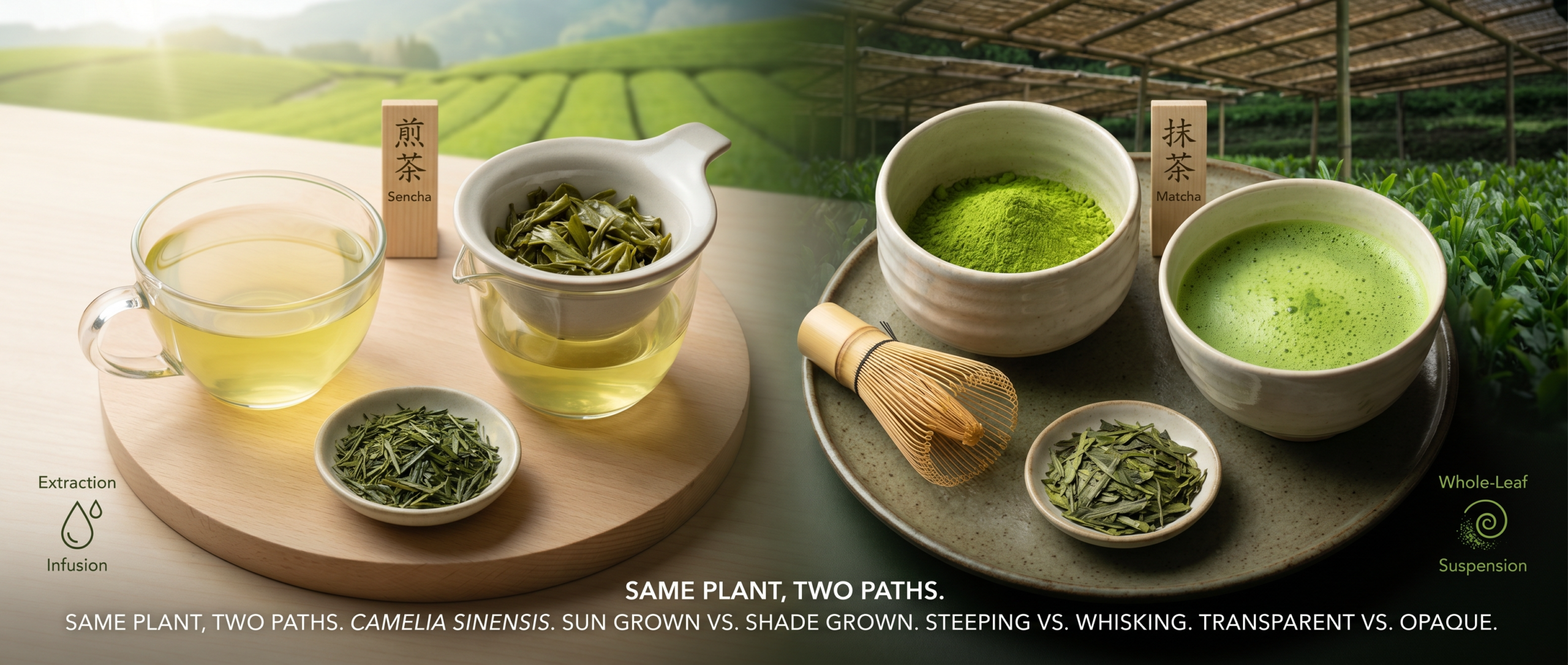
They come from the same plant — the same species, often the same regions. But one is steeped and strained away, and the other is shaded, ground, and swallowed whole. That single difference changes everything about how they taste, how they are made, and what they do.
It surprises most people to learn that matcha and green tea are made from exactly the same plant. Both come from Camellia sinensis, the tea shrub that produces nearly all of the world’s tea, and both are “green” in the technical sense — their leaves are heated soon after picking to stop oxidation, preserving their color and fresh character. By the broadest definition, matcha is a green tea. So why does a bowl of matcha look, taste, and behave so differently from a cup of brewed green tea?
The answer comes down to two decisions made before the leaf is ever prepared: how the plant is grown, and what is done to the leaf afterward. Ordinary green tea is grown in full sun, and its dried leaves are steeped in hot water and then thrown away — you drink an infusion, an extraction of the leaf. Matcha is grown in the shade, its leaves are processed into a special form called tencha, stone-ground into a fine powder, and whisked directly into water so that you consume the entire leaf. That distinction — infusion versus whole leaf — is the source of nearly every other difference between them.
This article walks through those differences clearly and factually. And because the qualities of any Japanese tea begin in the ground it grows in, it pairs naturally with our deeper exploration of where these teas come from: Where Tea Becomes Itself: The Regional Geography of Japanese Green Tea.
Same Plant, Two Paths
To be precise about terms: “green tea” in everyday English usually means leaf tea that is steeped — in Japan, most often sencha, the everyday green tea that accounts for the large majority of what Japanese people drink. Matcha is also a green tea by classification, but it is a fundamentally different product made by a different process from a differently grown leaf.
Both begin with the same species and, frequently, the same growing regions — Uji near Kyoto, Shizuoka, Kagoshima, and others all produce leaf destined for both. The paths diverge at the field. From the moment a grower decides whether to shade a particular plot or leave it in full sun, the two teas begin to become different things, in chemistry, color, flavor, and form.
Ordinary green tea is an infusion — you steep the leaf and pour the leaf away. Matcha is the whole leaf, shaded, ground, and swallowed. Nearly every other difference flows from that one.
The Shade: Where Matcha Is Made Different
The single most important step in making matcha happens weeks before harvest, in the field. The tea plants destined for matcha are deliberately covered — shaded from direct sunlight for roughly twenty days or more before picking, typically blocking the great majority of the available light. Sencha, by contrast, grows in full sun.
This shading does something specific and consequential. Deprived of strong sunlight, the plant slows its photosynthesis and adapts: it produces more chlorophyll, turning the leaves a deep, vivid green, and — crucially — it preserves and concentrates the amino acid L-theanine, which is responsible for the sweetness and savory umami depth prized in fine matcha. At the same time, shading reduces the conversion of that L-theanine into catechins, the compounds responsible for astringency and bitterness. The result is a leaf that is sweeter, rounder, more umami-rich, and less bitter than a sun-grown leaf.
This is why high-grade matcha tastes the way it does — gentle, sweet, almost broth-like in its savory depth — while sun-grown sencha is brighter, grassier, and more briskly astringent. The flavor difference is not an accident of brewing. It is built into the leaf in the field. The role of shading, and how it shapes the character of teas across Japan’s regions, is something we explore in detail in our guide to the regional geography of Japanese green tea.
Tencha: The Leaf That Becomes Matcha
After the shaded leaves are picked and steamed to halt oxidation, the processing diverges sharply from that of ordinary green tea. To make sencha, the steamed leaves are rolled and shaped into the tight, needle-like form that lets them unfurl when steeped. Matcha leaves are never rolled. Instead they are dried flat, and then their stems and veins are removed, leaving only the soft flesh of the leaf. This deveined, destemmed, flat-dried leaf has its own name: tencha (碾茶).
Tencha is the raw material of matcha — and matcha alone. It is rarely brewed or consumed in leaf form; its entire purpose is to be ground into powder. The final step is the one that gives matcha its name and texture: the tencha is milled, traditionally on slow-turning granite stones, into an extraordinarily fine, bright green powder with a talc-like softness. Stone grinding is slow — a single mill produces only a small quantity per hour — which is part of why genuine matcha is costly to produce.
This is the deepest structural difference between the two teas. Ordinary green tea is a leaf you steep and discard. Matcha is a leaf you grind and consume entirely. You are not drinking an extraction of the tea — you are drinking the tea itself, suspended in water.
Tencha exists for one reason: to be ground into matcha. It is shaded, steamed, deveined, and never rolled — a leaf made not to be steeped, but to be swallowed whole.
What Whole-Leaf Consumption Changes
Because you ingest the entire leaf rather than an infusion of it, matcha delivers more of the leaf’s compounds than steeped green tea does — and this accounts for several of the practical differences people notice.
Matcha generally contains more caffeine per serving than a cup of steeped green tea, because steeping extracts only a portion of what is in the leaf, while matcha delivers all of it. It is similarly higher in catechins and other antioxidants — studies consistently find that a serving of matcha provides substantially more of these compounds than a cup of brewed green tea, again because the whole leaf is consumed rather than strained away. The high L-theanine content from shading, combined with caffeine, is often cited as the reason matcha tends to produce a steady, focused alertness rather than a sharp spike — though the precise effects vary by person and serving size, and the broader research on green tea’s health effects remains an evolving field.
The practical takeaway is simple: matcha is concentrated in a way steeped tea cannot be. One bowl delivers more of the leaf, for better and for stronger, than one cup of sencha brewed from the same plant.
How They Are Prepared — and How They Taste
The preparation could hardly be more different. Green tea is steeped: leaves are placed in hot water, allowed to infuse for a short time, and removed (or strained out), leaving a clear liquid that ranges from pale gold to light green depending on the variety and water temperature. The leaves can often be re-steeped for additional infusions.
Matcha is whisked, not steeped. The powder is placed in a bowl, hot water is added, and the two are blended with a bamboo whisk (a chasen) until smooth and frothy. Nothing is strained out and nothing is discarded; the powder remains suspended in the water, producing an opaque, intensely green, slightly thick liquid with a layer of fine foam on top. There is no second infusion — the matcha is made and drunk in full.
In the cup, the contrast is clear. Good sencha is refreshing, vegetal, and brisk, with a clean astringency and a light body. Good matcha is rich, smooth, and full-bodied, with a pronounced umami sweetness from the shading and a faint, pleasant bitterness underneath — a more intense and textural experience than any steeped tea. Matcha also carries a creaminess and weight on the palate that comes directly from drinking the suspended leaf itself.
A Note on Grades
One practical point worth knowing when buying matcha: it is commonly sold in tiers often labeled “ceremonial” and “culinary.” These terms are marketing conventions rather than strictly regulated grades, but they point to a real difference. Higher grades are generally made from younger, more tender leaves from the first spring harvest, more thoroughly shaded and more finely ground, yielding a sweeter, smoother, more vividly green powder suited to drinking on its own. Lower grades, often made from later harvests or coarser leaf, are more astringent and less delicate — perfectly suited to lattes, baking, and cooking, where matcha is combined with milk, sugar, and other strong flavors that would overwhelm the subtlety of a fine drinking matcha.
For drinking matcha straight, a higher grade is worth seeking out. For a matcha latte or a dessert, a culinary grade is the sensible and economical choice. Neither is “fake” — they are simply matched to different uses.
Matcha and green tea are, at the root, the same plant — and that shared origin is exactly what makes their differences so striking. One choice in the field, to shade the plant from the sun, and one choice in the workshop, to grind the leaf rather than steep it, are enough to produce two teas that look, taste, and feel like entirely different things. To understand that is to understand something true of Japanese food and drink more broadly: that the most profound transformations often come not from new ingredients, but from the patient, deliberate handling of a single familiar one.
Read, then Taste
This article is part of Waden’s Origin series — traveling to the landscapes and regions where Japan’s finest ingredients begin. Read more at waden.umamibako.com.
Comment