Autumn on the Plate: Matsutake, Sanma, and the Arithmetic of Abundance
Japan is the only country that names a season after appetite. But the foods that define shokuyoku no aki now arrive with numbers attached — and most of those numbers are counting downward. This is what abundance looks like once it has to be measured.
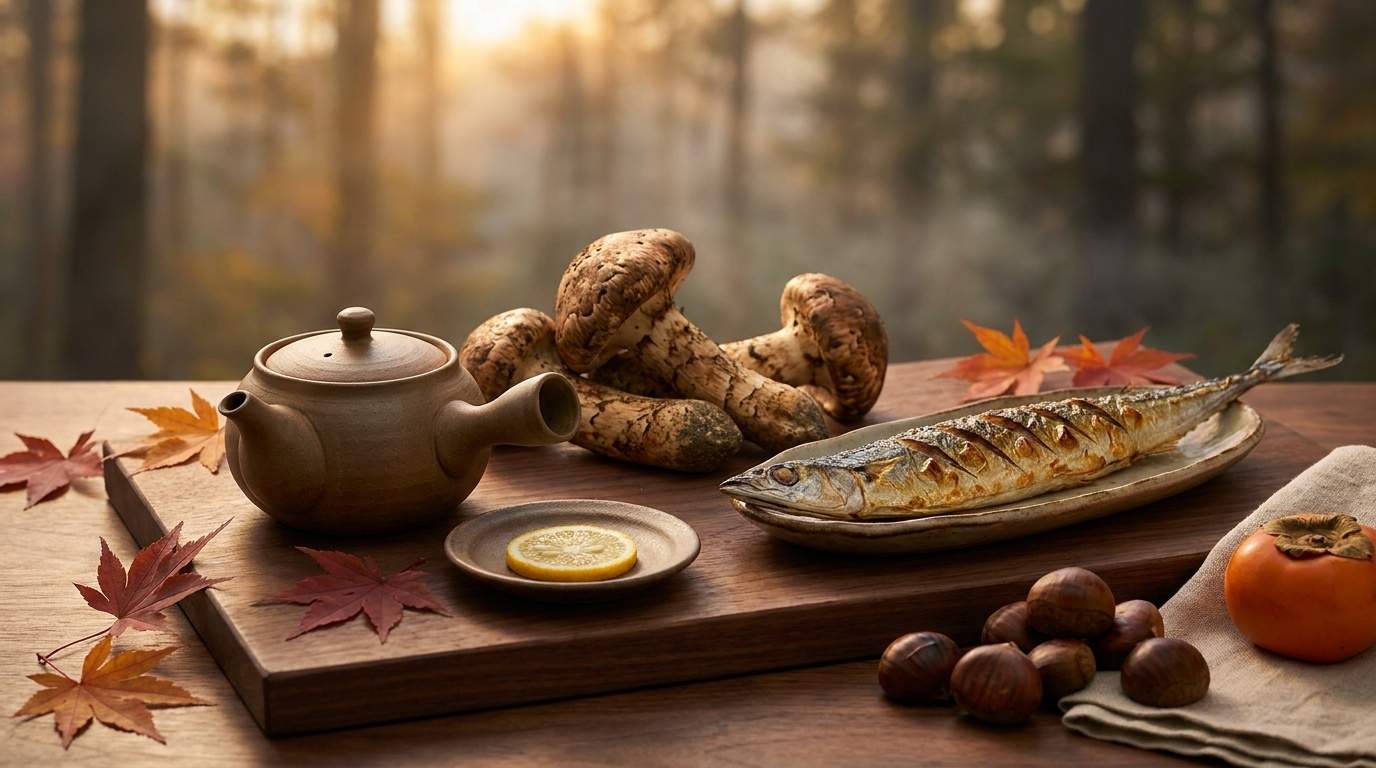
A small earthenware teapot is set in front of you, lid on, with a wedge of citrus balanced on the saucer beside it. You are not meant to lift the lid yet. First you pour a thimbleful of broth into the tiny cup, drink it, and only then take the lid off — and the smell that comes up out of the pot is the entire reason the dish exists. It is sweet and resinous and faintly like cinnamon, and it is gone within about a minute.
That pot costs what it costs because the mushroom inside it cannot be grown. And that single fact — that the emblem of the Japanese autumn is an organism nobody has learned to farm — turns out to be the key to the whole season.
Every other season asks something of the cook. Spring asks for speed, because a bamboo shoot turns bitter within a day of being dug. Summer asks for illusion, because the meal must read as cold whether or not it is. Autumn asks for almost nothing. Grill the fish whole. Tear the mushroom by hand. Cook the rice in plain water. The season arrives already finished, and the correct response is to get out of its way.
Which made autumn, for most of Japanese history, the easy season. It is not any more.
A Castle Underground
Shiitake will fruit in a plastic bag of sawdust. Enoki will do it in a bottle. Roughly ninety-five percent of Japan’s cultivated mushroom output now comes from such substrate beds, and the industry is so routine that the mushrooms are effectively a manufactured product. Matsutake has resisted this for more than a century of trying.
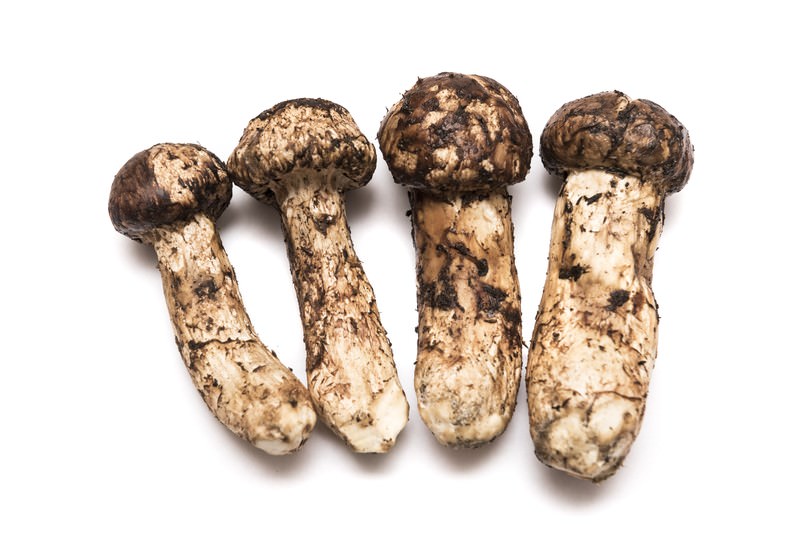
The obstacle is biological rather than technical. As the Forestry and Forest Products Research Institute explains it, shiitake and enoki are wood-decay fungi — they eat dead matter, and dead matter can be supplied. Matsutake is ectomycorrhizal. It cannot digest wood at all. It survives by wrapping itself around the living fine roots of the Japanese red pine, akamatsu, trading water and minerals for sugars the tree manufactures in its needles. Break the partnership and the fungus dies. There is no bag of sawdust that can substitute for a living tree.
Underground, the colony spreads as a slow fan of mycelium and colonised root tips that Japanese foresters call a shiro — a castle. It advances outward a few centimetres a year, and mushrooms push up along its leading edge when autumn soil temperatures fall and rain follows. A productive shiro is the accumulated work of decades. It can be destroyed in an afternoon by raking, by fertiliser, or simply by the slow accumulation of fallen leaves.
That last one is what happened, and the numbers are stark. According to the Ministry of Agriculture, Forestry and Fisheries, domestic matsutake production peaked in 1941 at roughly twelve thousand tonnes. By 1960 it had fallen to about three and a half thousand. In 2019 it was fourteen tonnes. The 2024 harvest came to forty-five. More than nine-tenths of the matsutake circulating in Japan is now imported — China supplying the majority, with Canada, the United States, Turkey, Mexico and Bhutan making up the rest. In 2020 the International Union for Conservation of Nature added Tricholoma matsutake to its Red List as Vulnerable.
The cause is counterintuitive enough to be worth stating plainly: Japan has too much forest, not too little. The pine groves that produced matsutake were satoyama, working woodland on the village edge, stripped every year for firewood, charcoal and leaf litter used as fertiliser. That relentless harvesting kept the soil thin and starved, which is exactly the condition red pine and matsutake require. When Japan converted to kerosene and gas in the postwar decades, the raking stopped. Litter piled up, humus enriched the ground, faster fungi and broadleaf saplings moved in and shaded out the pine, and pine wilt nematode killed much of what survived.
The mushroom did not vanish because the forest was destroyed. It vanished because the forest was left alone.
What the price actually buys is a smell. The aroma is carried by two dominant compounds — 1-octen-3-ol, first isolated from this mushroom and known in Japanese simply as matsutake-ol, and methyl cinnamate, which supplies the sweet, faintly cinnamon top note. Both are volatile, and both begin escaping the moment the mushroom is cut.
This is why the classical preparations are so close to empty of technique. Yaki-matsutake is the mushroom torn lengthwise by hand rather than sliced, because pulling along the fibres releases more scent than cutting across them, grilled briefly over charcoal and squeezed with sudachi. Dobin-mushi traps the aroma under the lid of that little teapot with dashi, a piece of chicken, a prawn and a ginkgo nut. Matsutake gohan perfumes an entire pot of rice with one or two caps. Each dish is a delivery system for something that is already evaporating.
The doctrine of shun, the belief that every ingredient has one true moment, applies here with unusual sharpness. An early mushroom, cap still closed, is firm and high-toned and belongs on the grill. A late one, cap fully opened, is earthier and heavier and belongs in the rice. Same organism, different dish, three weeks apart.
The Nut That Arrived Before the Rice
Chestnuts have a longer claim on this country’s table than rice does.
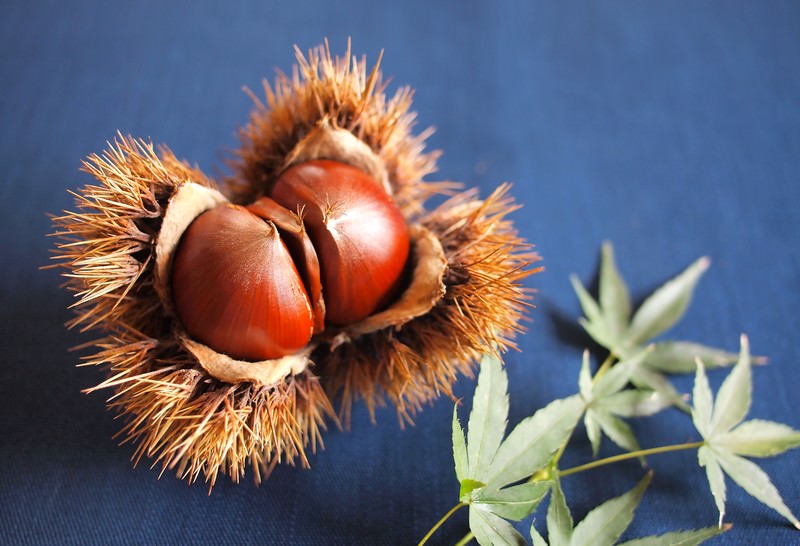
At Sannai-Maruyama in Aomori, a Jōmon settlement occupied for some fifteen centuries beginning around 5,900 years ago, excavators recovered chestnuts in extraordinary quantity — and found that the massive posts of the site’s largest structure had been cut from chestnut timber. DNA analysis of the recovered nuts showed genetic diversity narrower than a wild stand would produce, which is the signature of a grove being managed and replanted rather than merely foraged. Five thousand years before wet-rice agriculture reached its present dominance, somebody here was tending chestnut trees for food and for building material at once.
The court claimed them later. The Engishiki, the compendium of court procedure completed in 927, records Tanba — the highlands straddling modern Kyoto and Hyōgo — among the provinces sending chestnuts to the capital in tribute. Tanba chestnuts are still sold under that name, and still command a premium for size.
Then there is the peculiarity that shaped every Japanese chestnut recipe that followed. Castanea crenata, the Japanese chestnut, is effectively the only major chestnut species in the world whose inner skin, the shibukawa, refuses to separate from the flesh when cooked. The Chinese chestnut sold roasted as amaguri slips out of its skin under finger pressure. The Japanese one does not; the two layers are bonded, and the trait has since been traced to peeling-related genes that other chestnut species carry and this one largely lacks. Japan’s national agricultural research organisation released an easy-peel cultivar, Porotan, in 2007, and it remains a small share of the crop.
An entire tradition grew up around this inconvenience. Because the skin will not come away on its own, Japanese cooking either commits to removing it by hand with a specialised blade — for kuri gohan, chestnuts simmered into the new season’s rice, and for the sweet golden mash of kuri kinton that turns up in the lacquered tiers of New Year’s osechi — or refuses to remove it at all and makes a virtue of the refusal. Shibukawa-ni simmers the nuts with the skin still on through repeated changes of water, over days, until the astringency has been drawn off and the skin has become a dark, glossy, faintly bitter jacket. It is one of the great arguments for patience in the Japanese kitchen, and it exists because of a missing gene.
The scale is modest. The Ministry of Agriculture’s harvest survey put the 2025 crop at roughly sixteen thousand two hundred tonnes nationally, with Ibaraki producing about a quarter of it, followed by Kumamoto and Ehime. The planted area shrank again, as it has in most recent years.
A Fish With Autumn in Its Name
Sanma is written with three characters — autumn, sword, fish — and the spelling is younger than it looks. The spoken name is old and its etymology disputed, but the kanji were a modern coinage, popularised after the poet Satō Haruo published his “Song of the Sanma” in 1921. They describe the thing exactly: a narrow blade of silver that shows up in autumn.
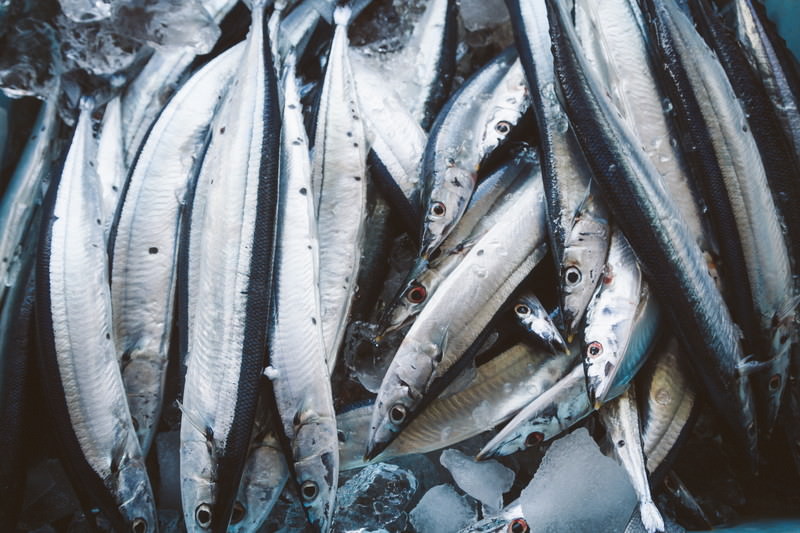
For most of the twentieth century it was the definitive cheap fish, the one that meant autumn in every household because every household could afford it. The rakugo Meguro no Sanma turns entirely on that position. A feudal lord, out hawking, eats a grilled sanma bought from a farmhouse and finds it the finest thing he has ever tasted. Back at the residence he asks for one; his retainers, appalled at serving a commoner’s fish, obtain the best specimen available, steam the fat out of it, remove every bone, and present a grey collapsed object. Where did this come from, he asks. Nihonbashi, they tell him — the finest market in Edo. “Ah,” he says. “That is the problem. Sanma must be from Meguro.” The joke lands because Meguro is landlocked, and because the fish’s entire virtue is the smoke and the fat and the char and the bitterness of the guts, which is precisely what refinement removes.
The fat is the point. Autumn is when the cold-water fish of the North Pacific load up before winter, and Japanese cooking tracks this carefully: the same logic makes modori-gatsuo, the returning bonito of autumn, an entirely different proposition from the lean first bonito of spring. A sanma at its peak is grilled whole with salt and served with grated daikon and a wedge of sudachi, innards included, the bitterness treated as the best part rather than something to be tolerated.
Here the arithmetic is at its harshest. Japanese landings ran to roughly 350,000 tonnes in 2008 and collapsed to around thirty thousand in the early 2020s. The 2025 season was, by recent standards, a reprieve — the national saury cooperative reported 64,737 tonnes, about one and seven-tenths times the previous year, with visibly larger fish. That is still under a fifth of the 2008 figure. The causes are tangled together: rising sea surface temperatures pushing the migration route away from the Japanese coast, so boats must steam far out into international waters; intensified high-seas fishing by several nations; and a genuinely diminished stock. Catch limits are now negotiated through the North Pacific Fisheries Commission, which set a total allowable catch of 121,500 tonnes for 2025 and trimmed it again to 115,425 tonnes for 2026.
The fish that once stood for ordinary autumn eating has become, in bad years, a luxury. That inversion says more about the present condition of the Japanese seasonal table than any single statistic.
Three of the four foods that define Japanese autumn now come with a red-list entry, a negotiated catch limit, or a national harvest that fits comfortably into two digits. Only the rice has held.
The Grain That Expires on New Year’s Eve
Against all of this, shinmai is the reassurance — and Japan takes the word seriously enough to regulate it. Under the national food labelling standard derived from JAS, brown rice may be sold as new rice only if it was packaged, or milled and packaged, by the thirty-first of December in the year it was harvested. At midnight on New Year’s Eve the same grain simply becomes rice.
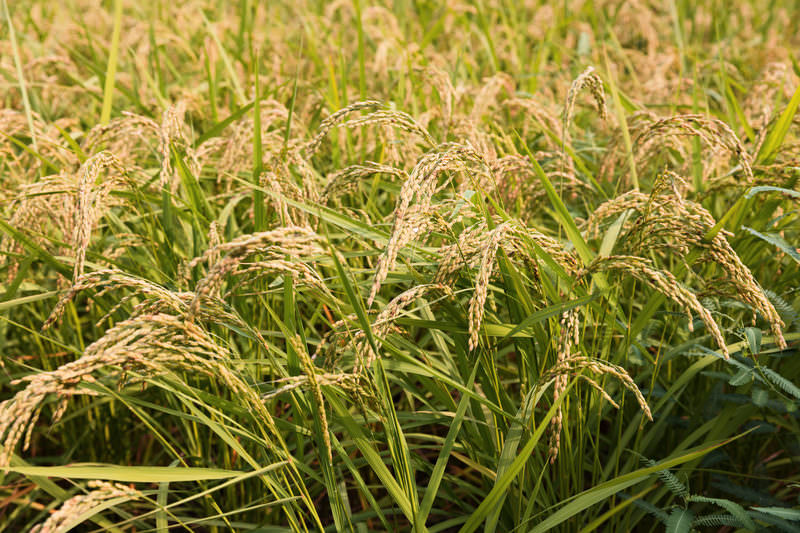
What distinguishes it is water. Freshly harvested rice holds more moisture than stored rice, which is why the standard household instruction is to reduce the cooking water by a few percent; done properly, the result is glossier, sweeter in the nose and softer than that same variety will ever be again. Rice from the previous year is not spoiled — Japan’s storage infrastructure is excellent — but it loses aroma and picks up a faint bran-like note that has a name of its own, komai-shū.
Rice is also why autumn has a ritual calendar at all. Niinamesai, the harvest rite at which the Emperor offers the year’s first grain to the deities and then eats it in their company, is among the oldest continuously observed ceremonies in Japan. It falls on the twenty-third of November — a date that survives in the modern calendar as Labour Thanksgiving Day, the harvest festival’s secular afterlife.
The Potato Moon
The moon-viewing that defines the Japanese autumn preserves a layer of history older than the rice ritual, if you know where to look for it.
Jūgoya, the fifteenth night — the harvest moon, chūshū no meigetsu — falls on the fifteenth day of the eighth lunar month, which in 2026 lands on the twenty-fifth of September. The practice of formal moon-viewing banquets came from Tang China and was taken up by Heian aristocrats, who composed poetry from boats and looked at the reflection rather than the moon itself. But the folk observance underneath the courtly one is agricultural, and its other name gives the game away. Imo-meigetsu means the potato moon. The offerings traditionally include satoimo, taro, because taro and other tubers were staple food before rice became universal, and because taro is what is actually ready to lift in the eighth lunar month. The moon festival is, underneath the poetry, a root-crop harvest festival that later acquired an aristocratic surface.
The rest of the altar follows the same reasoning. The stacked white dumplings, fifteen of them for the fifteenth night, are the moon. The plumes of susuki grass are stand-ins: what should properly be offered is a sheaf of rice ears, but in the eighth lunar month the rice is not yet cut, and susuki resembles it closely enough to serve — while its sharp-edged leaves were separately believed to turn away evil. And in parts of Aichi, Mie, Gifu, Fukushima and Miyazaki, a custom called tsukimi dorobō survives, in which children are permitted, on this one night of the year, to steal the offerings left out on doorsteps. It is a licensed theft, it is very close to trick-or-treating, and it is a great deal older.
A month later comes something China never had. Jūsanya, the thirteenth night — the twenty-third of October in 2026 — is a purely Japanese invention, traditionally credited to the court of Emperor Uda or Emperor Daigo. It is called the chestnut moon or the bean moon after what is set out for it, and the moon is deliberately not full. A superstition is attached: to view one of the two moons and not the other is kata-mitsuki, half-viewing, and considered unlucky. Having admired the perfect moon, you are obliged to come back in a month and admire the imperfect one.
That is a remarkably precise piece of cultural instruction, and it explains the season. The same sensibility produced the aki no nanakusa, the seven flowers of autumn, catalogued by Yamanoue no Okura in the Man’yōshū in the eighth century — bush clover, susuki, kudzu, pink, patrinia, boneset and bellflower. Unlike the seven herbs of spring, which are boiled into porridge and eaten, the seven flowers of autumn are only looked at. Spring’s list is medicine. Autumn’s is a view.
The Season of Nagori
Set the three seasons side by side and their intentions separate cleanly. Spring food is about arrival — bitter, brief, impatient. Summer food is about endurance, engineered to make heat survivable. Autumn food is about fullness, and inseparably about the awareness that fullness is the last stage before decline.
Japanese has a word for that stage. Nagori is the tail of an ingredient’s season, when it begins leaving the market, and its emotional register is not celebration but a sort of affectionate regret. Autumn is the season in which the entire year enters nagori at once. The moon that is deliberately not full. The mushroom priced by the gram because there are forty-five tonnes of it in the country. The fish with a season in its name that it can no longer reliably keep. The chestnut that has to be fought with for three days before it yields anything.
And underneath all of it the new rice — plain, white, faintly sweet, the one thing on the autumn table that turned up on time and in quantity, and the reason the rest of the meal has a centre at all. To see how this fits into the turning of the whole year, our walk through the twenty-four sekki of the Japanese table puts the calendar in order.
Read, then Taste.
This article is part of Waden’s Seasons series — following the rhythm of the Japanese culinary year, one season at a time. Read more at waden.umamibako.com.
Waden is an editorial journal exploring the depth and beauty of Japanese food culture — its history, ingredients, artisans, and traditions. Story first, always. waden.umamibako.com
Comment