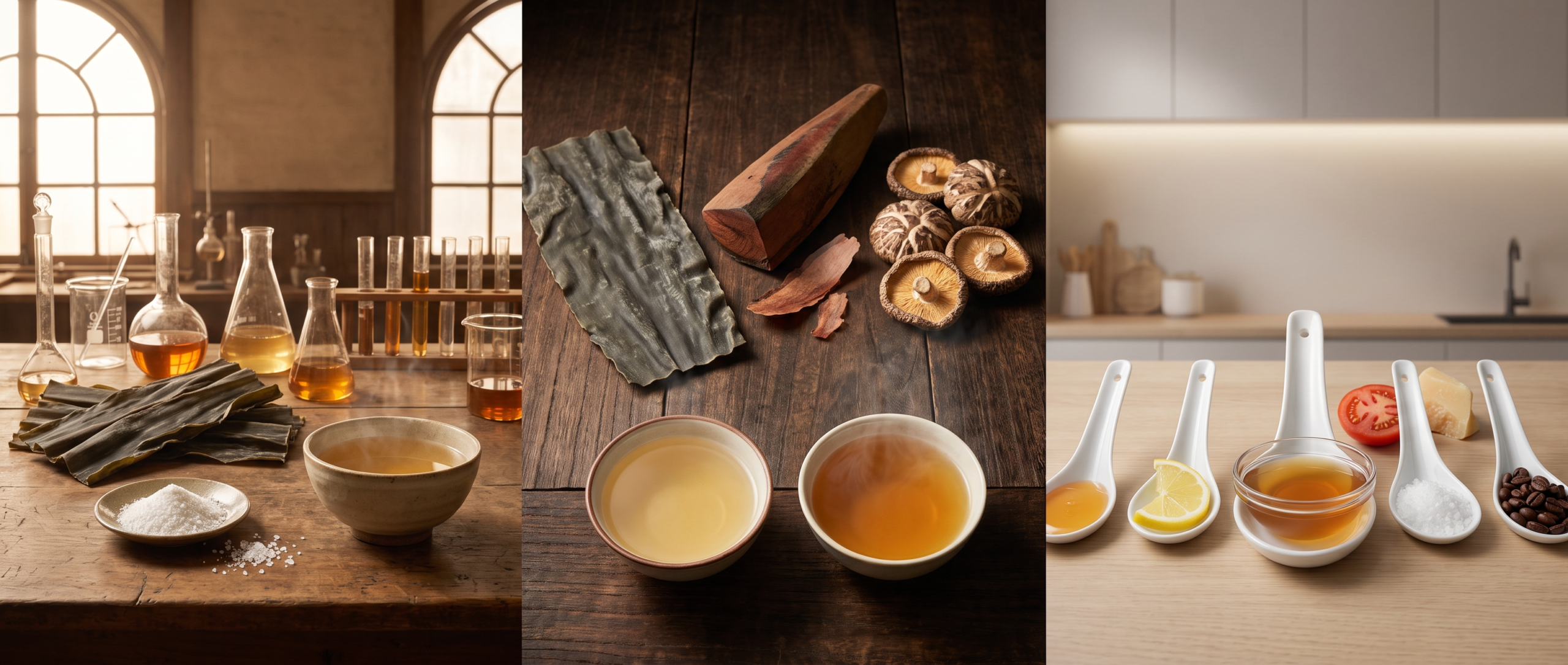
Umami: The Fifth Taste Japan Gave the World
For most of a century, Western science recognized four basic tastes. The fifth had already been discovered — in a bowl of kelp broth, by a Tokyo chemist, in 1908 — and it took the world ninety years to catch up.
Ask most people to name the basic tastes and they will get to four without much trouble: sweet, sour, salty, bitter. Then they stall. For a very long time, that list of four was treated as complete, a settled fact of human biology taught in schools around the world. It was also wrong — or at least incomplete — and the missing fifth taste had already been found, named, and bottled in Japan while the rest of the world was still insisting there were only four.
That fifth taste is umami, and its story is one of the most remarkable in the history of food: a genuine scientific discovery, made in a Japanese laboratory in 1908, that the world spent nearly a century refusing to fully believe. It is also the reason the very word Japan uses for “deliciousness” is now spoken, unchanged, in kitchens everywhere.
A Chemist and a Bowl of Broth
The discovery begins, as so much of Japanese cooking does, with dashi — the clear, restorative stock at the foundation of the cuisine. In 1908, a chemist named Kikunae Ikeda, a professor at Tokyo Imperial University, was struck by a question hiding in plain sight in his own dinner. The broth made from kombu, dried kelp, had a taste he could not file under any of the four recognized categories. It was not sweet, sour, salty, or bitter. It was something else — a deep, savory, mouth-filling quality that seemed to make food taste more like itself. He suspected it was a distinct, fundamental taste that no one had named.
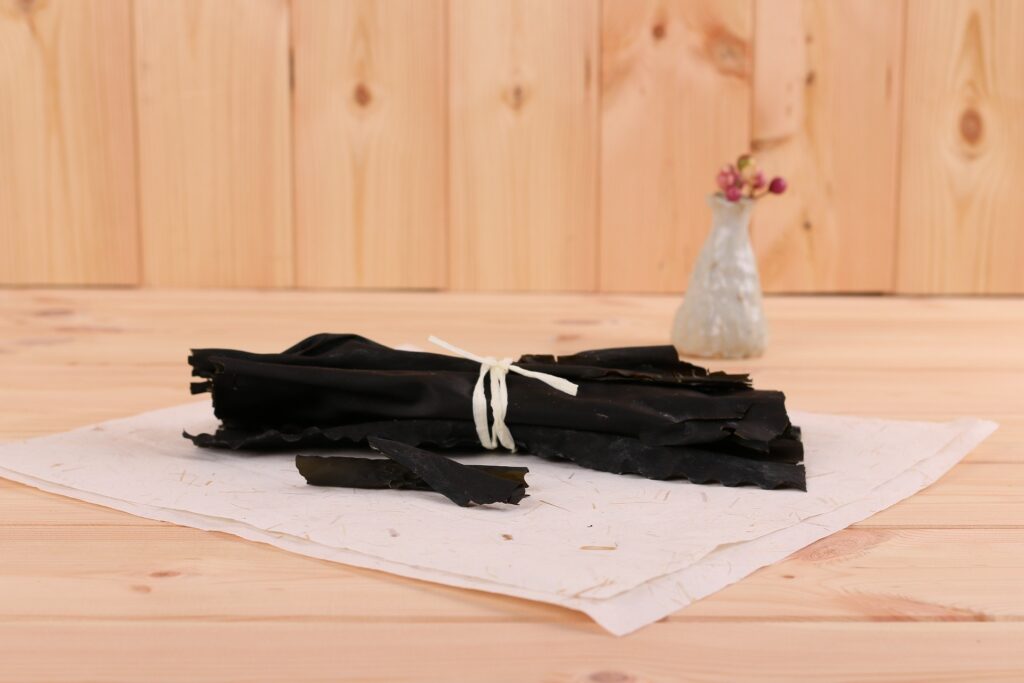
So he set out to isolate it. Working through a large quantity of kelp — some twelve kilograms of it — Ikeda succeeded in extracting a small amount, around thirty grams, of a crystallized compound. The substance was glutamic acid, an amino acid, and in the form of its salt, glutamate, it carried exactly the savory taste he had been chasing. He gave the taste a name, coined from the Japanese word for “delicious”: umami.

Ikeda’s insight was simple and radical: the savory depth of kelp broth was not a blend of the four known tastes, but a fifth taste in its own right — with its own name, and, though he could not yet prove it, its own biology.
From Laboratory to Kitchen Table
Ikeda did not stop at discovery. He patented a method for producing monosodium glutamate — MSG, the sodium salt of the compound he had isolated — and partnered with a businessman, Saburōsuke Suzuki, to sell it. In 1909, the world’s first commercial umami seasoning went on sale under a name that said exactly what it was: Ajinomoto, “the essence of taste.” For the first time, the fifth taste could be sprinkled from a jar.
This is the part of the story that later became complicated, and we will return to it. But it is worth pausing on the ambition of it: within two years, a taste had gone from an unnamed puzzle in a bowl of broth to an isolated molecule, a coined word, a patent, and a product. Few discoveries in the history of food have traveled from the laboratory to the kitchen table so fast.
The Trio, and the Secret of Dashi
Glutamate was only the first of umami’s components, and the discoveries that followed revealed something Japanese cooks had been exploiting, unknowingly, for centuries.
In 1913, Ikeda’s student Shintarō Kodama investigated the other great pillar of Japanese stock — katsuobushi, dried and smoked bonito — and found that its savoriness came from a different kind of compound: inosinate, a nucleotide, rather than an amino acid. Decades later, in 1957, a researcher named Akira Kuninaka identified a third umami substance, guanylate, as the source of the deep savor in dried shiitake mushrooms.
And then Kuninaka demonstrated the thing that makes umami not just a taste but a kind of culinary alchemy: synergy. Glutamate on its own is savory. But combine it with one of the nucleotides — inosinate or guanylate — and the perceived umami does not merely add up; it multiplies, leaping to many times the strength of either component alone. A pairing of glutamate and inosinate can taste several times more savory than the sum of its parts.
Here is why that revelation was quietly astonishing: Japanese cooking had been built on it for hundreds of years. The classic Japanese stock, awase-dashi, is made from kombu and katsuobushi together — glutamate and inosinate, the two halves of the synergy, combined in a single pot. Cooks had discovered by taste, over generations, the exact pairing that modern chemistry would later explain as a multiplication of savor. The science did not invent the technique. It caught up to it.
Kombu and bonito, glutamate and inosinate: Japanese cooks had been brewing the umami synergy into every bowl of dashi for centuries before a laboratory explained why it worked.
Why the World Took So Long
For all the elegance of Ikeda’s discovery, the wider scientific world was slow — spectacularly slow — to accept umami as a genuine basic taste. For most of the twentieth century, Western science held to the traditional four and treated umami, when it considered it at all, as merely a combination or enhancement of them rather than a category of its own. A taste discovered in 1908 remained, to much of the world, unofficial.
What finally settled the question was biology. Around the turn of the millennium, researchers identified the actual taste receptors on the tongue that respond specifically to glutamate — dedicated umami receptors, no less real than those for sweet or bitter. Once it was shown that the human body has specialized machinery for detecting umami, the argument was effectively over. Umami was recognized, internationally and scientifically, as the fifth basic taste. Nearly a century after a Japanese chemist named it, the world agreed.
The Long Shadow of a Single Letter
No honest account of umami can skip the strange chapter that nearly buried its reputation in the West — because it explains why many people still flinch at the word MSG even as they happily eat umami by other names.
In 1968, a short letter published in a prominent American medical journal described a set of symptoms the author associated with eating at Chinese restaurants, and speculated that MSG might be the cause. The phrase “Chinese Restaurant Syndrome” was born, and a decades-long panic followed. The trouble is that the science never held up: carefully controlled, double-blind studies have repeatedly failed to reproduce the reported effects, and food-safety authorities, including the US Food and Drug Administration, classify MSG as generally recognized as safe. Historians of the episode have noted, too, that the scare was tangled up with the era’s suspicion of Chinese food specifically — a bias dressed as science. Glutamate, after all, is the same molecule whether it comes from a jar, a ripe tomato, a wedge of aged parmesan, or a bowl of kelp broth. The panic was real; the danger, on the evidence, was not.
A Taste, and an Inheritance
What makes umami a story of heritage, and not merely of chemistry, is that it names something that was already there. Ikeda did not invent umami any more than a botanist invents a flower. He identified and named a taste that Japanese cooking had been organized around for a millennium — the savory foundation beneath dashi, miso, soy sauce, and the whole architecture of the Japanese meal. In doing so he gave the world a vocabulary for something people everywhere had always tasted but never had a word for.
That is why umami sits at the very center of what UNESCO recognized when it inscribed Japanese food culture — a point we explore in what Japan actually registered as washoku. It is why the savor of koji-fermented seasonings like shio koji feels so deep — fermentation is, in large part, a machine for liberating glutamate. And it is the invisible logic behind the humblest daily act of the Japanese kitchen: the drawing of a two-ingredient stock that turns out to be a lesson in molecular synergy.
The next time a dish tastes savory in a way you cannot quite name — rounder, deeper, more complete than salt alone could make it — you are tasting the thing a Tokyo chemist pulled from a bowl of broth in 1908, and named so well that the whole world eventually adopted his word for it. Sweet, sour, salty, bitter — and umami. The fifth taste was Japan’s to find, and Japan’s to give.
Read, then taste. This article is part of Waden’s Heritage series — tracing the ideas and traditions Japan has carried forward and handed on. To see umami at the heart of Japan’s food culture, read What Japan Actually Registered: Washoku and the UNESCO Misunderstanding.
Waden is an editorial journal exploring the depth and beauty of Japanese food culture — its history, ingredients, artisans, and traditions. Story first, always. waden.umamibako.com
Comment