The Thousand-Year Wait: What Dashi Is, and Why Japan Took So Long to Invent It
Japanese cooks do not make dashi. They draw it. That single verb — hiku — contains a philosophy of cooking, and the answer to why Japanese food tastes the way it does.
Set a bowl of good miso soup in front of someone who has never encountered Japanese cuisine and ask them to describe what they taste. They will likely struggle. It is savory, yes — but not the way a meat broth is savory. It is warm and round and somehow present without being assertive. It makes you want another spoonful, and then another, without quite knowing why. The flavor feels less like something added than like something revealed.
What they are tasting, beneath the miso and the tofu and the wakame, is dashi. And dashi is the answer Japanese cooking arrived at, over roughly a thousand years of trial, to a question most cuisines never ask directly: how do you make food taste more fully like itself?
A Word That Contains a Philosophy
In Japanese, the act of preparing dashi takes a specific verb: hiku (引く) — to pull, to draw out, to extract. You do not cook dashi. You do not make dashi. You draw it. Dashi wo hiku.
The choice of verb is not incidental. It encodes a posture toward ingredients that runs through the whole of the cuisine. The cook’s role, in this understanding, is not to impose flavor but to create the conditions under which something already present can come out — and then to stop. Water is the vehicle. The dried ingredient is the source. The cook decides when to intervene and, more importantly, when to leave the pot alone.
This is what commentators mean when they describe Japanese cooking as an art of subtraction. Where classical French technique builds depth by accumulation — butter, cream, reduction, hours — Japanese technique tends to remove: bitterness, strong odor, excess, anything that stands between the eater and the ingredient. Dashi is the purest expression of that tendency. It is a stock that, at its best, tastes of almost nothing and of everything at once.
What Dashi Actually Is
The word is plain to the point of bluntness. 出汁 combines the characters for “to come out” and “liquid”: the liquid that has been drawn out. Dashi is not one recipe but a family of infusions, each made by releasing flavor compounds from a dried ingredient into water.
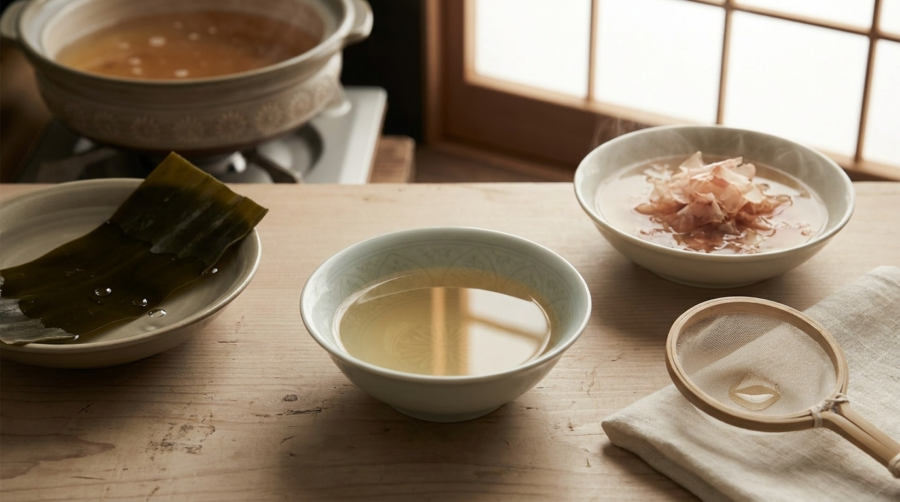
The most fundamental is awase dashi, the combination stock, made from kombu — dried kelp, whose character changes considerably depending on which stretch of Hokkaido coastline the kelp grew on — and katsuobushi, a fish dismantled by heat, smoke, and a fungus over six months until it is hard enough to ring when struck. Two dried things and water. That is the entire ingredient list.
It is worth pausing on how unlike a European stock this is. A French fond is built from raw material — bones, mirepoix, fat — over hours, and its depth comes from what is broken down during cooking. Dashi does none of that. The breaking down has already happened, elsewhere: months of drying on a Hokkaido shore, half a year of smoke and mould in a curing room. By the time the ingredients reach the pot, all the slow work is finished, and what remains is an extraction measured in minutes. A first dashi is over roughly ninety seconds after the shavings go in. The cuisine did not shorten its stock-making; it moved the long part upstream, into the drying yard.
Because those minutes are unforgiving, the mechanics deserve their own treatment, and we have given them one: the proportions, the temperature thresholds, the reason the kelp comes out before boiling and the shavings are never squeezed, and the two entirely different stocks a Japanese kitchen draws from one handful of shavings. This article is concerned with the other question — why a cuisine would organize itself around a liquid this quiet in the first place.
The Thousand-Year Wait
Dashi feels ancient, and the ingredients are. The broth is not. The gap between the two is the most interesting thing in its history.
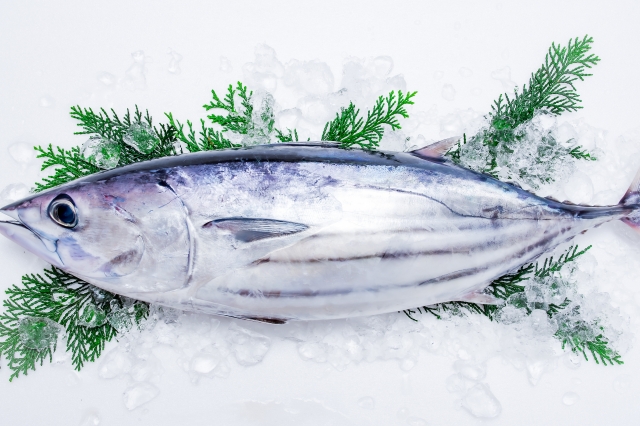
Kombu enters the written record in 715, in an entry of the Shoku Nihongi recording that an Emishi chieftain in the northeast had been sending kelp to the court, as his ancestors had before him. Katsuo appears in the eighth-century tax codes, where three forms of it were levied as tribute: katauo, dried bonito; nikatauo, boiled then dried — the recognizable ancestor of katsuobushi; and katsuo-irori, the boiling liquid reduced down to a concentrate. That third item is the one that matters here, and it is routinely misread as early dashi. The Ryō no Shūge, the legal commentary that describes it, files it instead under hishio — the salted ferments that were then the backbone of Japanese seasoning. Ancient Japan was not drawing broth from bonito. It was making a savory condiment, closer in kind to the fish-based seasonings that preceded soy sauce than to anything in a soup bowl.
Shaved bonito shows up long before drawn broth does. A Kamakura-period court cookbook already describes katsuo steeped in sake and its liquid used to dress jellyfish, and the word hanagatsuo — flower bonito, for the blossom-thin curls of a well-planed block — appears in a text on knife etiquette dated 1489. What is still missing at that point is the idea of extracting a broth as a foundation and building a dish on top of it.
That idea is first written down in a late-Muromachi manual of the Ōkusa school of cooking, and the passage is oddly specific. Take two blocks of katsuobushi, shave off the poor outer surface, put the good part in a cloth bag, simmer it in the cloudy water left from washing rice, strain it well — then combine three parts of that liquid with one part of clear miso. A bag, a strain, a ratio. It is recognizably the same operation performed in Japanese kitchens this morning, and it is the oldest description of it anyone has found.
Kombu is documented in 715. Bonito is taxed in the eighth century. The instruction to draw a broth from them and build a dish on it does not appear for another seven hundred years.
Everything then accelerates in the Edo period. Ryōri Monogatari, the practical cookbook of 1643, gives a working ratio for dashi and adds, almost in passing, that the spent shavings can be simmered a second time and used — the two-stage method, in print, by the mid-seventeenth century. The same book lists a meatless stock drawn from kombu, gourd shavings and dried grains, a reminder that kelp’s spread through Japan owed a great deal to the temple kitchens that cooked without flesh and needed umami from somewhere. And in 1668, in a recipe for a clear cod soup, a cookbook finally instructs the cook to put one block of katsuobushi and two sheets of kombu into the same pot of water. Glutamate and inosinate, deliberately combined. Awase dashi, in writing, at last.
By 1730 another cookbook could state it flatly: dashi wa ryōri no moto nari — dashi is the foundation of cooking. The century in between had settled the argument.
Two developments made that possible, and both were logistical rather than culinary. Katsuobushi became a serious ingredient only in the late seventeenth century, when fishermen from Kishū working in Tosa refined the smoking and mould-curing that turn a boiled fillet into the ringing block. And kombu became a national commodity only after the west-circuit sea route was established in the 1670s, sending Hokkaido kelp down the Japan Sea coast to Osaka and onward — the trade later known as the Kombu Road. Before that, kelp reached the capital in modest quantity through Wakasa; afterward it arrived by the shipload.
That trade also produced the east-west split that still defines Japanese broth. The best kombu sold first in Osaka, and what did not sell there went on to Edo, so Kansai got the superior kelp. Meanwhile Edo developed an appetite for bonito so fierce it became a genre of urban comedy — the competitive mania for the first bonito of the year is one of the defining obsessions of the period. And beneath the commerce, the water itself was pulling in the same direction: Kansai’s exceptionally soft water releases kombu’s glutamates cleanly, while Kanto’s harder water does not, which rewards the fish. A kombu-centered Kansai and a katsuo-centered Kanto were not simply matters of taste. They were what the shipping lanes and the geology jointly permitted — and in Kyoto they met the vegetables the city had been breeding for centuries, which is how the most restrained cuisine in Japan came to sit exactly where the water was softest.
Dashi reached ordinary households last. Cookbooks before the Meiji era were written for professionals and for banquets; only in the late nineteenth century did domestic manuals appear, and by 1904 a Tokyo cooking school aimed squarely at home kitchens was printing instructions for both first and second dashi. What had been a professional technique in 1668 was a household chore by 1904.
Two Ingredients, One Multiplication
The cooks who combined kelp and fish in 1668 had no idea why it worked. The explanation took another two and a half centuries and arrived from a laboratory.
In 1908 the chemist Kikunae Ikeda, puzzled by a savoriness in kombu broth that fit none of the four recognized tastes, worked through roughly twelve kilograms of kelp to isolate about thirty grams of crystals. The compound was glutamic acid, and he named the taste umami. His student identified the savor of katsuobushi as inosinate in 1913, and a third researcher found guanylate in dried shiitake in 1957 — along with the finding that matters most here. Glutamate and a nucleotide, tasted together, do not add. They multiply, by a factor commonly measured at seven or eight times. The full account of that discovery, and of the century the rest of the world spent declining to believe it, is the story of the fifth taste a Tokyo chemist pulled out of a bowl of kelp broth.
Kombu carries more free glutamate than almost any food on earth. Katsuobushi carries inosinate. Awase dashi is the synergy in a pot, arrived at by palate three centuries before anyone could name either molecule, and the reason two faint ingredients produce a broth that is not faint at all.
This also explains the practical effect that makes dashi worth the trouble. Umami is not simply a fifth flavor sitting alongside the others; it rounds and sustains them, and it lets a cook reach for less salt to reach the same sense of completeness — an effect now studied seriously as a public-health tool. A dish built on good dashi needs less seasoning because the seasoning has less work left to do.
Japanese cooks found the synergy by tasting, three hundred years before chemistry could explain it. The laboratory did not invent the technique. It caught up to it.
The Other Dashi
Awase dashi is the standard, not the whole family. Each variant expresses the same principle — umami drawn out of a dried thing into water — and each has its natural home.
Kombu alone, drawn cold, gives the cleanest and most transparent of all dashi: faintly mineral, almost colorless, the foundation of Kyoto’s refined cooking and of any dish where the broth should be felt rather than noticed. Niboshi dashi, from small dried sardines, is the everyday stock of home kitchens in the west and in Kyushu — toasty, frankly fishy, and entirely at home under a robust miso. Ago dashi, from dried flying fish, gives a clean fragrant broth that has spread well beyond its Kyushu origins in recent decades.
And then there is shiitake, the strangest of them, because dried shiitake has to manufacture its umami rather than merely release it: a fresh mushroom contains almost no guanylate, and whether any ends up in your bowl depends on the order and temperature of soaking and heating. It is the centerpiece of temple cuisine’s flesh-free stock, and a good demonstration that the restriction produced a technique more demanding than the one it replaced.
What Dashi Is Not
Three honest qualifications, because dashi tends to get described in terms slightly larger than the truth.
It is not Japan’s only source of umami, or even its main one by volume. The savory backbone of most Japanese meals is fermented rather than infused: the paste of soybeans, salt, and koji that ferments for months in a cedar barrel, and the five brewed soy sauces that season nearly everything else, both work by liberating glutamate from protein over time rather than pulling it out of water in ninety seconds. Before either of them dominated, Japan salted fish into liquid seasoning, and those fish sauces are still made and still used in pockets of the country. Dashi is one strategy among several for getting umami onto the table — the fastest one, and the only one that leaves the liquid clear.
It is also not a stock in the European sense, and treating it as one is the most common way visitors misjudge it. There is no fat, no collagen, no body, nothing to coat the mouth. A cook who tastes dashi expecting the richness of a reduced veal stock will find it thin and conclude that something went wrong. Nothing went wrong. The thinness is deliberate, because what will be set on top of it — a piece of white fish, a square of tofu, a single leaf — cannot be heard through richness.
And it is not, in contemporary Japan, usually drawn from scratch. In November 1970, at the height of the postwar boom and in direct response to shrinking household cooking time, a granulated instant dashi went on sale and changed the ordinary Japanese kitchen permanently. Consumer surveys today find that among people who cook dishes requiring dashi, close to nine in ten use commercial granules or bottled tsuyu, while only around a third ever draw a stock from kombu, katsuobushi or niboshi themselves. This is worth saying plainly, because the romantic version of Japanese home cooking — a pot of first dashi every morning — describes a minority practice. What the granules replaced was not ceremony. It was labor. What they cost was aroma, which is most of the point of a first dashi and the one thing a powder cannot store.
Where the Broth Goes
Once drawn, dashi disappears almost immediately into other things, which is why it is so easy to eat Japanese food for years without noticing it.
It becomes the soup in one soup and three dishes, the framework that organizes the Japanese meal — and the reason that soup is not an optional course but a structural element. It becomes the simmering liquid in the slow, quiet cooking of nimono, where vegetables absorb seasoned dashi rather than being seasoned directly. It becomes the broth under a bowl of udon and the regional soba traditions that argue about it, and — in a form that has traveled furthest from its origins — it is half the equation in the tare that gives a bowl of ramen its name, where a Japanese-style stock is routinely blended into a Chinese-derived one.
It is the dipping sauce beside a plate of tempura, cut with soy and mirin. It is the water a block of tofu is warmed in, in the single most minimal dish the cuisine has produced. It is in the batter of okonomiyaki, in the egg of chawanmushi, in the rice of takikomi gohan. And at the highest register — a clear suimono served in a lacquered wooden bowl, lifted to the face so the aroma arrives before the liquid does — it stops being a foundation and becomes the dish itself. That bowl is where a kaiseki chef is judged, and there is nothing in it to hide behind.
The Invisible Architecture
Tasted alone, good dashi is an underwhelming thing. No richness, no strong fragrance, nothing assertive. To a palate expecting the intensity of a reduced Western stock, it can seem barely there.
That is the design. Dashi is architecture, not decoration: the structure inside which other flavors do their work. When it is present, everything built on it tastes more fully like itself. When it is absent, something is missing that most eaters cannot name but register immediately.
Japan marks the twenty-fourth of November as Washoku Day, chosen for a pun — ii Nihonshoku, good Japanese food — and designated not by the government but by a civic association formed in 2013, the year UNESCO inscribed washoku on its intangible heritage list, to protect the country’s food culture. Dashi is not the whole of what that day commemorates, but it is what the association reaches for first when it explains the point. What that inscription actually covered is more specific and more interesting than most reporting suggested, and we have taken it apart in our piece on what Japan really registered. But dashi sits close to the center of it, for a reason worth stating directly: it is not a technique that Japanese cuisine happens to use. It is the cuisine’s central conviction, in liquid form — that the deepest flavors are not added but drawn out, and that the cook’s highest skill is not imposition but restraint.
Dashi wo hiku. Draw it out. Then stand back and let the ingredient speak.
Read, then Taste.
This article is part of Waden’s Technique series, exploring the craft, philosophy, and practice behind Japanese culinary methods. Read more at waden.umamibako.com.
Waden is an editorial journal exploring the depth and beauty of Japanese food culture — its history, ingredients, artisans, and traditions. Story first, always. waden.umamibako.com
Comment