The Cup Came Last: Tokkuri, Ochoko, and the Vessels That Shaped Japanese Drinking
The flask on your table was designed to carry soy sauce. The cup beside it started life as a dish for appetisers. Almost nothing in the Japanese sake service was built for the job it now does — which is exactly what makes the set interesting.
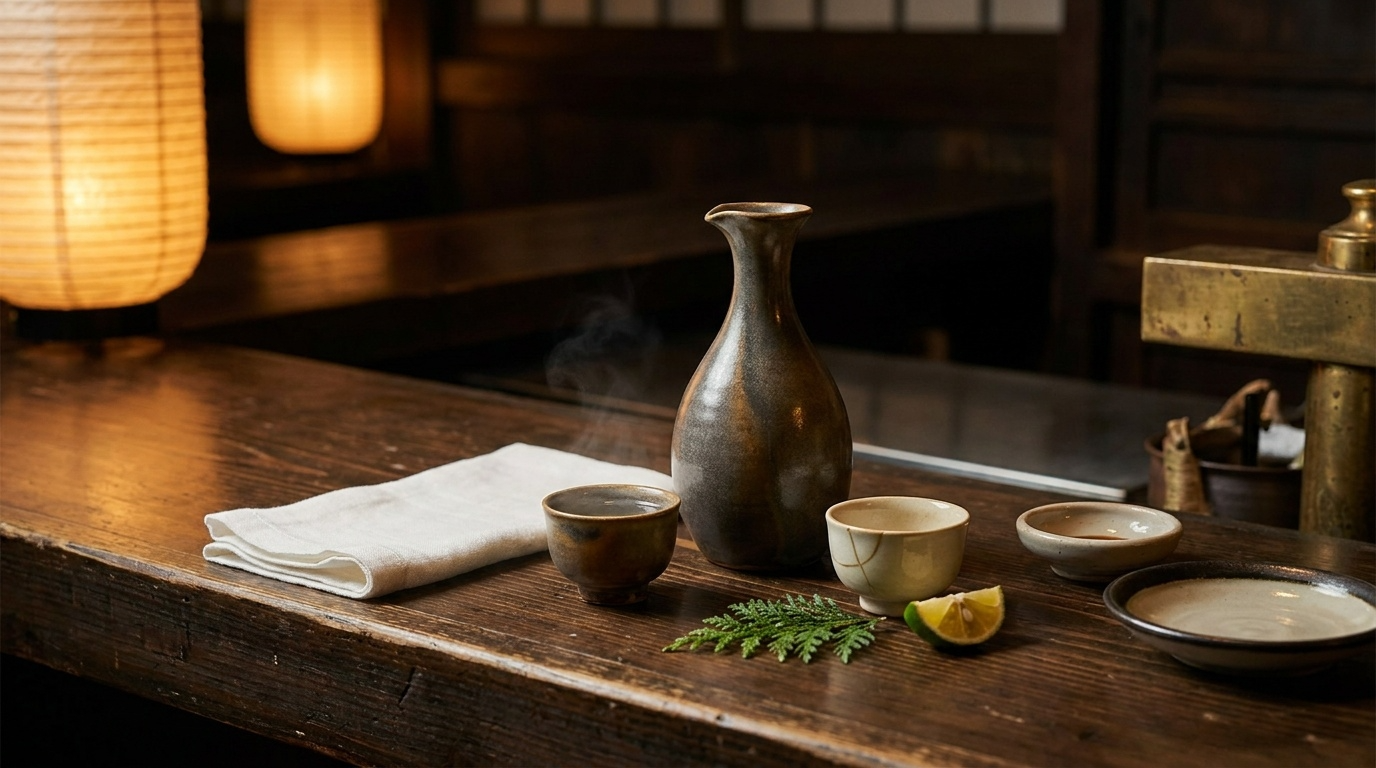
Order sake in a Japanese pub — an izakaya, the noisy, informal kind of restaurant where people drink and eat small dishes together — and you are asked, in effect, three questions at once: warm or cold, how much, and in what. The third is usually answered for you. A small narrow-necked flask arrives with a cup barely larger than a walnut, and the arrangement looks so settled, so obviously ancient, that it seems to have always been that way.
It has not. The set on the table is roughly a century and a half old, and every piece of it was doing something else before it ended up there.
There are four objects worth knowing by name, and you will meet all of them in this article. The tokkuri is the flask. The ochoko is the small cup, and the guinomi is the same idea one or two sizes up. The masu is a square wooden box. Two units of volume also keep appearing, because Japan measured liquid by them for centuries: one gō is 180 ml (about 6 fl oz), and one shō is ten times that, 1.8 litres. Almost every vessel below is some multiple or fraction of those two numbers.
The Vessel Nobody Uses Any More
Start with a word that is wrong.
In an izakaya, a customer will call for o-chōshi ippon — “one flask” — and what arrives is a small ceramic bottle. But a chōshi is not that. It is a metal or wooden vessel with a long handle projecting sideways, used for pouring at formal banquets, and if you have ever seen photographs of a Japanese wedding held at a Shinto shrine, you have seen one. The long-handled pourer used in the ritual exchange of cups between bride and groom is the real object. Surviving court examples are gilt bronze, with cranes and tortoises — both symbols of long life — worked into the metal, a spout at one lip for formal service and sometimes at both lips for the looser business of a large drinking party.
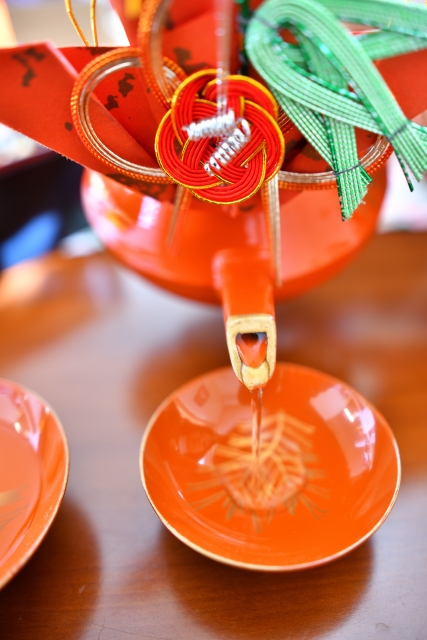
Beside the chōshi stood its assistant, the hisage: a lidded pot with a handle arching over the top, like a small kettle. Sake was drawn from the barrel into the hisage, and the hisage refilled the chōshi whenever it ran dry. Its nickname was kuwae, the adder.
Then, sometime early in the Edo period (1603–1868), the assistant took over. People began pouring directly from the hisage into cups — and calling that vessel a chōshi too. By the 1830s and 40s they were being made in iron, tin, wood and finally ceramic, and once porcelain took hold there were painted and blue-and-white ones as well.
The word then jumped a second time. When the small warming flask became standard during the Meiji period (1868–1912) — the decades when Japan opened to the world and remade much of its daily life — it inherited the name on the grounds that it did the same job. So o-chōshi ippon is a phrase describing an object that fell out of use, transferred to its replacement, and then transferred again to that replacement’s replacement. Nobody minds, and nobody corrects it. But it is worth knowing that the formal vessel of Japanese drinking is not the one on your table. It is the one at the altar.
The Flask Was a Storage Jar
The tokkuri comes from a different lineage, and a more sacred one.
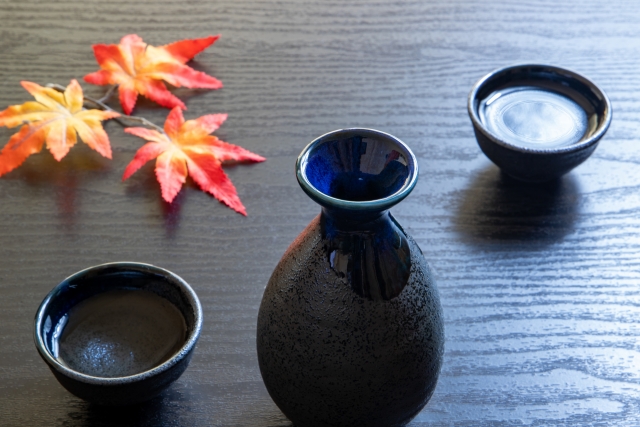
It descends from the heishi, the narrow-mouthed bottle used to offer sake to the gods, recorded in a book of court and shrine regulations completed in 927 and thought to derive from the Chinese meiping wine bottle. Sake has been an offering before it was ever a refreshment — a story told in full in The Drink That Belongs to the Gods — and pairs of heishi still stand today on the small household shrines that many Japanese homes keep on a high shelf. By the Muromachi period (1336–1573) the word tokuri was in use for the domestic descendant of that shape.
And for centuries that descendant was not a serving vessel at all. It was a container. Edo-period tokkuri came in sizes of two and three shō — three and a half to five litres, the size of a demijohn — and held not only sake but soy sauce, vinegar and grain. Surviving examples from the Tanba kilns in western Japan are glazed in iron brown and lettered across the shoulder with a place name or a shop name: Fushimi, Kasagiya. These are kayoi-dokkuri, “commuting flasks”, or kashi-dokkuri, “loaned flasks”. Sake was sold by measure out of a barrel and the customer brought the bottle. The vessel carried the merchant’s name because it belonged to the merchant, and was expected to come back.
Only later in the Edo period do small one- and two-gō flasks appear — 180 to 360 ml, the size on your table now — and with them the habit of pouring straight from the flask into a cup, rather than decanting into something formal first. What we treat today as the classic instrument of Japanese hospitality began as a delivery container that got small enough to put on a table.
The tokkuri was branded with the shop’s name because it belonged to the shop. It was a returnable container, not a serving vessel.
Its shape, though, turned out to be unexpectedly well suited to the job it fell into. A bulging body with a narrow neck is the right geometry for warming sake in a hot-water bath, which is still the method that gives the best results at every point on the temperature scale: the wide belly sits in the water and takes up heat across a large surface, while the constricted neck slows the movement of warm liquid at the top and limits how fast the aromas escape.
The narrow neck also meters the pour. You cannot dispense a large volume quickly from a tokkuri — which is precisely why the pour became social. In Japan you fill your companion’s cup and they fill yours; pouring for yourself is faintly graceless. A flask that empties in three seconds does not generate a ritual of refilling one another. One that dribbles does.
Down from the Saucer
The cup has travelled furthest of all.
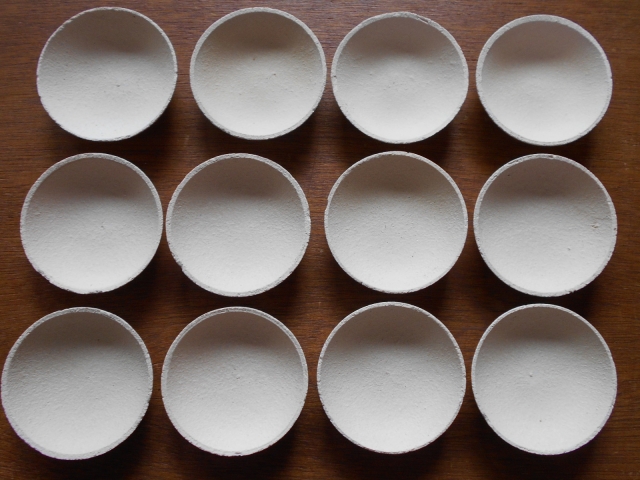
For most of Japanese history sake was drunk from kawarake: unglazed, low-fired earthenware, closer to a flowerpot than to tableware, and often used once and discarded. That remained normal until roughly the Muromachi period, and the plain clay cups still used for sacred offerings at shrines are the direct survival of it. Lacquered cups called sakazuki — broad, shallow, saucer-shaped, coated in the hard natural resin described in our piece on urushi — came into use around the fifteenth century, and the warrior class turned the passing of cups into an elaborate social technology.
The formal banquet of that era ran on a structure called shiki-san-kon: three rounds, each pairing a dish with three sips of sake. Its descendant is san-san-kudo, the rite still performed at Shinto weddings — three pours, three sips, three cups, nine mouthfuls in all — and the reason that long-handled chōshi is still in production.
Everything about the sakazuki assumes that the cup moves between people. It is wide, shallow and easy to offer with both hands, and it was entirely normal to hand your own cup to a guest, have it filled, and have them drink from it. This produced a piece of furniture that has since vanished: the haisen, a bowl of water kept on the table for rinsing a cup between users. Early accounts describe people simply commandeering a large bowl for the purpose; by the late nineteenth century, restaurants had dedicated ones in porcelain, lacquer or tin, sometimes beautifully painted. You will almost never see a haisen today, and its disappearance marks the precise moment when the cup stopped being shared and became personal.
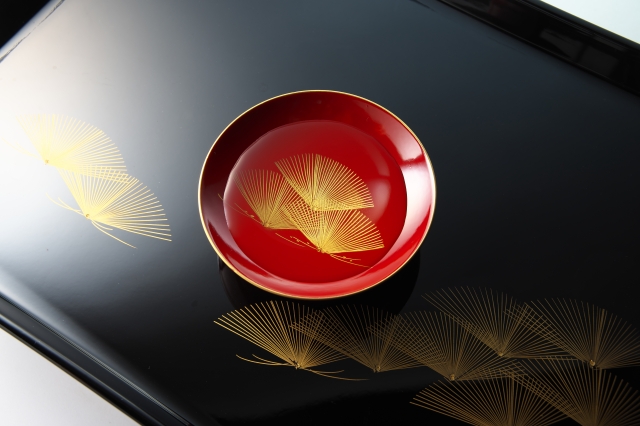
Porcelain cups arrive around the 1790s, and their origin is a piece of borrowing. The choko was not designed as a sake cup. It was the mukōzuke — the small dish placed at the far side of the tray in kaiseki, the multi-course meal of the tea ceremony tradition, holding a course of raw fish or something dressed in vinegar. Someone drank out of it. The same is said of the larger guinomi. Cooks and drinkers reached for a bowl already on the table, decided it worked, and the borrowing hardened into a category.
Then the cups shrank. Through the nineteenth century and into the Meiji period the choko steadily got smaller, and the reasons are worth setting out, because they are entirely about how people were drinking rather than about design. Sake was being brewed stronger and more aromatic. The practice of passing one large cup around a party was falling away. Izakaya were flourishing, and the evening drink at home was becoming an ordinary daily thing rather than an occasion. A small cup suits a strong drink, a private drinker and a long evening; a large one suits a ceremony. As drinking became casual, the vessel contracted.
The etymology of choko is genuinely unresolved, and Japanese sources disagree. It is written with characters meaning “boar’s mouth”, but these are almost certainly ateji — characters borrowed purely for their sound, with no connection to the meaning. There are no pigs involved. Proposals include an old native word for something small or slight, the family of words behind chokotto (“just a little”), and a borrowing from Korean. Nobody knows.
The One Cup That Was Designed on Purpose
There is exactly one sake vessel in common use that was engineered rather than inherited, and it is the one nobody drinks from for pleasure.
The kiki-jōko, the tasting cup, is white porcelain with two concentric cobalt-blue rings painted in the bottom — the janome, the “snake’s eye”. It is a measuring instrument disguised as tableware. The blue rings are read for clarity, because a hazy sake blurs the boundary between the blue and the white; the white ground is read for colour, because any tint in the liquid shows against it. It is made in graded sizes from about 36 ml upward, but the version used by brewers and at the national new-sake competitions is the hon-kiki, holding a full gō — 180 ml. That is a large, wide-mouthed cup, held at a distance, and it exists because a professional needs both a big surface and a big air space above the liquid to judge aroma properly.
Which is a useful corrective. The tiny cup is not the optimal instrument for tasting sake. It is the optimal instrument for drinking it with other people. The industry has always known the difference, and quietly kept two sets of equipment.
Wood, and a Measure of Rice
The masu is the strangest object on the list, because for most of its existence drinking from it would have been like drinking from a measuring jug — which is exactly what it was.
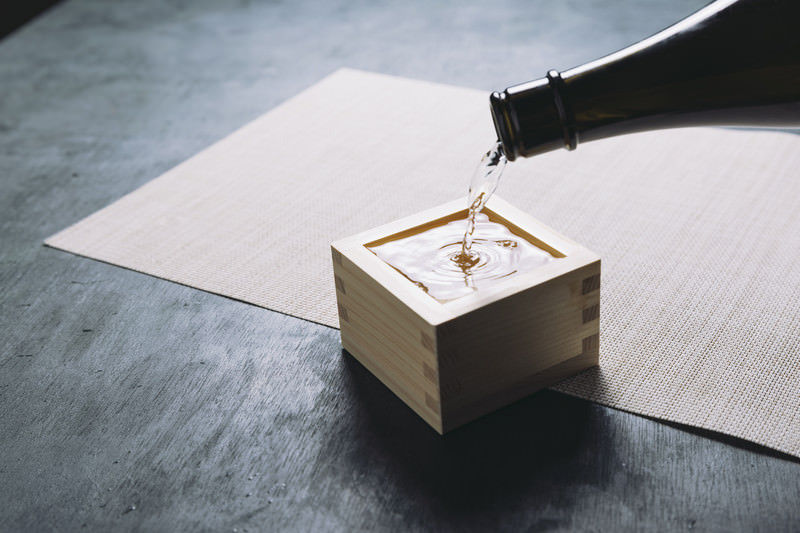
The masu is a unit of volume made physical: a square box of plain cedar, joined at the corners, unglazed and unlined. Toyotomi Hideyoshi’s national land survey in the late sixteenth century established the Kyoto masu as the standard, and in 1669 the Tokugawa government fixed the dimensions of the one-shō box for the entire country — roughly 14.8 cm square and 8.2 cm deep, holding 1.8 litres. This was the instrument by which rice was measured, taxes assessed and samurai stipends paid. It kept that legal standing until the old units were withdrawn from official trade use, a process completed between 1959 and the mid-1960s. Only after it was retired from measurement did the masu become primarily a drinking vessel.
Hence mokkiri, the izakaya service in which a glass is set inside a masu and deliberately overfilled until the sake spills into the box. Today it reads as generous theatre. It began as a demonstration of honest measure in a shop that sold by volume, and it means what it always meant: nothing is being held back.
Drink from the wood and the sake picks up cedar. Whether that is the whole point or a serious problem depends on the bottle — a fragrant, fruity ginjo is simply overrun by it. And note that many modern masu are lacquered on the inside, in which case there is no cedar aroma at all and the object is functioning purely as a shape.
What the Material Actually Does
Which brings us to the claim that a cup changes the taste of what is in it — made constantly, and worth separating into the parts that are solid and the parts that are not.
The solid part is thermal. This is simply heat transfer, and it is the most consequential thing a vessel does, because temperature is by far the largest variable in how sake presents itself. Thick stoneware conducts heat poorly and has real mass, so it holds a hot pour near its temperature for a long time; it is the correct choice for anything served warm. Thin glass has almost no thermal buffer, so a chilled pour warms up in your hand within minutes — which is why cold sake is served in small glass vessels and drunk quickly, and why the hand-cut glass of the Edo and Satsuma traditions became the summer material. The distinction between porous, insulating earthenware and dense, cool porcelain, which underlies all of this, is the subject of Clay, Fire, and the Food Between.
Tin sits at the opposite end. Its conductivity is far above ceramic or glass, so a tin cup takes the temperature of its contents almost instantly and telegraphs it to your hand: a cold pour in tin reads colder than the same pour in porcelain. The craft behind it is real. Tin working in Osaka is a nationally designated traditional craft, and the foundry Nousaku in Takaoka, casting since 1916, built an international business on vessels of pure tin — soft enough to bend by hand. Tin’s low melting point, around 231°C, is what makes it workable at all.
The part that is not solid is the flavour claim attached to tin. The standard explanation is that tin ions dissolve into the sake and neutralise harsh notes, rounding and sweetening the drink. It is repeated everywhere, including by the people who make and sell tin, and it is essentially unverified; even sympathetic accounts concede that the mechanism has never actually been demonstrated. This does not make tin cups a fraud. It means that whatever they do is more plausibly explained by temperature, by the weight of the object in the hand, and by the way a metal rim meets your lip, than by chemistry.
The shape claim stands on firmer but subtler ground. A wide mouth exposes more surface and releases aroma into the room; a narrow one funnels it toward your nose. A thin rim delivers liquid in a fine stream to the front of the tongue; a thick, rolled rim spreads it and slows it down. The angle you must tilt your head, the rate the sake arrives, where it lands and how much air comes with it — all of that is set by the geometry of the cup, and all of it affects what you perceive. You will sometimes see this explained by a diagram of “taste zones” on the tongue, sweet at the tip and bitter at the back. That map is long-discredited textbook folklore; all five basic tastes are detected across the whole tongue. The effect of cup shape is real, but the mechanism is delivery and aroma, not geography.
The clearest demonstration is the one that broke with tradition entirely. Since 2011 a Japanese competition has judged sake specifically in wine glasses, and it now draws well over a thousand entries a year — 1,148 sake from 260 breweries in 2026. The premise is straightforward: the aromatic ginjo and daiginjo styles spend their entire existence being fragrant, and a tulip-shaped bowl that gathers those volatile compounds and delivers them to the nose shows them better than a vessel designed in an era when nobody was brewing that way. It is not sacrilege. It is the same logic that produced the professional tasting cup, applied to a different set of aromas.
A Small Working Set
If you are assembling vessels rather than collecting them, three cover almost everything.
A thick ceramic flask with a matching small cup, for anything served warm — a robust junmai, the full-bodied style made from nothing but rice, water, koji mould and yeast — where the mass of the clay is doing real work holding temperature and the smallness of the cup keeps each pour close to it. A wine glass, or any thin glass with some bowl to it, for the aromatic styles served cold, where you are paying for fragrance and want it delivered. And a plain white cup, ideally with the blue janome rings in the bottom, for the times you want to know what a bottle is actually doing rather than simply enjoy it. If you are not yet sure which style you have in your hand, our beginner’s guide is the place to start.
Everything else — the tin, the masu, the lacquered sakazuki, the Bizen guinomi with a surface like wet rock — is chosen for the occasion, the weight in the hand, and the pleasure of the object. Those are perfectly good reasons, and they should be described as such rather than dressed up as chemistry.
The Deeper Point
The history makes the argument on its own. Almost none of these things were designed for the use they now have. A shrine bottle became a soy sauce jug, then became a serving flask. A banquet pourer lent its name to two successive replacements and survives only at weddings. A dish for a course of raw fish became the standard cup, and then shrank by half because drinking moved from the ceremony to the kitchen table.
Japanese craft is often described as a tradition of purpose-built perfection, and in some domains it genuinely is: the tapered chopstick, the iron kettle, the lacquer soup bowl. The sake service is the opposite case, and in some ways the more honest one. It is what a culture ends up holding after several centuries of picking up whatever was nearest and discovering that it worked.
Which is worth remembering the next time somebody tells you that you are using the wrong cup. The cup has always been wrong. That is where it came from.
Read, then Taste.
This article is part of Waden’s Vessel series. For the drink itself, start with our beginner’s guide to sake, then the map of the categories, and how to serve it. Read more at waden.umamibako.com.
Waden is an editorial journal exploring the depth and beauty of Japanese food culture — its history, ingredients, artisans, and traditions. Story first, always.
Comment