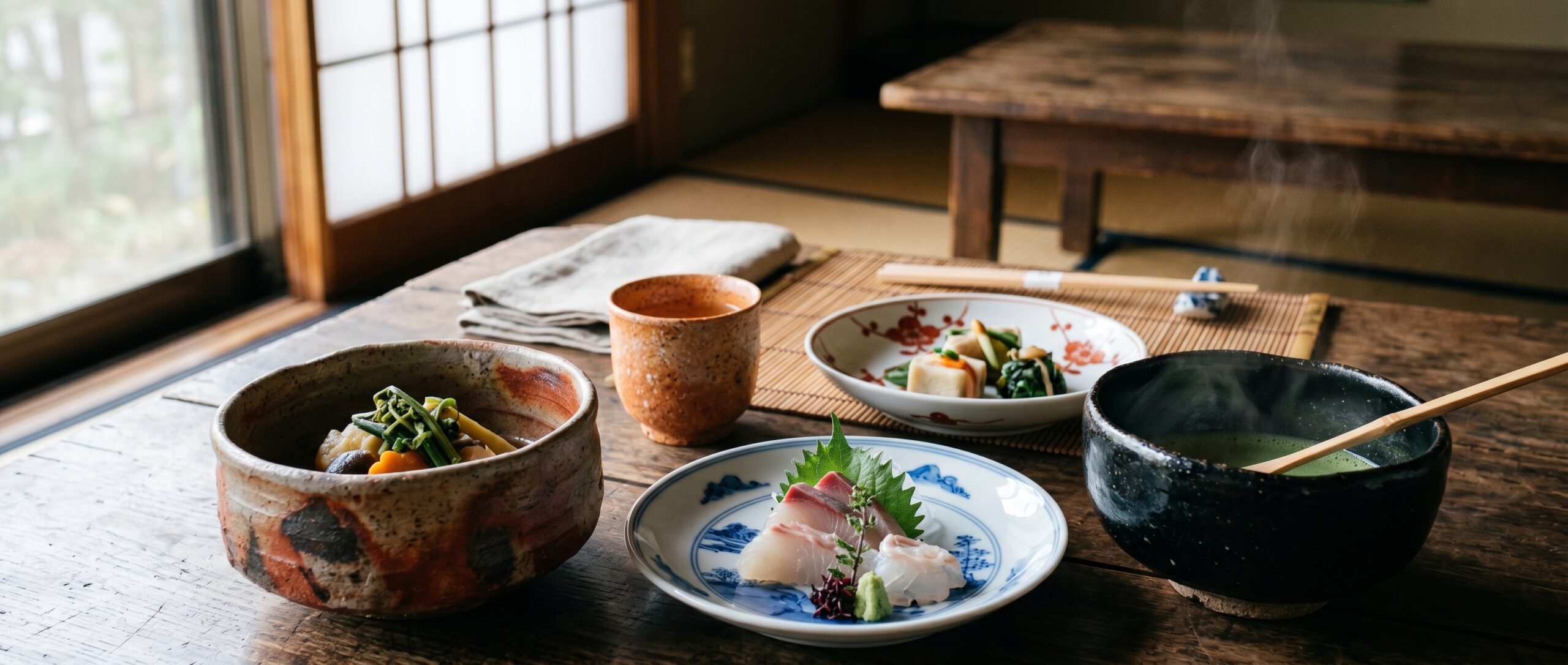
Clay, Fire, and the Food Between
An Introduction to Japanese Tōki and Jiki
In Japan, the vessel is never incidental. A kaiseki chef selecting a bowl for a simmered dish is not choosing a container — the chef is choosing the first thing the diner will see, the first thing they will touch, the context in which the food will be understood. The temperature of the clay in the hand, the texture of the unglazed rim against the lip, the way a rough, dark surface makes a single piece of pale fish appear luminous: these are not accidents of presentation. They are decisions embedded in the Japanese conviction that the vessel and what it holds are inseparable, that neither is complete without the other. That conviction is the reason Japanese ceramic culture is what it is. And it began more than fifteen thousand years ago.
Two Words, Many Materials
The Japanese term tōjiki (陶磁器) covers everything fired from clay or stone — what English broadly calls ceramics. Within it, Japanese makes a fundamental distinction that English collapses: tōki (陶器, pottery) and jiki (磁器, porcelain). These are not simply different styles or aesthetics. They are different materials, fired at different temperatures, producing objects with fundamentally different physical properties and different roles at the table.
Tōki is made from clay, fired at approximately 800 to 1,200 degrees Celsius. The resulting body is opaque, slightly porous, and water-absorbent when unglazed — a quality that means tōki must often be “seasoned” before first use (medome), a process of soaking the piece in starchy water or rice water to fill the pores and prevent staining. Tōki vessels feel warm to the touch, tend toward matte or semi-matte surfaces, and produce a dull sound when struck. They retain heat well and sit comfortably in the hand in a way that dense, hard porcelain does not.
Jiki is made from tōseki — crushed porcelain stone, a kaolin-rich mineral — fired at approximately 1,300 degrees Celsius or higher. At that temperature, the material vitrifies — the silica in the clay body melts and fuses, producing a surface that is non-porous, translucent when thinly formed, and distinctly harder and colder to the touch than tōki. Jiki rings clearly when struck and holds its whiteness and brilliance across centuries. It does not absorb flavors or staining; it needs no preparation before use.
Between the two, sekki (炻器, stoneware) occupies an intermediate position — fired at high temperatures like porcelain but from clay bodies rather than porcelain stone, producing a dense, vitrified result that is waterproof without glazing. Several of Japan’s most celebrated ceramic traditions, including Bizen and Shigaraki, produce work that falls into this category. In practice, the distinction between sekki and tōki can be subtle, and many classic Japanese wares sit at the boundary.
What matters for anyone encountering Japanese ceramics at the table is not the technical classification but the experiential difference: tōki warms in the hand and invites physical intimacy; jiki maintains a cool, hard precision that keeps the diner at a slight aesthetic distance. The two are used differently, placed differently in a meal, and understood differently within the tradition that produced them.
Fifteen Thousand Years of Clay
Japan has one of the oldest ceramic traditions in the world. The earliest known Japanese pottery dates to the Jōmon period — beginning approximately 10,500 BCE — making it among the oldest fired ceramics yet found anywhere on earth. Jōmon pottery (the name means “cord-marked,” for the patterns pressed into wet clay before firing) was shaped by hand and fired in open bonfires at low temperatures, producing thick-walled, low-fired earthenware used for cooking, storage, and what appears to have been ritual purposes. Some pieces are elaborately decorated with flame-like crests; others are simple cooking vessels. The variety suggests that, from the very beginning, Japanese ceramic production was concerned with both function and expression.
Through the Yayoi period, the Kofun era, and into the historical periods, ceramic technology in Japan developed through repeated waves of influence from continental Asia — Korea and China in particular — each wave introducing new techniques, new materials, and new forms. The introduction of the potter’s wheel, kiln construction methods that allowed higher firing temperatures, and eventually the use of glaze all arrived from the continent. Each was absorbed, modified, and reinterpreted within Japan’s own ceramic sensibility — which was, from early on, oriented toward vessels for use rather than decoration alone.
The term most commonly used in Japan for ceramics — yakimono (焼きもの), “fired things” — reflects this emphasis. A yakimono is defined by its having passed through fire; the fire is what makes it what it is. The transformation from raw clay to fired vessel is not merely mechanical. In Japanese ceramic culture, it has always been understood as something that involves unpredictability, irreversibility, and a collaboration between the maker’s intention and the kiln’s own agency. The marks left by fire — ash deposits, color shifts, the natural glazes that develop in high-temperature wood-firing — are not imperfections to be eliminated but results to be cultivated.
The Six Ancient Kilns
By the medieval period, distinct regional ceramic traditions had established themselves across Japan, each shaped by local clay deposits, available fuel, and the demands of nearby markets and religious communities. Six of these traditions are recognized as the Nihon Rokkoyo — the Six Ancient Kilns of Japan — a designation that acknowledges their continuous operation from the Heian or Kamakura period to the present.
They are Seto (Aichi), Tokoname (Aichi), Shigaraki (Shiga), Echizen (Fukui), Tamba (Hyogo), and Bizen (Okayama). Each produced utilitarian stoneware for ordinary use — storage jars, sake vessels, cooking pots — before the tea ceremony elevated their output into objects of aesthetic contemplation. What they share is an emphasis on the qualities of unglazed or minimally glazed clay at high temperatures: the natural ash glazes that form when kiln ash deposits on the surface during wood-firing; the color variations produced by iron in the clay body; the textures of specific regional clays that no other location can replicate.
Bizen ware is the most extreme expression of this aesthetic. Produced in Okayama Prefecture from a single local clay body — dense, iron-rich, and non-plastic — Bizen is fired unglazed in wood-burning kilns for ten to fourteen days at temperatures around 1,200 degrees Celsius. The color and surface patterns that result — warm rust reds, grey-browns, patches of amber where ash has settled — cannot be planned or predicted in detail. Each piece emerges from the kiln unique, marked by its specific position in the firing and the particular path taken by ash and flame. The rustic quality of Bizen made it popular for use in the Japanese tea ceremony. A Bizen sake cup cools sake more slowly than thin porcelain; a Bizen flower vase is said to keep cut flowers alive longer. Whether or not these qualities can be scientifically verified, they reflect the Japanese understanding that the vessel and its contents are in active relationship.
Shigaraki ware, from Shiga Prefecture near Lake Biwa, uses a coarse local clay containing larger particles of feldspar that melt during firing to produce glistening specks on the surface — like stars in the clay. The warm orange tones of Shigaraki clay, combined with natural ash glazes in grey and brown, produce surfaces of particular depth. Shigaraki is also associated with the tanuki (raccoon dog) figurines found outside shops and restaurants across Japan, believed to bring good fortune — a reminder that even Japan’s most serious ceramic tradition has a thoroughly popular dimension.
The Tea Ceremony and the Transformation of Value
The single most important event in the history of Japanese ceramics was the rise of the tea ceremony (sadō or chadō) as a high cultural practice in the 15th and 16th centuries — and specifically the transformation of that ceremony under the tea master Sen no Rikyū (1522–1591). Rikyū’s tea aesthetic — known as wabicha — made a deliberate turn away from the polished Chinese wares that had been the status objects of previous tea culture, toward simple, unglazed Japanese stonewares that had been used as utilitarian vessels for farmers.
Many of the Japanese-made ceramics used in the tea ceremony are unglazed stonewares first intended as utilitarian vessels for farmers, made at kilns including Shigaraki and Bizen. By the authority of the leading tea masters, these objects were elevated to the same level as ancient Chinese treasures. This aesthetic, which celebrates austerity, spontaneity, and apparent artlessness, is known as wabi. The implications for Japanese ceramic culture were enormous and permanent. Objects valued for their imperfections, asymmetries, and evidence of the making process became objects of the highest aesthetic consideration. A bowl with an uneven rim, a glaze that ran unexpectedly, a dent left by the kiln shelf — these became marks of authenticity rather than defects.
The most direct expression of this philosophy is Raku ware. In the 16th century, Rikyū asked a tile-maker named Chōjirō to produce hand-molded tea bowls for use in the wabi-styled ceremony that was Rikyū’s ideal. Unlike wheel-thrown ceramics, Raku bowls are formed entirely by hand — pressed, pulled, and shaped finger by finger — and fired at low temperatures, then removed from the kiln while still glowing hot and allowed to cool in open air. The result is a bowl of exceptional individuality: slightly irregular, thick-walled, warm in the hand, and absorptive of the matcha’s color and warmth in ways that smooth porcelain is not. The name “Raku” — meaning ease or enjoyment — was bestowed upon Chōjirō’s descendants by the warlord Toyotomi Hideyoshi, cementing the tradition’s place in Japanese cultural history. The Raku family continues to produce tea bowls today, in direct descent from Chōjirō, making it one of the oldest continuous craft lineages in Japan.
The Birth of Japanese Porcelain
For most of its ceramic history, Japan produced only pottery and stoneware. Porcelain — the white, translucent, vitrified material that China had been producing since the Tang dynasty — was imported from the continent and treated as a luxury beyond Japanese production capability. That changed in the early 17th century, in the Arita region of Kyushu.
Around 1616, a Korean potter named Yi Sam-pyeong, who had been brought to Japan following Toyotomi Hideyoshi’s invasions of Korea in the 1590s, discovered deposits of the high-quality porcelain stone needed to produce true white porcelain in the hills near Arita, in present-day Saga Prefecture. This discovery initiated the production of Japanese porcelain — and, over the following decades, one of the most consequential chapters in the global history of ceramics.
Arita ware developed rapidly through the 17th century, progressing from simple blue-and-white underglaze designs to the elaborately decorated overglaze enamel styles that made it famous. By the mid-17th century, Arita had transformed into a major export product, carried aboard Dutch East India Company ships through the port of Imari — hence the name Imari ware that became synonymous internationally with Japanese porcelain. The timing was favorable: China’s transition from Ming to Qing dynasty had disrupted Chinese porcelain exports, and European courts and aristocracies, already in the grip of a passion for East Asian ceramics known as chinoiserie, turned to Japan to meet their demand.
Within Arita’s production, three styles achieved particular significance. Ko-Imari (Old Imari) featured luxurious combinations of underglaze blue with overglaze red, gold, and black enamel — ornate, layered, designed for European tastes accustomed to elaborate decorative objects. Kakiemon, developed by the potter Sakaida Kakiemon and his descendants from around the 1660s, used a milky-white ground (nigoshide) and sparse, asymmetric arrangements of motifs — red squirrels, flowering plum, bamboo — in a palette of soft red, blue, yellow, and green. The elegance of Kakiemon, with its emphasis on empty space as a compositional element, was enormously influential in Europe: Meissen, Sèvres, Bow, and Chelsea all produced pieces that directly imitated it. In the 18th century, many areas across Europe started making porcelain that imitated the Kakiemon design. Nabeshima ware, produced under strict supervision for the Nabeshima clan and presented as gifts to the shogunate and regional lords, represents the most technically controlled of the three — precise, formal, and never intended for commercial export.
While Arita dominated porcelain production, Kutani ware from Ishikawa Prefecture developed its own identity — characterized by bold, saturated colors and large-scale designs covering almost the entire surface of the vessel. The Kutani palette — deep red, green, yellow, purple, and blue — produces an effect of intensity and density that is the aesthetic opposite of Kakiemon’s restrained elegance. Both are expressions of Japanese porcelain at its most confident, each in a completely different register.
The Vessel and the Food: A Philosophy of the Table
Understanding why Japanese ceramic culture developed as it did requires understanding how vessels function in Japanese food culture. The Japanese table is not organized around a single large shared surface with separate serving dishes. It is organized around individual place settings — each diner receives their own bowls, plates, and cups, selected and arranged by the cook to complement the specific dishes being served. A kaiseki meal may employ twenty or more distinct vessels across its courses, each chosen for its color, texture, form, and seasonal reference in relation to the food it will carry.
This means that the selection of tableware is itself a creative act. A rough, dark Bizen sake cup makes sake look different — and taste different, according to some — from the same sake served in white Arita porcelain. A piece of pale fish against the irregular surface of a Shigaraki plate appears differently than against the geometric precision of a Nabeshima dish. The cook’s choice of vessel is an extension of the cook’s intentions for the dish.
The concept of yō no bi (用の美) — the beauty of utility — runs through Japanese ceramic aesthetics at all levels. A vessel is complete only when it is used; its beauty is most fully expressed in the act of serving, holding, and drinking from it. This conviction explains why Japan has produced some of the world’s greatest ceramic art in the form of objects intended for eating, drinking, and cooking rather than display — and why the most celebrated Japanese potter of the 20th century, Hamada Shōji, considered himself a craftsman first, a maker of usable objects, rather than an artist in the Western sense.
It also explains the seasonal dimension of Japanese tableware. At a formal meal, the vessels change with the calendar: summer calls for cool blue-and-white porcelain, glass, or celadon — materials that suggest freshness and light; winter calls for warm, heavy stoneware in earth tones that retain heat and invite the hands to cup them for warmth. The same soup, served in a thin white porcelain bowl in August and in a thick dark Bizen bowl in January, is a different experience. The vessel does not simply carry the food. It carries the season.
Quick Reference: Tōki vs. Jiki — Key Distinctions
| Tōki (陶器) — Pottery | Jiki (磁器) — Porcelain | |
|---|---|---|
| Raw material | Clay | Porcelain stone (kaolin-rich mineral) |
| Firing temperature | ~800–1,200°C | ~1,300°C and above |
| Opacity | Opaque | Translucent when thin |
| Porosity | Porous when unglazed; requires seasoning | Non-porous; no preparation needed |
| Surface feel | Warm, textured, matte to semi-matte | Cool, smooth, hard |
| Sound when struck | Dull thud | Clear ring |
| Aesthetic character | Wabi — rustic, natural, irregular | Precision, luminosity, decorative potential |
| Representative styles | Bizen, Shigaraki, Raku, Hagi | Arita / Imari, Kakiemon, Nabeshima, Kutani |
| Seasonal association | Autumn, winter — warmth and weight | Spring, summer — light and coolness |
A piece of Japanese pottery is not finished when it leaves the kiln. It is finished when it is used — when food is placed in it, when hands hold it, when the meal it was made for finally happens. The long history of Japanese ceramics is, in this sense, not a history of objects but a history of experiences: of green matcha against the darkness of a Raku bowl, of pale fish luminous against Bizen clay, of blue-and-white Arita porcelain carrying the cold clarity of a summer dish. Every fired thing has been waiting for that moment. That is what yō no bi means: that use is not the vessel’s diminishment. It is its completion.
Comment