Before Soy Sauce
The Ancient World of Japanese Fish Sauce
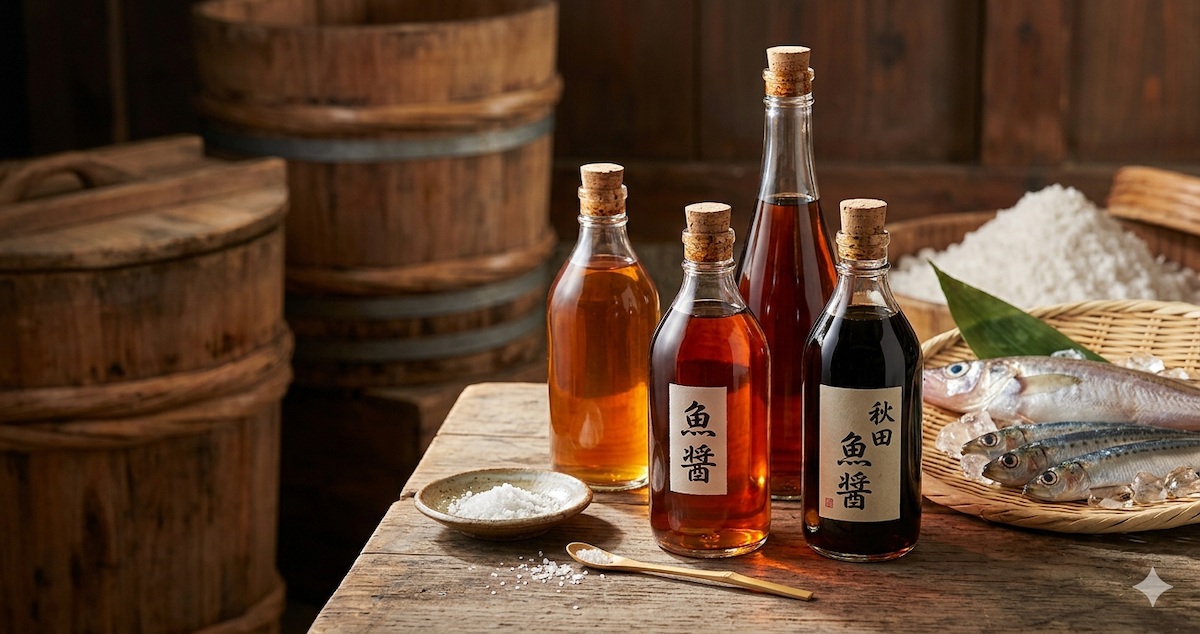
Soy sauce is so central to Japanese cuisine that it is easy to assume it has always been there — that Japanese cooking and the dark, savory liquid in that ceramic bottle are inseparable. They are not. For much of Japan’s culinary history, the dominant liquid seasoning was not derived from soybeans but from fish. It was called gyoshō, and in coastal communities across the country, it was as fundamental to the kitchen as salt itself. That seasoning still exists. In three regions of Japan, artisans are still making it by methods that have not changed in centuries. Understanding gyoshō means understanding a layer of Japanese food culture that soy sauce eventually covered — but never entirely erased.
What Gyoshō Is
Gyoshō (魚醤) is the Japanese term for fish sauce — a liquid condiment produced by fermenting fish or seafood with salt over an extended period, typically between several months and several years. The word combines gyo (魚, fish) and shō (醤), the character used for fermented pastes and sauces — the same character found in shōyu (soy sauce). The lineage embedded in that shared character is not accidental.
The process by which gyoshō is made is called autolysis: enzymes naturally present in the fish’s own flesh and viscera begin to break down proteins into amino acids when the fish is salted and sealed from oxygen. Over months and years, this self-digestion produces a liquid dense with free glutamic acid — the molecule responsible for the sensation of umami. The salt draws moisture from the fish through osmosis, concentrates the fermentation, and prevents the growth of putrefactive bacteria. What begins as whole fish and coarse salt becomes, through time alone, one of the most concentrated sources of savory flavor that fermentation can produce.
This transformation is not unique to Japan. Fish sauces have been produced independently across many cultures: the ancient Roman garum, made from mackerel and other oily fish fermented in unglazed jars under the Mediterranean sun, was a staple condiment of the Roman empire from at least the 1st century BCE. Thai nam pla, Vietnamese nước mắm, Korean aekjeot — these are all expressions of the same fundamental discovery, made independently, that fish and salt and time produce something greater than any of them alone. What distinguishes Japanese gyoshō is not the principle but the expression: the specific fish, the specific terroir, and the particular flavors those regional conditions produce.
The History: A Condiment Older Than Soy Sauce
The oldest anthology of Japanese poetry, the Man’yōshū (compiled in the late 8th century), contains references to mixing crabs with salt and preserving fish in salt for use as seasoning — evidence that the Japanese were already familiar with gyoshō-type condiments well before the formalization of their food culture. The term hishio (醤) was used in ancient Japan as a generic name for preserved, fermented seasonings. Fish hishio — gyobishio — was one of its most important categories, along with meat-based and grain-based varieties. The Yōrō Code of 718, which regulated the administration of the Japanese state, stipulated how hishio was to be produced and distributed, indicating that fish-based fermented sauces were already a regulated part of official provisioning.
The arrival of Buddhism in Japan during the 6th and 7th centuries introduced vegetarianism as a dietary ideal for the ruling class and the monastic community, and brought with it Chinese soy-based fermented foods — the predecessors of what would become miso and, eventually, shōyu. Over the following centuries, grain-based sauces derived from soybeans gradually displaced fish-based ones among the aristocracy and temple communities. The logic was both religious and social: soy sauce aligned better with Buddhist dietary restrictions, and its production could be centralized and industrialized in ways that hyperlocal fish sauces could not.
By the Edo period (1603–1868), soy sauce had become the dominant liquid seasoning across most of Japan. But in the fishing communities of the coastline — particularly along the Sea of Japan, where fish were abundant and winter cold provided ideal fermentation conditions — gyoshō survived. Before soy sauce reached the fishing villages of Akita and the Noto Peninsula as an affordable commodity, almost every household in those communities was said to have made its own fish sauce. It was the seasoning of the kitchen, the base of the soup, the fundamental umami of daily cooking. Soy sauce came later, and it came from the cities.
The 20th century was difficult for gyoshō. Industrialization, urbanization, the standardization of the national food supply around soy sauce, and the demographic decline of Japan’s fishing communities all reduced production drastically. By the late 20th century, the tradition had contracted to a tiny number of producers in a handful of locations, some on the verge of disappearing entirely. What has happened since is a story of deliberate revival — of researchers, producers, and chefs recognizing what was being lost and working to preserve it.
The Three Great Japanese Fish Sauces
Japan’s coastline stretches nearly 30,000 kilometers, and fish sauces were historically made across much of it. Today, three regional varieties are recognized as the canonical representatives of the tradition. Each uses a different fish, comes from a different region, and produces a flavor profile that is distinctly its own.
Shottsuru (しょっつる) — Akita Prefecture
Shottsuru is produced in Akita Prefecture on the Sea of Japan coast of northern Honshu, and is made primarily from hatahata — the sailfin sandfish (Arctoscopus japonicus), a cold-water species caught in large numbers in the Sea of Japan during winter. Hatahata has a particular place in Akita’s food culture: the fish arrives in the sea off Akita in enormous schools in late autumn and early winter, and its seasonal appearance has long marked the beginning of the preservation season in the region’s fishing communities.
Traditional shottsuru production begins with removing the heads, entrails, and tail fins from the fish, washing them, and layering them in wooden barrels with salt and rice malt (koji). The ratio is approximately ten kilograms of fish to around 1,800 milliliters each of rice malt and salt. The barrels are sealed, weighted, and stored in a cool, dark place. The fermentation period is long — approximately three years for a fully matured product. After fermentation, the liquid is filtered and briefly boiled. The koji in the shottsuru recipe contributes additional enzymes and amino acids to the fermentation, producing a result that is slightly milder and more complex than fish-salt-only methods.
The flavor profile of shottsuru is among the mildest of the three great gyoshō — relatively clean and light, with a delicate marine character that becomes richer and sweeter when heated. It is the traditional base of shottsuru nabe, a hot pot dish considered the canonical local cuisine of Akita, in which the fish sauce seasons a broth alongside hatahata, tofu, and vegetables. The fish sauce aroma, pungent when cold, largely dissipates with heat, leaving the umami behind.
By the late 20th century, production of authentic shottsuru had declined to near extinction, with only a single major producer remaining. A revival effort — including research into traditional methods, the involvement of young brewers, and the designation of shottsuru as a regional specialty — has gradually restored the tradition, though production volumes remain small.
Ishiru / Ishiri (いしる / いしり) — Noto Peninsula, Ishikawa Prefecture
Ishiru (also spelled ishiri, yoshiru, or yoshiri, with local variations in usage) is produced on the Noto Peninsula — a narrow finger of land jutting into the Sea of Japan from Ishikawa Prefecture — and represents perhaps the most complex and distinctive of the three great gyoshō. Its name is a contraction of io (fish) and shiru (soup or liquid), meaning simply “fish liquid.”
What makes ishiru unusual is the variation within the tradition based on geography within the peninsula itself. The west coast of Noto traditionally produces ishiru from the viscera of sardines (iwashi), mackerel, and horse mackerel — the internal organs rather than the whole fish, which concentrates the enzymatic activity and produces a more intensely flavored, darker sauce. The east coast has traditionally used the viscera of Japanese flying squid (surume ika), which produces a different flavor entirely: inkier, more mineral, and with a pronounced oceanic depth that is unlike any other fish sauce. Both coasts ferment with approximately 30% salt by weight — about four parts fish to one part salt — for between seven and nine months.
The result is the most assertive of the three great gyoshō — robust, complex, and deeply umami-forward, with an aroma that is pronounced when raw but transforms significantly with cooking. Ishiru is used in Noto cuisine across a wide range of preparations: as a soup base, as a seasoning for simmered dishes, and drizzled over ingredients in ways that parallel the use of soy sauce elsewhere. In Noto’s food culture, ishiru occupies the position that soy sauce holds in Kyoto or Tokyo — the default liquid seasoning, the medium through which the sea expresses itself in the kitchen.
Ikanago Shōyu (いかなごしょうゆ) — Kagawa Prefecture
Ikanago shōyu is produced in the Bisan area along the Seto Inland Sea coast of Kagawa Prefecture, and differs from the other two great gyoshō in both its raw material and its production method. Ikanago — the Japanese sand lance (Ammodytes japonicus) — is a small, thin, silver fish caught in late winter and spring in the shallow waters of the Seto Inland Sea. It is the same fish used to make ikanago no kuギsoni, a spring delicacy of the Kobe-Akashi region in which the fish are simmered in a sweet soy sauce glaze.
The production of ikanago shōyu is distinctive: rather than salt alone as the fermenting medium, the fish are mixed with existing soy sauce at a ratio of approximately two parts fish to one part shōyu, then left to ferment for a minimum of 100 days before the liquid is extracted and filtered. This method — fermenting fish within soy sauce rather than with salt — produces a result that bridges gyoshō and shōyu: a sauce with the deep, layered umami of fish fermentation combined with the familiar flavor base of soy sauce. The result is somewhat more approachable than shottsuru or ishiru for those encountering gyoshō for the first time, and it integrates naturally into cooking contexts where soy sauce would ordinarily be used.
What Gyoshō Tastes Like — And How to Cook With It
First-time encounters with gyoshō often begin with the aroma — and the aroma, undiluted, is powerful. It is the smell of the sea concentrated and aged: briny, intensely savory, and unmistakably fermented. For those who have encountered Southeast Asian fish sauces, Japanese gyoshō occupies a similar register but with some meaningful differences. Japanese gyoshō — particularly shottsuru — tends to be lighter in color (golden to amber rather than dark brown), more delicate in aroma when cooked, and less aggressively pungent in the finished dish than Thai or Vietnamese fish sauces. Ishiru, particularly the squid variety, is more assertive and complex. The range within Japanese gyoshō is wide.
The key principle in cooking with gyoshō is heat. The raw aroma dissipates substantially when the sauce is heated, leaving behind pure umami depth without the oceanic sharpness. This is why gyoshō is particularly valuable in cooked applications: simmered dishes, hot pots, soups, braised vegetables, and warm sauces. A few drops added to a bowl of dashi-based broth deepens the soup’s savory foundation without making it taste specifically of fish. Added to a sauté of mushrooms or root vegetables, it amplifies the natural umami of the ingredients in a way that neither salt nor soy sauce achieves in quite the same way.
In raw or minimally cooked applications, gyoshō is used in small quantities as a finishing seasoning — a few drops over cold tofu, sashimi, or grilled fish, where its concentrated flavor acts as a punctuation rather than a base note. It can also be used as a substitute for soy sauce in dipping sauces and dressings, where it contributes a more complex, mineral quality. The rule of thumb is to start with less than you think you need: gyoshō is far more concentrated than soy sauce, and a single teaspoon delivers more umami than a tablespoon of most soy sauces.
Beyond traditional Japanese preparations, gyoshō functions as a natural partner for any cooking that benefits from anchovy-type umami depth — pasta, roasted vegetables, grains, legumes, egg dishes. Its amino acid profile is close to that of Worcestershire sauce and fish-based Southeast Asian condiments, and it integrates seamlessly into cooking that has no specifically Japanese intention. This versatility is part of why gyoshō has attracted attention from chefs outside Japan in recent years: it is a deeply useful condiment that operates quietly, boosting depth without announcing its presence.
The Science of the Flavor: What Fermentation Actually Produces
The umami intensity of gyoshō is not a culinary trick. It has a specific biochemical explanation. During the fermentation process, proteolytic enzymes present in the fish’s muscle tissue and viscera break down proteins into their constituent amino acids. The most flavor-active of these is glutamic acid — the amino acid responsible for umami, which the human tongue detects through specific taste receptors as a deep, savory sensation that amplifies other flavors and extends their persistence on the palate.
Well-fermented gyoshō contains extremely high concentrations of free glutamic acid — often higher than soy sauce, and produced entirely through natural enzymatic activity without the addition of any flavor enhancers. This is what artisan producers mean when they describe their fish sauce as “just fish and salt”: the complexity of the flavor does not come from added ingredients but from the chemistry of the fish itself, released by time and salt. The longer the fermentation — and the highest-quality gyoshō is fermented for two to three years — the more complete the protein breakdown, and the more concentrated and rounded the umami becomes.
Alongside glutamic acid, fermentation produces a range of volatile aromatic compounds — the specific combination of which varies by fish species, salt ratio, fermentation temperature, and duration, and is responsible for the distinctly different aromatic profiles of shottsuru, ishiru, and ikanago shōyu. The science and the craft converge at the same point: the specific character of each gyoshō is inseparable from where it comes from.
A Tradition Being Reclaimed
The current moment in Japanese gyoshō production is one of deliberate revival. In Akita, the number of shottsuru producers has grown from its near-extinction low, supported by regional food promotion efforts, academic research, and the involvement of a generation of young brewers interested in traditional fermentation. In Noto, the 2024 earthquake that devastated the Noto Peninsula disrupted production in several of the region’s remaining ishiru breweries, and the recovery of those producers has become a matter of cultural as well as economic concern.
Interest from outside Japan has played a role in this revival. As fermented condiments attracted broader culinary attention globally — driven partly by the influence of Nordic cuisine’s anchovy and fermented fish traditions, partly by the worldwide growth of interest in umami as a flavor concept — Japanese gyoshō attracted notice from chefs and food writers who recognized it as one of the world’s great fermented condiments and one of its least known.
The trajectory that gyoshō describes — from ancient condiment, to displaced tradition, to near disappearance, to deliberate recovery — is a pattern familiar across Japanese food culture, and one that Waden exists to document. Foods that require time, craft, and specific local conditions are always vulnerable to industrialization. They survive when enough people understand what they are and why they matter. Gyoshō has survived. It deserves to be understood.
Quick Reference: Japan’s Three Great Gyoshō
| Shottsuru (しょっつる) | Ishiru / Ishiri (いしる) | Ikanago Shōyu (いかなごしょうゆ) | |
|---|---|---|---|
| Region | Akita Prefecture | Noto Peninsula, Ishikawa Prefecture | Bisan area, Kagawa Prefecture |
| Primary ingredient | Hatahata (sailfin sandfish) + koji | Sardine / squid viscera | Ikanago (sand lance) + soy sauce |
| Fermentation period | ~3 years | 7–9 months | Minimum 100 days |
| Flavor character | Mild, clean, delicate marine depth | Bold, complex, intensely savory | Rounded, approachable, bridges fish and soy |
| Color | Golden amber | Dark amber to deep brown | Dark brown |
| Best used for | Hot pot (nabe), soups, braises | Soups, simmered dishes, finishing | Dressings, dips, general seasoning |
Gyoshō is what Japanese kitchens tasted like before the soybean arrived. It is older than soy sauce, older than most of what we recognize as Japanese cuisine, and it carries within it a particular kind of knowledge: that the sea and salt and time are sufficient to produce something extraordinary, without intervention, without complexity of method. The fisherman who first sealed hatahata in a barrel of salt and returned months later to find a golden, savory liquid did not need to understand proteolysis or free glutamic acid to know that something remarkable had happened. The fish had become more than fish. That is, in essence, what fermentation does. And gyoshō is one of its oldest and most direct expressions.
Comment