The Country That Forgot How to Make Salt: Japan, the Sea, and the Salt on Your Shelf
Japan is an archipelago with no rock salt, no salt lakes, and a climate too wet to dry seawater in the sun. For two thousand years it solved that problem with extraordinary ingenuity — and then, in a single year in the 1970s, abolished every salt field it had. What grew back in its place is a shelf of four thousand products and almost no way to tell them apart.
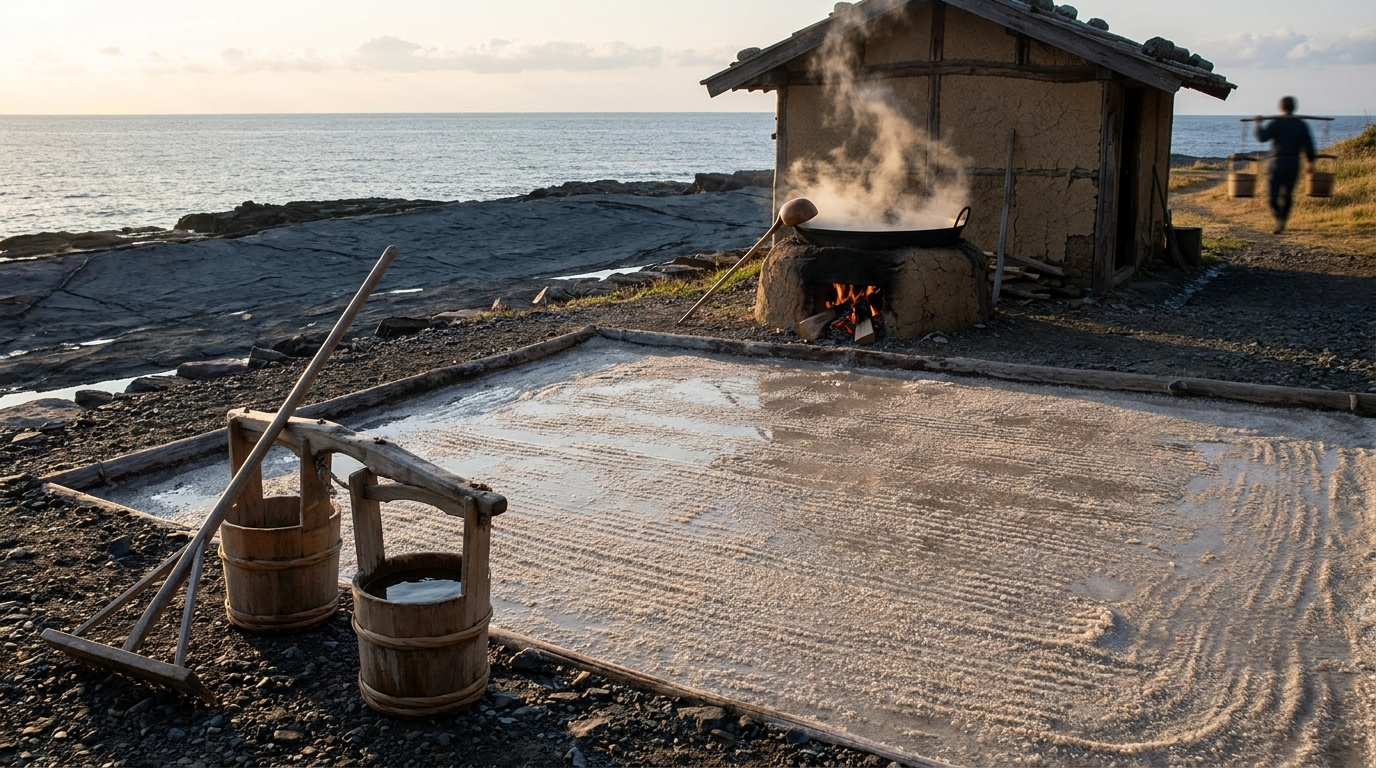
On a stretch of coast at the northern tip of the Noto Peninsula, a man carries two wooden buckets on a shoulder pole up a slope from the sea, and throws the water onto sand. He will do this for hours. The salt field is about the size of a tennis court, laid with clay and dressed with fine sand, and over a summer’s day it will take something like a tonne of hand-carried seawater. What comes out at the end, after the sand is raked and gathered and rinsed and the resulting brine is boiled all night over a wood fire, is a few dozen kilograms of salt.
It is an absurd way to make a commodity that costs a hundred yen a kilo at any supermarket. It is also the last surviving example of the oldest salt-making technique in Japan, and the reason it survives is a small legal exemption inside a state monopoly that lasted ninety-two years and very nearly erased the whole craft.
An Island Nation With a Salt Problem
Start with the geology, because everything else follows from it. Roughly seventy percent of the world’s salt comes from something other than the sea — rock salt mined from ancient buried evaporite beds, brine pumped from underground, salt lakes. Japan has none of these in usable quantity. Every grain of salt the country has ever produced domestically has come out of seawater, which is about three percent salt and ninety-seven percent water you have to get rid of.
Elsewhere on the planet you get rid of it with sunlight. Solar salt fields in Mexico and Australia flood shallow ponds and let months of dry heat do the work, which is why those two countries supply most of the salt Japan imports today. Japan cannot do this. The rainy season arrives precisely in the months when evaporation would be strongest, and the humidity across most of the archipelago is high enough that seawater sitting in a pond will not reliably crystallise before the next rainfall dilutes it.
So Japanese salt-making split into two operations that had to be solved separately, and the vocabulary reflects it. Saikan is the concentration stage: getting seawater from three percent up to something in the high teens or low twenties. Sengō is the boiling stage: taking that concentrated brine and driving off the rest of the water with fire. Every technical advance in two thousand years of Japanese salt history is an advance in one or the other. And because the second stage requires enormous quantities of fuel, the geography of salt in Japan is also a geography of firewood.
Burning Seaweed on the Inland Sea
The earliest solution used seaweed, and we know about it mostly from broken pottery.
From the late Jōmon period, roughly four thousand years ago, coastal communities were concentrating brine by soaking and drying seaweed repeatedly — the salt accumulating on the fronds with each cycle — then washing it off into a smaller volume of very salty water and boiling that down in dedicated earthenware vessels. Around the Seto Inland Sea the practice ran from the middle Yayoi period through the Heian, and the archaeological sites there are littered with the discarded salt-making pottery, thousands of vessels at a time, which is how we know the salt was being made at concentrated production sites and carried inland rather than made everywhere.
The Man’yōshū, the eighth-century poetry anthology, refers to it repeatedly — tamamo, jewelled seaweed, gathered in the morning calm and burned for salt in the evening calm. But no document survives explaining how it was actually done. The technique had been dead for a millennium.
It was reconstructed, remarkably, in living memory. In 1984, during construction work on Kami-Kamagari Island in Hiroshima Prefecture, Kofun-period salt-making pottery turned up at the Okiura site. A local Buddhist priest and cultural properties officer named Nobuhide Matsuura, who had been doing archaeology for thirty years, started asking historians how the vessels had been used and was told, consistently, that nobody knew. Working from the word tamamo in the Man’yōshū poems — jewelled seaweed, meaning the beaded fronds of Sargassum — he spent more than a decade experimenting. The method he arrived at soaks Sargassum in seawater, dries it, and repeats until the brine is concentrated, then boils it in earthenware. It was accepted by an academic symposium on ancient salt production, and in 1998 a factory went up on the same beach where the pottery had been found. Matsuura was later given a government citation as, essentially, the man who cracked ancient Seto Inland Sea salt.
The salt is pale beige rather than white, and tastes rounder and less aggressive than refined salt — a consequence of the magnesium and other minerals carried over from the seaweed and the brine. Whether this is precisely what people ate in the seventh century is unknowable. It is, at minimum, a serious attempt.
No document survived explaining how ancient salt was made. It took a rural priest ten years of experiments, and a single line of eighth-century poetry, to work it back out.
The Sand Revolution
By the Nara period, seaweed had been replaced by something better: sand.
The insight is that a beach is an enormous surface area for evaporation, and that damp sand exposed to sun and wind will develop salt crystals on every grain. Gather that sand, pile it into a filtering box called a nui, pour seawater through it, and the water dissolves the accumulated crystals on its way down. What comes out the bottom is dramatically saltier than what went in — and you have concentrated a large volume using nothing but sunlight and labour.
The first proper salt fields, agehama or “lifted beach,” are built above the high-water line, which means every drop of seawater has to be carried up by hand. They are small, weather-dependent, and impossible to work in winter or rain. They are also brutally labour-intensive, which is why almost every one of them eventually disappeared.
The improvement came on the Inland Sea. An irihama or “entering beach” field is built at a level between high and low tide, ringed with a sea wall and laced with channels, so that seawater flows in through sluices at high tide and soaks the field from below by capillary action. No carrying. The tide does the lifting. Ako, in modern Hyōgo Prefecture, is where the developed form of this was perfected under the Asano lords in the seventeenth century — the domain progressively reclaiming tidal flats until, by the end of the Edo period, the eastern and western fields together covered around four hundred hectares and produced something on the order of eight percent of all the salt in Japan. The technique spread across the Inland Sea, and by the late Edo period that one region was making roughly eighty percent of the country’s salt.
Ako’s two halves made different products, for reasons that were purely local hydrology. The western fields, diluted slightly by fresh water from the Chikusa River, yielded brine low in bittern and produced mashio — clean, high-purity salt, shipped to Osaka and Kyoto and burned at high temperature to make a premium table salt. The eastern fields specialised in sashijio, made by returning bittern-rich liquid into the boiling pans to raise yield at the cost of purity, and shipped it by coastal freighter to Edo and the northeast for pickling and food processing. Two grades of salt, from two ends of the same beach, sold into two different markets.
It is worth pausing on that, because it is the earliest clear evidence that Japanese cooks distinguished between salts on purpose. The premium grade went where salt would be tasted. The mineral-heavy grade went where salt would be doing work — drawing water out of vegetables, holding a barrel of fish stable through a summer. Four hundred years later that is still, almost exactly, the right way to think about it.
Ninety-Two Years of State Control
In June 1905, in the middle of the Russo-Japanese War, the Meiji government made salt a state monopoly.
The stated reasons were twofold and both real. Cheap high-quality foreign salt was arriving after the opening of the ports and threatening a domestic industry that was still producing a great deal of low-purity sashijio; and the war was catastrophically expensive. Salt is the classic object of a revenue monopoly because everybody has to buy it.
What followed was seventy years of consolidation, and the state was explicit about it. The First Salt Industry Reorganisation of 1910–11 eliminated some thirteen thousand four hundred producers and eighteen hundred hectares of salt field. The Second, in 1929–30, removed sixteen hundred more producers and twelve hundred hectares. The Third, in 1959–60, took out another two thousand hectares as the industry converted from irihama to flow-down fields — a change the monopoly’s own history describes as destroying the harsh, skilled salt-field labour of the early modern period, cutting labour by ninety percent while doubling or tripling output.
Then came 1971. Ion-exchange membrane technology had matured: rather than evaporating seawater at all, you pass an electric current through it across selective membranes and pull the sodium and chloride ions into a concentrated stream. It is efficient, weather-proof, and requires no beach. The Fourth Reorganisation converted the entire national concentration stage to ion-exchange membranes, and twenty-two hundred hectares of salt field vanished. The monopoly’s own account calls it a reform without precedent in the history of Japanese salt-making.
It was also a full stop. From 1972, salt fields no longer existed in Japan. Seven companies produced all of it, by membrane and vacuum pan, and essentially one hundred percent of the salt on the Japanese market until 1997 was ion-exchange salt. The product is superb by one measure — very pure sodium chloride, consistent, cheap — and by that measure only.
The monopoly ended in April 1997, ninety-two years after it began, replaced by the Salt Business Act and a market that is in principle free. Everything discussed in the second half of this article — the choosing, the labels, the four thousand products — is younger than that. Two generations of Japanese cooks grew up with one salt and reasonably concluded that salt was one thing.
The Family That Kept Going
Which brings us back to the Noto Peninsula, and to the question of how any of the old technique survived at all.
In Suzu, at the northern tip of Ishikawa Prefecture, the Kadohana family have been working an agehama field — the hand-carried kind, the oldest kind — since before 1596. The salt-making tradition in the area goes back roughly two thousand years, and Noto’s fields were sustained partly because the Kaga domain protected and taxed them. Through the monopoly years the Kadohana continued, at a scale small enough and with enough recognised heritage value to persist where industrial fields were being erased. In 2008 the Agency for Cultural Affairs designated “the technique of agehama-style salt production in Noto” an Important Intangible Folk Cultural Property, one of only a small number of designations in the folk-technology category; the tools themselves — a hundred and sixty-six of them — had already been designated as Important Tangible Folk Cultural Property back in 1969.
Then, on the first of January 2024, the Noto Peninsula earthquake struck. Along that coast the seabed rose. At Suzu the shoreline moved out by something like sixty metres, and a technique whose entire premise is that you carry seawater up from the water’s edge suddenly had a much longer walk and a stranded coastline. The salt fields cracked. Nine months later, in September, record rainfall brought landslides down over some of them. Volunteers came from across the country to dig them out. Salt-making restarted at Suzu in April 2024 with pumps drawing water from the receded sea, and the roadside salt village at Suzu resumed full production in the spring of 2025, three springs after the quake.
What is being protected there is not really a product. It is a sequence of physical judgements — how to scatter water evenly across sand, how to read the sand’s dryness, how long to hold the fire — that exist nowhere except in the hands of people who do it.
What “Natural Salt” Is Not Allowed to Say
Deregulation in 1997 produced a boom, and with it a great deal of nonsense.
Small producers appeared along coastlines all over Japan — solar evaporation in greenhouses, brine trickled down through bundles of bamboo branches in a shijōka tower to concentrate by wind, boiling in flat pans over wood. Much of it is genuinely good. But the marketing very quickly converged on a claim that the salt was “natural,” implicitly against the “chemical” industrial product, and by 2004 the Japan Fair Trade Commission had issued a formal warning about salt labelling. The industry moved to police itself: the Japan Edible Salt Fair Trade Council formed in 2008, and its Fair Competition Code took effect in 2010.
The code prohibits the words shizen-shio and tennen-shio — natural salt — along with related constructions like “natural method” or “natural crystallisation,” on the grounds that they mislead. It also bars blanket mineral boasts: “rich in minerals,” “packed with minerals.” Superlatives require documented justification, and so, interestingly, do historical claims — assert that your salt is made “the ancient way” or “as it has been for centuries” and you must be able to substantiate it. Health and beauty claims are barred outright.
In exchange, the code makes production method a mandatory disclosure, described in a fixed vocabulary of seventeen process terms printed in the order the steps occurred. Learn to read that line and the entire biography of the salt in your hand opens up.
The terms fall into four groups. For concentrating the brine: ion-maku (ion-exchange membrane), gyaku-shintōmaku (reverse osmosis), yōkai (dissolving imported salt back into water or seawater), shinshi (steeping — the seaweed step that defines moshio), tenpi (solar), and jōhatsu (evaporation). For crystallising: hiragama (open flat pan), tategama (closed vacuum or pressure vessel), spray-drying, and heated drum. For finishing: drying, milling, roasting, blending, washing, granulating. And for mined salt, saikutsu, extraction.
Read as a sequence, four common patterns emerge. Ion-maku → tategama is industrial refined salt: seawater concentrated electrically, crystallised in a vacuum evaporator, near-pure, cheap, utterly consistent. Yōkai → hiragama means Australian or Mexican solar salt redissolved in Japan and boiled here — a large share of what feels, from the front of the package, like domestic artisanal salt. Tenpi alone is an imported solar salt, washed and packed. And kaisui → hiragama, with little or nothing in between, is seawater boiled in an open pan in Japan. That last one is the expensive one, and now you can find it without reading a word of marketing copy.
Three more things the back of the bag will tell you. The raw material line uses only six permitted words — seawater, sea salt, rock salt, lake salt, hot-spring water, solar salt — and domestic products must state where the material came from. Bittern content may be declared only when magnesium exceeds 0.1 percent, which is a useful floor to know. And the small shio kōsei mark indicates that the labelling has been verified against the code; it applies to packaged consumer salt of at least 40 percent sodium chloride, so bulk and low-sodium blends fall outside it.
Two harmless oddities, while you are back there. Salt may legally omit a best-before date, because it does not meaningfully change. And the nutrition panel reads zero for energy, protein, fat and carbohydrate, because salt is an inorganic mineral — the only number that means anything is the sodium.
What the Minerals Actually Do
Which leaves the central question of the whole premium salt market: does the bittern matter?
It does, but not in the direction most people assume, and the evidence is unusually clean. Yuka Endo and Kyoko Ishikawa, working at Akita Prefectural University and publishing in the Bulletin of the Society of Sea Water Science in 2015, took the individual bittern compounds and added them one at a time to a 0.8 percent salt solution — roughly the salinity of a clear soup — then ran triangle tests with trained panels alongside instrumental taste-sensor measurement.
First, the detection thresholds. Potassium chloride and sodium sulphate became perceptible at 0.08 percent. Magnesium sulphate at 0.04 percent. Magnesium chloride only at 0.16 percent. Below those levels, panellists could not tell the doped solution from plain salt water at all.
Then the direction of the effect, which is the surprise. Potassium chloride and sodium sulphate made the solution taste saltier and deeper as their concentration rose. Both magnesium compounds made it taste less salty. The sensor explained why: the magnesium salts lit up the mineral-bitterness channel far more strongly than anything else tested, and that bitterness masks saltiness rather than enriching it. Magnesium is not adding roundness so much as subtracting sharpness by getting in the way.
That is a real effect and, in small doses, a pleasant one — the “softness” people describe in a good sea salt is substantially this. But note the arithmetic. Commercial salts measured by the same group carried magnesium chloride at around 0.013 percent and magnesium sulphate at around 0.01 percent, an order of magnitude below the thresholds where a trained panel could find them. A great deal of expensive salt sits in that range. The minerals are genuinely present, honestly declared, and undetectable.
The bittern in most premium salt is real, legal, and below the threshold at which a human tongue can find it.
The practical conclusion is liberating rather than cynical. Mineral composition is a weak reason to choose a salt, and an actively poor one if the salt is going into anything cooked, fermented, or seasoned with soy sauce. Where composition earns its price is raw, on the surface, at the last moment.
The Property That Actually Changes Your Cooking
It is not composition. It is shape, and unlike mineral content you can see it.
A salt crystal wants to grow as a cube — a regular hexahedron. Change the temperature, the humidity, the speed of evaporation, and it grows into other things instead: stepped pyramids, hollow inverted pyramids, thin irregular flakes, spheres. Salt itself has a fixed specific gravity of 2.16, so a cubic centimetre of solid crystal always weighs 2.16 grams. But a spoonful of salt is crystals plus the air between them, and shape decides how much air there is.
Hence the single most consequential number in domestic salt use. A teaspoon of dry, free-flowing refined salt weighs about 6 grams. A teaspoon of the moist, irregular sea salt sitting next to it weighs about 5 grams. That is a twenty percent difference in the unit most recipes are written in. Switch salts, keep the same spoon, and every dish you cook moves by a fifth — which is roughly the width of the gap between seasoned correctly and seasoned wrong. Flake salts widen the gap further; their bulk density can be half again lower. If you take one operational thing from this article, take this: weigh your salt, or recalibrate your spoon when you change brands.
Shape governs dissolution too, by simple surface area. For a given weight, small crystals and thin flakes dissolve almost on contact; large cubes and rock salt take their time. This is why a flake scattered on grilled meat reads as a bright immediate hit that fades, while a coarse cube on the same meat gives a slower, rounder arrival — identical sodium, different schedule. It is also why hardness is not a trivial property: rock salt crystallised over geological time is physically harder than vacuum-pan salt grown in hours, and behaves differently under a grinder and between the teeth.
And moisture. A damp salt clumps, resists an even scatter, and carries less sodium per spoon because part of the spoon is water. A dry salt flows through a shaker and lands evenly across a fillet. Neither is better. They are for different jobs, and confusing them is the commonest way a good salt makes a dish worse.
One more thing worth holding in mind, because it governs how much salt you need in the first place. Salt does three distinct things to other flavours. It contrasts — a pinch on watermelon makes the fruit read sweeter. It reinforces — added to something already savoury, it deepens rather than merely salting. And it suppresses — sourness and bitterness both retreat under salt, which is why a few grains in coffee smooth it out. Most cases of over-salting are attempts to get one of these effects by brute force when a smaller amount, added earlier or later, would have done it.
A Working Kit
Three salts cover essentially everything, and only one of them needs to be expensive.
The first is a cheap, fine, dry, high-purity salt in a large bag. This is for every situation where the salt dissolves and disappears: pasta and blanching water, brines, pickling, bread dough, and tate-jio — the Japanese practice of dissolving salt in water to roughly seawater strength, about three percent, and immersing fish or vegetables in it rather than salting them dry, which seasons far more evenly and gently than any amount of careful sprinkling. Nobody tastes a crystal here. Paying a premium for bittern and then pouring it down the sink with the blanching water is money set on fire. Buy on purity and price.
This is also the salt whose behaviour drives one of the oldest rules in the Japanese kitchen. Sodium chloride’s small molecular size lets it diffuse into food far faster than sugar can, which is the actual physics behind putting sugar into the pot first — a rule we take apart in our piece on the discipline of the quiet simmer.
The second is a moist, medium-coarse sea salt, ideally an open-pan one — kaisui → hiragama on the back of the bag. This is the everyday cooking salt: rice balls, furi-jio on fish before grilling, blanched greens dressed at the last second, anything where the salt stays near the surface and you register it as salt. Here the slower dissolution and the faint bittern bitterness do genuine work. Here, too, is where the 5-gram teaspoon lives, so keep the scale within reach.
The third is a finishing salt — flake, pyramid, or a large-crystal solar salt — kept at the table and used only on food that is already finished. Its whole function is texture and the small percussive event of a crystal breaking. This is the one worth spending real money on, and the one where differences between products are not only detectable but audible.
Rock salt is a fourth, specialist category in Japanese cooking. Its coloured varieties carry mineral signatures from the strata they formed in, which can be excellent on beef and badly out of place on anything delicate.
Where the Salt Disappears Entirely
And then there is the enormous invisible category, where none of the above applies because the salt is not there to be tasted at all.
Salt is the gatekeeper of nearly every fermented food Japan makes. It sets the concentration that decides which microorganisms can live in a vat and which cannot, which is why the salinity of a miso determines almost everything about how it ferments and tastes, and why a barrel of fish and rice can be left for a year without killing anyone. Salt holds the line until the acid takes over. Those recipes specify salt as a percentage of the weight of the fish or the beans, and they mean the percentage — crystal shape is irrelevant to a microbe, and a twenty percent error in a fermentation is not a seasoning mistake but a spoilage risk.
The same logic applies to anything built on dashi or seasoned with soy sauce. By the time glutamate, aroma compounds and the several hundred volatiles of a fermented seasoning are in the pot, whatever nuance your salt had is not surviving the encounter. Use the cheap one. Save the good one for the last thirty centimetres between the plate and the mouth.
The Numbers Nobody Expects
Here is the fact that reframes all of this. Japan’s overall salt self-sufficiency is about eleven percent. The country consumes something in the region of seven to eight million tonnes a year and imports around six million.
But that figure is almost entirely about industry, not food. Roughly eighty percent of Japan’s salt goes to the soda industry — chlorine, caustic soda, soda ash, and from those, paper, aluminium, soap, glass, PVC, water treatment chemicals. That demand is met with imported solar salt from Mexico and Australia, because it is cheap and purity requirements are different. Edible salt is a small slice of the total, and by the Ministry of Finance’s own supply figures, domestic production covers the household and food-industry demand for it.
So the picture is not a country that lost the ability to feed itself salt. It is a country whose salt statistics are dominated by chemistry, inside which a much smaller food-salt sector quietly rebuilt itself after 1997 into something more various than it had been at any point since the Meiji era. Estimates put the number of salt products now circulating in Japan, domestic and imported together, at around four thousand — where for twenty-five years there was effectively one.
What did not come back is the scale. Four hundred hectares of salt field at Ako is now a park with a reconstructed field in one corner and a museum. The Inland Sea coastline that once made most of Japan’s salt makes almost none. Salt was, for most of Japanese history, the thing that determined where people lived on a coast, what a domain taxed, which ships sailed where, and how far inland a fish could travel before it spoiled. It has become the cheapest thing in the kitchen.
On the Noto coast a man is carrying seawater up a slope in two buckets, as his family has done for four centuries, on a shoreline that moved sixty metres away from him two years ago. It is not efficient. Efficiency was resolved in 1972, definitively, and the answer was a membrane. What he is doing is something else — holding open the possibility that the oldest way of getting salt out of the sea does not have to be a thing we read about.
Read, then Taste.
This article is part of Waden’s Origin series — travelling to the landscapes that shape Japan’s finest ingredients, and meeting the people who tend them. Read more at waden.umamibako.com.
Waden is an editorial journal exploring the depth and beauty of Japanese food culture — its history, ingredients, artisans, and traditions. Story first, always. waden.umamibako.com
Comment