Eating the Mountains: Sansai and Japan’s Art of Making Wild Vegetables Edible
Every spring, Japan gathers a fern that is mildly carcinogenic raw, soaks it in wood ash, and serves it as a delicacy. That sentence contains most of what is interesting about sansai — the wild mountain vegetables that are the last part of the Japanese diet still genuinely foraged rather than farmed.
In the snow country the calendar does not begin in January. It begins in the week the drifts pull back from the south-facing slopes and the ground underneath turns out to have been alive the whole time.
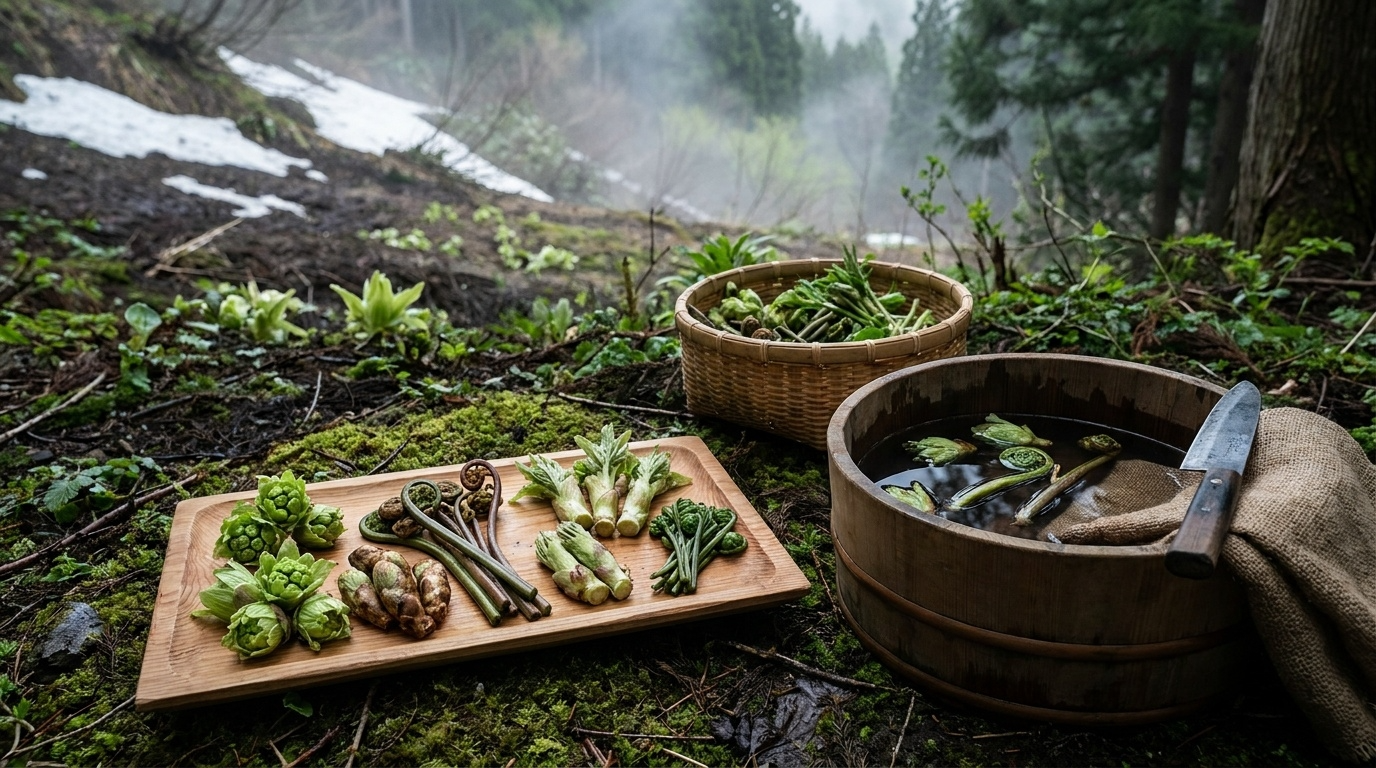
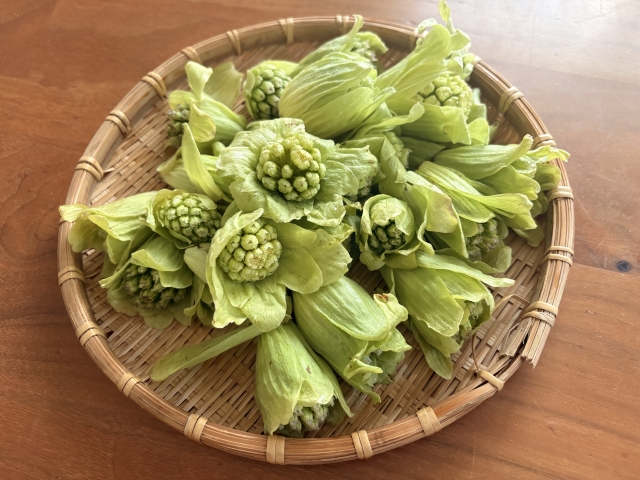
What comes up first is not planted. Fukinotō, the flower bud of the butterbur, pushes through the last crust of snow looking like a small green fist. Then bracken fiddleheads, then the coiled crosiers of zenmai on the wet north-facing crags, then the buds at the tips of the angelica trees. Within about six weeks it is over, and the mountain closes for another year.
Collectively these are sansai — mountain vegetables. Around three hundred species are considered edible in Japan, of which perhaps a dozen appear regularly on a plate. They are the oldest food in the Japanese diet and, more surprisingly, one of the very few that has never been fully domesticated. Almost everything else Japan eats has been brought under cultivation, standardised, and made available in November. Sansai has largely refused, and the reason it has refused is worth following.
The Word Is Newer Than the Food
Excavations of Jōmon settlements have turned up remains of some forty plant foods, bracken and zenmai among them, which means people on this archipelago were eating these particular ferns thousands of years before rice arrived. By the eighth century warabi had made it into poetry: the Man’yōshū preserves a small, perfect verse by Prince Shiki in which meltwater crashes over rock and the fiddleheads are pushing up beside it, and spring, he realises, has actually arrived. It is one of the most quoted spring poems in the language, and its subject is a weed.
But the word sansai itself is late — by one account it only settles into common use in the Edo period, and it settles in during a run of catastrophic famines. That timing matters. For most of Japanese history these plants were not a seasonal treat. They were kyūkō shokumotsu, famine food: the thing you ate when the rice failed.
The literature this produced is remarkable. Domains printed survival manuals telling people what in the surrounding hills could be eaten and how to prepare it. The most famous is Katemono, commissioned by Uesugi Yōzan of the Yonezawa domain after the Tenmei famine of 1783 and compiled by his retainer Nozoki Yoshimasa. Completed in 1800 and distributed in 1802 in 1,575 copies, it lists roughly eighty wild plants in syllabary order with instructions for cooking each one. Yonezawa tradition holds that when the next great famine came in the Tenpō years, the domain lost almost no one to starvation. Whatever the precise truth of that claim, the book survives — the printing blocks are still held in Yonezawa — and it tells you exactly how this knowledge was regarded. Not folklore. Infrastructure.
Bracken went further than the leaf. Its underground rhizome is full of starch, and villages dug it, pounded it, and washed the starch out — an appalling amount of labour for a small return, which is precisely why it was famine work. That starch, warabiko, is the original material of warabimochi, and Nara became the celebrated source. It was also boiled into glue for paper umbrellas and lanterns. Today real warabiko is so expensive that most warabimochi sold in Japan is made of sweet potato or tapioca starch instead. A famine ration has become a luxury confection that hardly anyone can afford to make properly.
These plants were not a seasonal treat. They were what you ate when the rice failed.
Bitterness, Deliberately
There is an old kitchen saying: haru no sara ni wa nigami o more — heap bitterness on the spring plate. The Meiji physician and food theorist Ishizuka Sagen invoked something like it, and the logic given is that a body slowed by winter needs waking, and the bitter compounds of early spring are what wake it.
Whether or not the physiology holds, the culinary observation is exact. Sansai are bitter, and the bitterness is not incidental — it is the flavour. A fukinotō without its bitterness is a limp green nothing. What Japanese cooking developed, over a very long time, was not a way to remove bitterness but a calibration: how much to take out, and how much to leave.
The word for what gets taken out is aku. It has no clean English equivalent — harshness, astringency, the raw edge — and chemically it is a bundle of unrelated things: oxalic acid, tannins, homogentisic acid, various alkaloids. Some of it is merely unpleasant. Some of it is not merely unpleasant.
What Wood Ash Actually Does
Bracken is the case that makes the whole system legible.
Raw warabi contains ptaquiloside, a compound that damages DNA and causes tumours in laboratory animals; it is also the reason grazing cattle that eat too much bracken sicken. On the strength of the animal evidence, the International Agency for Research on Cancer classified bracken fern as possibly carcinogenic to humans back in 1987, while noting that direct human evidence is thin.
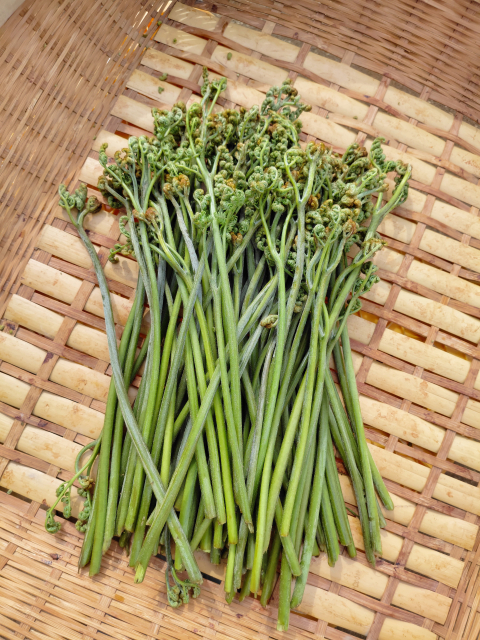
Japan has eaten it continuously for several thousand years anyway, because at some point — and nobody can say when — people worked out that ash fixes it. Ptaquiloside is unstable in alkali and unstable in heat, and the traditional aku-nuki applies both at once. You scatter wood ash over the bracken — roughly a handful to four hundred grams — pour boiling water over the top, weight it down, and leave it overnight; in the morning you rinse it in running water. Sodium bicarbonate is the modern substitute and works, though cooks who have used both generally say the ash gives a better texture and a cleaner colour. The compound is destroyed almost entirely, and Japan’s forestry research bodies take the view that at ordinary eating frequencies, properly prepared bracken presents no meaningful risk.
Consider what that represents as a piece of inherited knowledge. A population with no chemistry identified a specific plant as dangerous, identified a specific reagent — the alkaline ash sitting in the bottom of every hearth in the country — and arrived at a procedure that neutralises the exact molecule involved. Then they encoded it as a rule that everyone’s grandmother knew.
Not every sansai needs this. Kogomi, the ostrich fern fiddlehead, has essentially no aku at all; you boil it briefly and eat it, which is why it is what everyone recommends to beginners. But the hierarchy of Japanese wild foods is organised almost entirely by how much processing stands between the plant and the plate, and bracken sits near the top precisely because it demands the most.
Zenmai: Eleven Kilos In, One Kilo Out
If bracken is the chemistry, zenmai is the labour — and it is the sansai that built an actual economy.
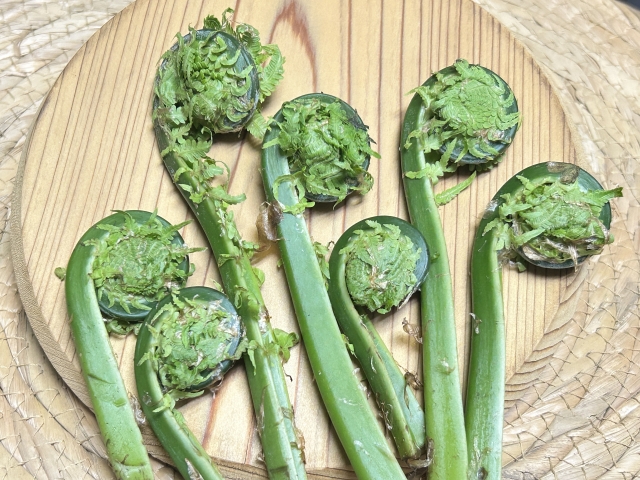
The name comes from money. The tight spiral of the emerging frond looks like a coin being rolled up: zeni o maku, worn down over time to zenmai. The best of it grows on wet, half-shaded north-facing crags in the beech zone, and the good stands are on ground that ordinary walkers cannot reach. Professional pickers in Akita wear spiked jika-tabi with four-pointed iron crampons strapped over them, tie a rope to the scrub above a cliff face, and work along the slope on the line. A day’s haul averages around seventy kilos, carried out on the back across snowfields still lying in the valley bottoms. Back and knee trouble is regarded as an occupational disease.
Then the real work starts. Boiled fronds are spread on straw mats in the sun and rubbed between the palms — five or six times over the course of each day, for two or three days, sometimes up to a week. Rub too hard and the fibres break and the texture is ruined; too gently and the piece dries stiff. The yield is about one part in eleven. Eleven kilos of fresh zenmai becomes one kilo of the dried product, which is why dried zenmai runs several thousand yen a kilo and why almost none of it is farmed — the fresh crop is still around ninety-five percent wild.
In the deep valleys, when the weather was too poor for sun-drying, pickers boiled the fronds and smoked them over a fire bed in the mountains before finishing them at home; that product was called ao-boshi, blue-dried, as against the aka-boshi, red-dried, made on the sunlit ground of the satoyama. Because the good ground was days from the village, whole families moved out for the season into zenmai-goya, huts built in the mountains, and stayed for a month picking, boiling and drying — a practice called tomari-yama, staying on the mountain. A study of Asahi village in Niigata found that as late as around 1955 some seventy percent of the households in the village kept one.
And the plant fed more than the household. The fiddleheads emerge wrapped in a fine brown wool, which women pulled off before boiling and dried; it went into bedding as a wadding substitute, and in the Kameda district of Akita it was spun with cotton into a cloth — zenmai-ori — that turned out to be both insect-resistant and water-resistant. It was commercialised in the 1880s and is still woven for demonstration today. A wild fern was providing a village with food, savings and textile fibre out of the same six-week window.
The most telling detail is a rule of restraint. Zenmai sends up two kinds of frond: fertile ones bearing spores, and sterile ones that become ordinary leaves. Pickers call the fertile fronds otoko-zenmai, male, and the sterile ones onna-zenmai, female, and the ironclad rule is that you take only the female and leave every male standing. Take the spore-bearers and the stand does not come back. This is a conservation protocol several centuries old, transmitted through a metaphor, enforced by nothing but the fact that everyone in the valley expected to be picking the same slope in twenty years.
Two Plants That Went Different Ways
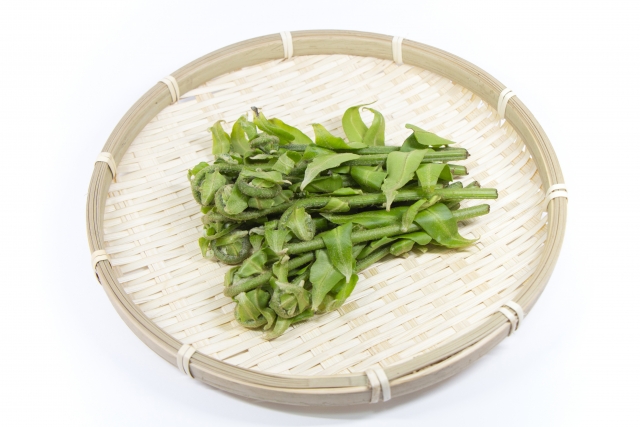
Fukinotō is one of the very small number of vegetables genuinely native to Japan — Petasites japonicus, the flower bud of the butterbur, up before anything else and intensely bitter. It has stayed close to its wild self. Its bitter principle, petasin, drew attention in 2021 when a Gifu University group reported that it strongly suppressed the growth and spread of cancer cells in the laboratory; that is early-stage research and not a reason to eat anything, but it is a nice inversion of the bracken story. The compound the plant made to be inedible turns out to be the interesting one.
Taranome, the bud of the angelica tree, went the other way entirely. Fat, nutty and only faintly bitter, it is called the king of the mountain vegetables and priced accordingly. In the 1980s growers in Yamagata perfected fukashi forcing: cut dormant branches in winter, stand them in water in a heated greenhouse at fifteen to twenty degrees and high humidity, and the buds break as though it were April. It works so well that most taranome on the market is now cultivated rather than gathered, and it ships from December — arriving, deliberately, in the dead months when nothing else green is available.
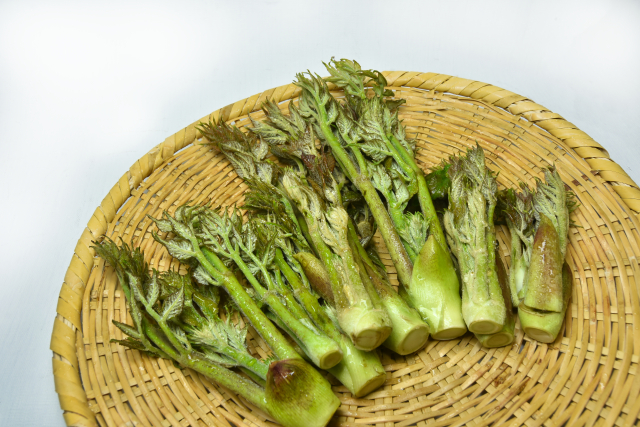
Which is the exception that clarifies the rule. The moment a sansai can be forced, it stops being a sansai in any meaningful sense and becomes a winter vegetable. Everything interesting about these plants is bound up with the fact that their season is imposed rather than chosen.
Somebody Owns the Mountain
There is an assumption, common to visitors and increasingly to Japanese city-dwellers, that a forest is a kind of public space. It is not, and the law on this is blunter than most people expect.
Article 197 of the Forest Act creates a specific offence of forest theft: taking produce from someone else’s forest carries up to three years’ imprisonment or a fine of three hundred thousand yen. Article 198 raises that to five years, or five hundred thousand yen, inside a designated protection forest.
Underneath the criminal law sits something much older and much more interesting: iriai-ken, common rights. The Civil Code acknowledges these in two articles and then, unusually, declines to define them, deferring instead to local custom. The community of a given village holds the right to take firewood, grass, mushrooms and sansai from a particular stretch of hillside, on terms that the village itself has set and remembered. It is one of the very few places where a modern legal code simply steps back and says: whatever these people have always done is the law here.
That arrangement is what a satoyama actually is. Not wilderness and not farmland but a managed middle zone, kept open and productive by continuous small human interference — cutting, coppicing, clearing — with the wild plants growing in the light that management creates. Sansai are a product of that relationship. Where the coppicing stopped and the plantations closed over, the sansai went too.
The Season Is Moving
Commercial sansai is now a very small industry, and the official numbers are smaller than the cultural weight of the thing suggests. The Forestry Agency recorded 596 tonnes of bracken in 2024, 96 tonnes of taranome, and 12 tonnes of dried zenmai — that last figure being what an eleven-to-one yield looks like from the far end. Yamagata leads on bracken, followed by Niigata, Fukushima and Iwate, and most of it is still gathered by hand, mostly by people well past retirement age who know which gully produces in which week. For a household that knows the ground, a spring can be worth a few hundred thousand yen; it arrives, conveniently, just before the farming year gets busy.
But the window is shifting. Producers report that the bracken harvest now runs two to three weeks earlier than it did in the 1990s, following the snowmelt. Deer and wild boar have altered the understorey in some regions. Bear encounters have become a serious constraint on when and where people are willing to go in: Japan recorded its worst year on record in 2025, with 238 people injured and thirteen killed, and spring foraging is one of the recurring circumstances. Meanwhile the people who hold the knowledge — which slope, which week, which frond to leave — are not being replaced at the rate they are being lost.
What Is Left of Foraging
What makes sansai worth understanding is not that it is rustic or photogenic. It is that it is the one substantial part of Japanese cooking that never made the transition the rest of the diet made.
Rice was organised into a landscape, a calendar and a state. Kyoto’s vegetables were bred over a millennium to suit the demands of temple and court kitchens. Even salt, drawn from the sea by hand for two thousand years, was industrialised out of existence in a single decade. Sansai stayed where it was, on a slope, available for about six weeks, in whatever quantity the mountain decided to produce that year.
Which means that the techniques around it are old in an unusual way — not preserved deliberately, but never superseded. The wood ash. The rule about the male frond. The rubbing of the boiled zenmai, five or six times, until the yield is one part in eleven. The salting-down of the surplus in a barrel so that in February you can simmer something out of a jar that grew last April. None of it was invented for pleasure. All of it was invented because a household in the mountains had one short chance each year to get a year’s worth of food off the hillside.
The bitterness on the plate in April is the residue of that. It tastes like early spring because it is early spring — the compounds a plant makes when it has to push through snow — and it tastes slightly of ash, because two thousand years ago somebody worked out that this was how you make the mountain safe to eat.
Read, then Taste.
This article is part of Waden’s Origin series, on the landscapes that shape Japanese ingredients. Read more at waden.umamibako.com.
Waden is an editorial journal exploring the depth and beauty of Japanese food culture — its history, ingredients, artisans, and traditions. Story first, always.
Comment