Grown for a Thousand Years: Kyoto’s Extraordinary Heritage Vegetables
The Heirloom Vegetables of Kyoto
Most vegetables are bred to travel. Modern commercial varieties are selected for durability in transit, uniformity of appearance, and tolerance of cold storage — qualities that have nothing to do with flavor and everything to do with supply chains. Kyoto’s traditional vegetables — known collectively as kyōyasai — were bred for the opposite: for a table at most twenty kilometers away, for a cuisine that measured quality in subtlety, for kitchens that had been refining the same dishes for five hundred years. Some of them cannot survive being transported at all. Their skin is too thin, their flesh too delicate, their color too unstable after harvest. They exist, as they always have, for Kyoto.
What Kyōyasai Is
Kyōyasai (京野菜) means, simply, “Kyoto vegetables.” The term refers to heirloom vegetable varieties that have been cultivated in Kyoto Prefecture using traditional seeds and methods, with documented histories that predate the Meiji era — before 1868. They are distinguished from modern commercial hybrids not by any single characteristic but by a combination: distinctive shapes, flavors, aromas, and textures that reflect centuries of selective cultivation for a specific culinary context.
The official framework for kyōyasai was established in 1989, when Japan’s Ministry of Agriculture, Forestry and Fisheries began certifying and promoting them as “Kyoto Brand Products,” marked with a stylized “K” logo. Currently, 40 types are recognized as traditional kyōyasai by the Kyoto Prefectural Department of Agriculture, with 20 designated as premium Kyoto Brand Products eligible for the certification seal. The criteria are clear: the variety must originate in Kyoto Prefecture and must have been introduced and cultivated before the Meiji period. What the criteria cannot capture is the more complex reality: that many of these vegetables reflect a millennium of accumulated agricultural judgment, dietary philosophy, and culinary expectation.
Why Kyoto, and Why These Vegetables
The conditions that produced kyōyasai were simultaneously geographic, political, and culinary — and they converge in a single fact: Kyoto was Japan’s imperial capital from 794 CE, when Emperor Kanmu moved the court from Nara to the newly constructed Heiankyō, until 1868, when the Meiji Restoration transferred political authority to Tokyo. That is 1,074 years as the center of Japanese political, cultural, and religious life. For over a millennium, everything finest in Japan — court robes, ceramic ware, lacquerware, poetry, and food — was concentrated in one place, refined by one demanding audience, and produced for one set of tables.
The geography reinforced the culinary tendency. Kyoto is located in a valley — the Yamashiro Basin — surrounded on three sides by mountains known as Higashiyama, Kitayama, and Nishiyama, with a maximum height of approximately 1,000 meters above sea level. This interior positioning means Kyoto is landlocked and distant from the sea — a significant fact in a country where coastal access defines the food supply. Without reliable access to fresh fish, the imperial capital and its temples developed a cuisine built predominantly around vegetables, tofu, and other plant-based ingredients. The Kamo and Katsura rivers have formed an alluvial fan that lets water percolate down, creating a supply of groundwater so vast that Kyoto has been described as a city sitting on top of a big water jug. The alluvial soils deposited by these rivers across the basin floor are deep, fertile, and well-draining — ideal for root vegetables and leafy greens. The city’s famous soft groundwater — essential to Kyoto’s tofu, sake, and pickles — runs through the same aquifer that irrigates its vegetable farms.
The result of these conditions was a virtuous cycle: during the Edo period (1603–1868), kyōyasai underwent significant development amid Japan’s prolonged peace and urban expansion, with Kyoto’s markets driving demand from samurai, merchants, and the growing middle class. These vegetables became integral to tea ceremonies and kaiseki multi-course meals, where their subtle flavors and textures complemented seasonal aesthetics. The more sophisticated the cuisine, the more demanding the requirements placed on the ingredients. The more demanding the requirements, the more precisely the vegetables were selected and bred to meet them. Over generations, this pressure produced vegetables shaped as much by culinary philosophy as by agricultural practice.
Two culinary traditions in particular drove the development of kyōyasai. Shōjin ryōri (精進料理) — Buddhist temple cuisine — developed in Kyoto’s numerous monasteries and temples, where the prohibition against taking animal life required a vegetable-based diet of exceptional sophistication. Kaiseki ryōri (懐石料理) — the multi-course haute cuisine developed alongside the tea ceremony — demanded seasonal precision, aesthetic beauty in raw ingredients, and a flavor profile delicate enough not to compete with the tea. Both traditions placed the highest possible demands on vegetables, and kyōyasai was shaped by meeting those demands for centuries.
Six Vegetables Worth Knowing
Among the forty recognized kyōyasai, a smaller group has achieved canonical status — vegetables so closely associated with Kyoto’s identity that they appear on menus, in gift boxes, and in the city’s seasonal calendar as reliable markers of time and place. Six of them trace the range of what kyōyasai can be.
Kamo Nasu (加茂茄子) — The Queen of Eggplants
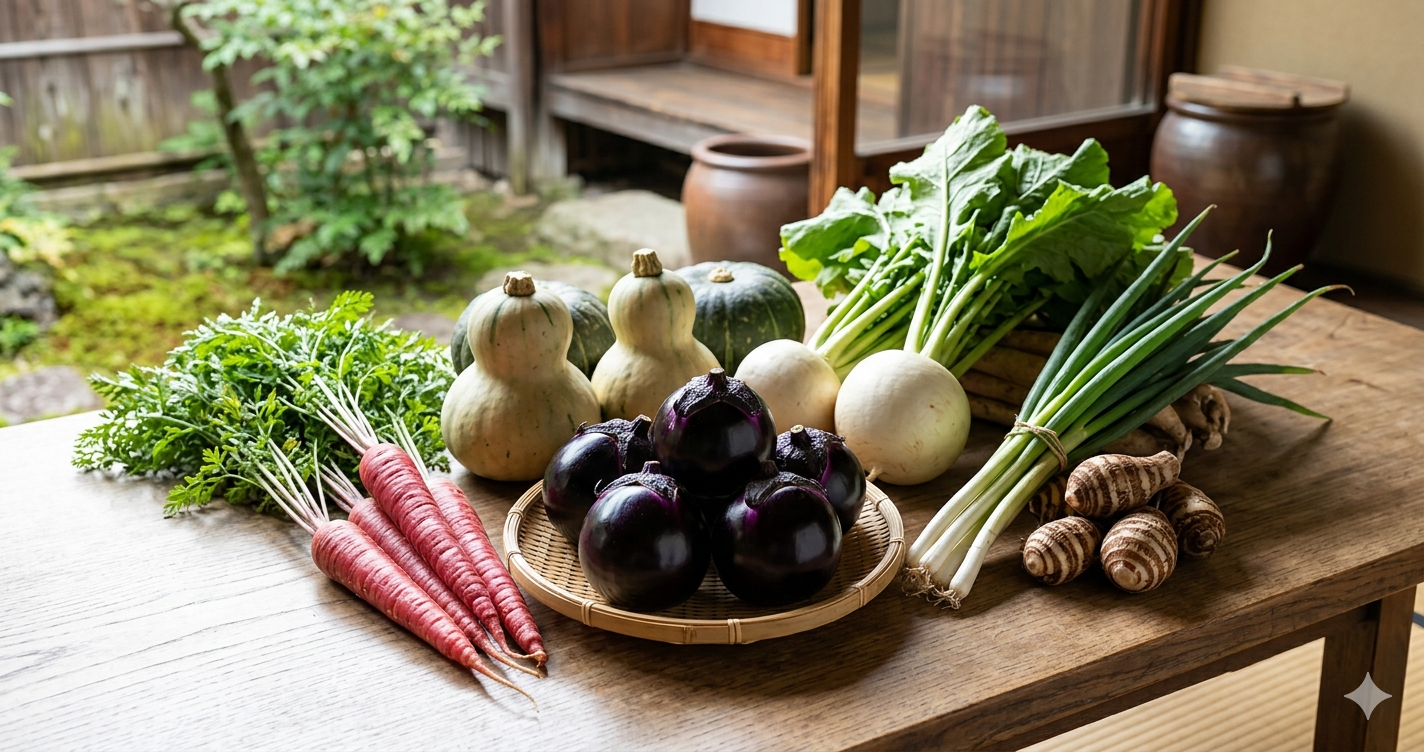
The present Kamo eggplant type is carefully nurtured by the people of Kamogamo. It is a masterpiece of Kyoto and is said to be the queen of eggplants. Round, heavy, and a deep glowing purple, the Kamo nasu weighs between 300 and 400 grams and is characterized by a white band beneath the calyx — the green leaves at its stem end — which is the mark of its authenticity. Kamo-nasu or Kamo Eggplant are thought to have been first cultivated in Kyoto’s Fushimi ward and have been referenced in Edo-period texts as producing the finest flavor among Japan’s many eggplant varieties. Its flesh is dense, firm, and remarkably rich in moisture — qualities that make it ideal for the kaiseki preparations it was bred to serve. The canonical preparation is dengaku: the eggplant is halved, scored, grilled with oil until the surface caramelizes, and served topped with a sweet white miso paste. The firmness holds through the heat; the moisture becomes concentrated sweetness. It has been cultivated since 1600 and remains one of the rare vegetables cultivated based on a traditional secret method passed through designated farming families in the Kamigamo area.
Kujo Negi (九条ねぎ) — The Oldest Green Onion
The Kujo negi is one of the oldest among kyōyasai, with 1,300 years of history. Named for the Kujo district in southern Kyoto where it was historically cultivated, it is a type of green onion distinguished from the white-stemmed negi common in eastern Japan: the Kujo negi is predominantly green, with a larger leafy portion, and its characteristic oneba — a viscous, sticky juice within the leaves — gives it a particular sweetness and body when cooked. Grown in winter, it is said to improve in flavor during severely cold weather. Compared with other green onions, it has a lot of sticky juice, which makes the taste sweeter. The entire plant — both the white root and the deep green leaves — is edible and used in cooking. Kujo negi appears in broths, grilled alongside tofu, shredded over soba and udon, and in Kyoto’s traditional winter hot pot preparations. It is also one of the few kyōyasai varieties that have achieved significant commercial distribution, though locally grown Kujo negi retains the character that mass production dilutes.
Shishigatani Kabocha (鹿ヶ谷かぼちゃ) — The Pumpkin of the Temple
The snowman-shaped Shishigatani squash evolved from chrysanthemum pumpkins brought from Tsugaru, in northern Japan, during the Edo period. The vegetable was originally grown in Kyoto’s Shishigatani region, where the Anrakuji Temple, for 300 years, has held the Kabocha Kuyo (Pumpkin Service), which gives blessings for continued health and recognizes that vegetable’s nutritional role in helping ward off disease. The squash’s distinctive shape — a bulbous lower half connected by a narrow waist to a smaller upper half, resembling a traditional Japanese figure — is entirely natural, the result of centuries of selective cultivation in Shishigatani’s specific soil conditions. Its flesh is dense, dry, and intensely sweet, with a chestnut-like depth of flavor. The Shishigatani squash contains alpha-linolenic acid, which helps prevent adult diseases. The annual Kabocha Kuyo ceremony at Anrakuji Temple on July 25th — where the squash is offered in gratitude and as a prayer for health — represents one of the more intimate intersections of vegetable culture and religious practice in Japanese food life.
Shōgoin Kabu (聖護院かぶ) — The Great Turnip
The Shōgoin turnip is typically sliced into big thin circles for use in the popular Kyoto senmaizuke pickles. It can grow to a weight of up to five kilograms and is one of Japan’s largest turnips. It is said to have been grown in the early 1700s by a farmer living in Kyoto’s Shōgoin area and cultivated from a seed from a neighboring region of Japan. Its flesh is exceptionally fine-grained, sweet, and free of the fibrous texture associated with ordinary large turnips — qualities that made it the natural choice for senmaizuke, Kyoto’s most famous pickled vegetable preparation: the turnip is shaved into paper-thin rounds, layered with kombu and seasoned with salt and a small amount of vinegar, and left to pickle under pressure. The resulting translucent circles — “senmmai” means “a thousand sheets” — are served as a refined winter condiment, with a sweet, mild flavor that is the opposite of aggressive pickling. Shōgoin kabu is a winter vegetable, reaching its peak sweetness in the coldest months when the cold concentrates its sugars.
Kintoki Ninjin (金時人参) — The Red Carrot
Where the orange carrots common across most of the world are descendants of Dutch selective breeding in the 17th century, the Kintoki carrot was imported to Japan from China during the 16th century. It is intensely red — closer to crimson than the orange of Western carrots — with a flesh that is sweeter, softer, and without the grassy bitterness that can characterize ordinary carrots. The name comes from Kintoki, a legendary figure from Japanese folklore associated with robust red health, and the color of the carrot signals its season: it is a winter vegetable, available from November through January, and its vivid red is among the most visually striking of all kyōyasai in the market. A long cultivation time and machine-free harvesting means it is one of the more precious kinds of kyōyasai on the market. Research has found that Kintoki carrots contain roughly three times the antioxidant power of regular orange carrots. In Kyoto cuisine, its color makes it a natural ornamental element in celebratory dishes — New Year’s preparations, in particular, rely on the contrast of red kintoki carrot against the white and green of other vegetables.
Ebi Imo (海老芋) — The Shrimp Taro
Ebi imo — “shrimp taro” — takes its name from its curved shape and the striped pattern on its skin, which together recall the appearance of a shrimp. It is a variety of satoimo (taro root) that was developed specifically for Kyoto’s sandy, well-draining alluvial soils, and it cannot be produced with its characteristic quality in other soil conditions — its flesh becomes coarser and its flavor less refined when grown elsewhere. The flesh of ebi imo is white, very fine-grained, and remarkably non-sticky compared to other taro varieties — a quality that makes it ideal for nimono, the simmered dish preparations central to kaiseki cooking. Simmered in dashi, soy sauce, and mirin until the surface takes on a lacquered gloss while the interior remains creamy, ebi imo is the epitome of what kyōyasai produces at its best: an ingredient whose specific qualities allow a simple preparation to achieve a result that substitution cannot replicate.
What Makes Kyōyasai Different: The Science Behind the Flavor
The superior flavor and nutritional density of kyōyasai is not a marketing claim. It has been substantiated by research from Kyoto Prefectural University and the Kyoto Prefectural Agriculture, Forestry and Fisheries Technology Center, comparing traditional kyōyasai varieties with modern commercial hybrids grown under equivalent conditions.
Research has found that kyokanzashi carrots and murasaki zukin purple soybeans have roughly three times the antioxidation power of regular carrots and edamame soybeans, respectively. Kujo negi leeks have twice the dietary fiber of regular shiro negi leeks. The glucosinolates in Shōgoin turnip hydrolyze into isothiocyanates which exhibit antimutagenic properties and reduce inflammation, potentially lowering cancer risk and aiding digestive processes through prebiotic effects.
The explanation lies in how these vegetables were selected over generations. Modern hybrid varieties are bred primarily for yield, uniformity, and durability in transport — traits that are economically valuable but have no bearing on flavor or nutritional density. Kyōyasai were selected by farmers and cooks whose sole criterion was quality at the table: sweetness, texture, color that held in cooking, flavors that complemented dashi-based preparations. Over centuries, this consistent selection pressure produced varieties with genuinely superior sensory and nutritional qualities, at the cost of the yield and durability that commercial agriculture requires. The vegetables are often lower-yielding, more fragile, and more sensitive to growing conditions than modern hybrids. What they offer in return is irreplaceable.
Near Extinction, and Recovery
F1 vegetable cultivars became the national norm after World War II, and kyōyasai faced the risk of extinction. Consequently, farmers, researchers, municipalities, and other groups decided to preserve kyōyasai. The post-war decades were the most dangerous period for traditional Japanese vegetable varieties. F1 hybrids — first-generation crosses that produce uniform, high-yielding plants — offered economic advantages that heirloom varieties could not match. As urban markets standardized and distribution chains lengthened, vegetables that could not survive transport were simply not grown. In several cases, kyōyasai varieties that had been cultivated in Kyoto for centuries were reduced to a handful of farming families or a few seed collections before revival efforts began.
The revival began in earnest in the early 1980s, driven by a combination of agricultural researchers, prefectural government support, and chefs in Kyoto’s kaiseki restaurants who recognized that the quality of their cuisine was being compromised by the disappearance of its essential ingredients. The Kyoto Brand Products certification system established in 1989 formalized this recovery effort, providing economic incentives for farmers to grow and market traditional varieties and creating a recognition framework that connected producers directly to the restaurants and consumers who valued authenticity.
Some varieties — like the Yamashina nasu eggplant, which had nearly disappeared by mid-century — were revived through seed bank recovery and the involvement of designated farming families committed to traditional cultivation methods. The Yamashina nasu eggplant rarely travels outside the prefecture simply because its thin skin doesn’t hold up well after transportation. Its color could also change within a few hours after harvest. This fragility, which makes it commercially unviable, is also precisely what makes it culinarily exceptional — and it survives today because a small community of people decided that what it offers at the table is worth the difficulty of keeping it alive.
Kyōyasai and Kyoto’s Culinary Identity
Kyoto has been the center of Japan’s politics, culture, and religion for over 1,000 years, fostering a diverse culinary heritage that includes kaiseki ryōri — the refined multi-course cuisine of the aristocracy — shōjin ryōri — the vegetarian meals of Buddhist monks — and obanzai — the simple yet flavorful home-style dishes enjoyed by commoners. Each of these three culinary traditions relies on kyōyasai in different ways: kaiseki places it at the center of aesthetic and seasonal expression; shōjin ryōri makes it the primary source of sustenance and flavor; obanzai uses it as the everyday backbone of household cooking.
What runs through all three is a shared conviction about the relationship between the ingredient and the dish. In Kyoto’s culinary philosophy — more explicitly articulated there than almost anywhere else in Japan — the cook’s role is not to impose flavor on ingredients but to reveal what is already in them. A kaiseki chef preparing ebi imo in dashi is not adding flavor to a neutral medium; the chef is constructing conditions in which the taro’s sweetness and texture can express themselves most clearly. This philosophy demands ingredients that have something to express. Kyōyasai, bred for generations by farmers who shared that philosophy, delivers exactly that.
Quick Reference: Six Key Kyōyasai
| Vegetable | Japanese Name | Season | Defining Character | Canonical Preparation |
|---|---|---|---|---|
| Kamo Eggplant | Kamo nasu (加茂茄子) | May–September | Round, dense, moisture-rich | Dengaku (grilled with sweet miso) |
| Kujo Green Onion | Kujo negi (九条ねぎ) | Year-round; peak winter | Sweet, viscous juice; fully edible leaves | Hot pot, broth seasoning, grilled |
| Shishigatani Squash | Shishigatani kabocha (鹿ヶ谷かぼちゃ) | Summer | Gourd shape, dry sweet flesh | Simmered in dashi, temple offerings |
| Shōgoin Turnip | Shōgoin kabu (聖護院かぶ) | October–February | Up to 5kg, fine-grained, sweet | Senmaizuke (thousand-sheet pickles) |
| Kintoki Carrot | Kintoki ninjin (金時人参) | November–January | Deep red, soft, sweet, no bitterness | New Year dishes, simmered preparations |
| Shrimp Taro | Ebi imo (海老芋) | Autumn–Winter | Curved shape, fine-grained, non-sticky | Nimono (simmered in dashi broth) |
A vegetable that cannot survive being transported is, from a commercial standpoint, a failure. From a culinary standpoint, it is the opposite: proof that something in it was so well suited to its place of origin that it became inseparable from it. Kyōyasai cannot be abstracted from Kyoto’s alluvial soils, soft groundwater, and the culinary culture that spent a thousand years deciding what vegetables should taste like. They are the record of that decision — grown slowly, selected carefully, and offered, in season, as evidence that a city’s food culture can be as much a work of civilization as its temples and its poetry.
Comment