The Living Bed: A Guide to the Ancient Art of Nukazuke
How to Raise a Nukadoko
In some Japanese households, there is a container in the kitchen that has been in continuous use for over a hundred years. It is passed from parent to child alongside knives and lacquerware, with the same care and the same understanding: that it is alive, that it needs daily attention, and that if you tend it well, it will outlast you. The container holds a dense, earthy-smelling paste called nukadoko — a fermented rice bran bed — and the pickles it produces, called nukazuke, are one of the oldest and most quietly complex expressions of Japanese food culture. This article is about how that bed works, how to start one, and how to keep it alive.
What Nukadoko Is
Nukadoko (糠床) means, literally, “bran bed.” It is a moist, dense paste made primarily from rice bran (nuka), salt, and water, in which vegetables are buried to ferment into pickles. But describing nukadoko as a pickling medium undersells what it actually is: a living microbial ecosystem, populated by billions of lactic acid bacteria, yeasts, and other microorganisms that transform both the bed itself and any vegetable placed inside it.
The bacteria responsible for nukazuke’s character are primarily Lactobacillus species — the same genus of lactic acid bacteria found in yogurt, kimchi, and sauerkraut. These bacteria occur naturally on the outer skins of vegetables; when vegetable scraps are buried in the bran-salt mixture, the bacteria migrate into the bed, find an environment rich in carbohydrates and nutrients from the rice bran, and begin to multiply. As they do, they produce lactic acid, which acidifies the bed and creates nukazuke’s characteristic mild sourness. The salt in the mixture simultaneously draws moisture from the buried vegetables through osmosis, accelerating fermentation and keeping undesirable microbes at bay.
What makes nukazuke nutritionally unusual among pickled foods is the direction of exchange: nutrients flow from the rice bran into the vegetables, not just out of them. Rice bran is one of nature’s richest sources of thiamine (vitamin B1), along with B6, vitamin E, minerals, and amino acids. A cucumber pickled in an active nukadoko for twelve hours absorbs up to ten times more vitamin B1 than an unpickled cucumber. This nutritional transfer is unique to the nukazuke method and is central to the historical importance of the practice.
A History Born from White Rice
Nukazuke developed in the early Edo period, around the 17th century, and its origins are inseparable from a specific moment in Japanese food history: the widespread adoption of polished white rice. Before this period, Japanese people ate brown rice, which retains its outer bran layer — a layer rich in B vitamins, including thiamine. When rice polishing technology improved and white rice became the staple of the Japanese diet, an enormous amount of rice bran became available as a milling byproduct — and a serious nutritional problem emerged.
Beriberi — a disease caused by thiamine deficiency — spread across Japan’s growing urban population, particularly in Edo (present-day Tokyo), where the shift to white rice was most pronounced. The disease became so associated with the city that it was known as “the Edo disease.” Nukazuke, which transferred vitamin B1 from rice bran into vegetables during fermentation, became a practical and effective corrective. Pickled vegetables eaten alongside white rice partially restored the vitamin content lost in milling. The bed spread through households rapidly, not only for its flavor but because eating from it was, in a genuine sense, protective.
From the Meiji through Showa eras, nukazuke became a domestic staple — a fixture of the Japanese kitchen, maintained by the household and eaten at nearly every meal. The 20th century brought industrialization, refrigeration, and processed foods, and the daily maintenance required by a nukadoko fell out of practice in many families. But the tradition never disappeared, and in recent decades it has experienced a significant revival — partly as a fermented food with recognized probiotic benefits, and partly as a form of daily practice with its own rhythms and satisfactions.
What You Need to Start
Building a nukadoko requires very few ingredients. The essential three are rice bran, salt, and water. Everything else is optional, but several traditional additions help to season the bed, regulate fermentation, and introduce complexity from the beginning.
Rice bran (nuka) is the foundation. It should be raw or lightly toasted — toasting briefly in a dry pan removes any raw, dusty aroma and makes the bed smell pleasantly nutty. One kilogram of rice bran is a practical starting quantity for a household bed.
Salt performs two functions: it creates the osmotic pressure that draws moisture from buried vegetables, and it suppresses undesirable bacteria while allowing lactobacilli to thrive. The standard ratio is approximately 13% salt by weight of the rice bran — about 130 grams per kilogram of bran. Use salt without additives: sea salt, kosher salt, or pickling salt are all appropriate. The chlorine in tap water can inhibit fermentation, so filtered or boiled-and-cooled water is recommended.
Kombu (dried kelp) is the most important traditional addition: a sheet placed at the base of the bed contributes glutamates — natural umami compounds — that deepen the flavor of the nukadoko over time. Dried red chili peppers (typically two to three whole peppers) serve both as flavoring and as antibacterial agents, helping to keep unwanted microbes from establishing themselves. Fresh ginger adds aromatics and similarly contributes antimicrobial properties. Some cooks also add dried shiitake mushrooms for additional umami, or a small piece of yuzu or citrus peel for fragrance. These are customization choices — not requirements.
The container matters too. A ceramic crock or a food-grade plastic container with a lid is ideal — wide enough to allow deep stirring with both hands, with enough volume for a quantity of bran that can be thoroughly mixed without spilling. The nukadoko should fill the container no more than two-thirds full, leaving room for the daily stirring action.
Building the Bed: The First Two Weeks
The construction of a nukadoko is straightforward, but the bed does not become fully active immediately. The first two weeks are a maturation period — a process of establishing the microbial community that will do the actual work of fermentation.
Begin by combining the rice bran and salt in the container, then add the water gradually, mixing until the paste reaches the consistency of damp sand — it should hold its shape when pressed but release no standing liquid. Add the kombu, chili peppers, and any other seasonings, pressing them down into the bed. The mixture at this stage will smell of raw bran and salt; this is normal.
The next step is inoculation: vegetable scraps — the trimmings and outer leaves of whatever vegetables are available, such as cabbage leaves, carrot peels, or the ends of cucumbers — are buried deep in the bed. These scraps carry the lactic acid bacteria that will seed the fermentation. Press the surface flat, smooth it down to eliminate air pockets, and store the container in a cool, dark place at room temperature, ideally between 20 and 25 degrees Celsius (68–77°F). This is the active temperature range for lactobacillus; too cold and fermentation stalls, too warm and it proceeds too fast and produces off-flavors.
From the following day onward, the bed must be stirred once daily — pushing the surface bran to the bottom and bringing the bottom to the top, mixing thoroughly, then pressing flat again. The scraps are replaced with fresh ones every three to four days as they exhaust their moisture and nutrients. These early-stage scraps should not be eaten; they are serving as food for the bacteria, not as finished pickles.
After seven to ten days, a subtle sourness should begin to develop in the aroma of the bed — a sign that lactic acid bacteria are establishing. By day fourteen, the bed should smell pleasantly tangy, faintly earthy, and slightly yeasty: the smell of a living ferment working correctly. At this point, real pickling can begin.
Daily Life With a Nukadoko
Maintaining an active nukadoko requires approximately two minutes of attention per day. The daily practice is simple and must not be skipped for more than a few days at a stretch.
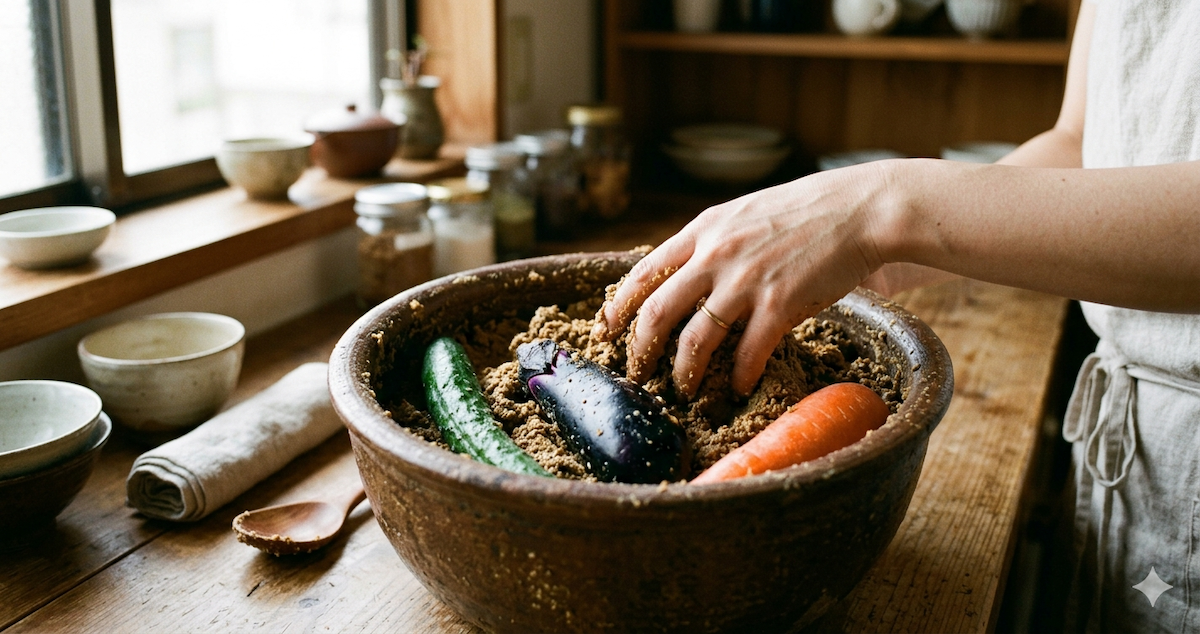
Stir deeply, every day. Push both hands into the bed, reaching the bottom, and fold the lower bran up to the surface while pressing the surface down. This action aerates the bed, redistributing bacteria and preventing pockets of anaerobic fermentation that produce unpleasant odors. It is universally recommended in Japanese tradition that this stirring be done with bare, clean hands — not because tools cannot do the mechanical work, but because the natural bacteria on human skin contribute to the microbial population of the bed, gradually influencing its character. Different cooks, different beds: a nukadoko absorbs something of its keeper over time.
Monitor moisture. A properly maintained nukadoko should feel like a moist, firm paste — roughly the texture of an earlobe, as the Japanese description goes. If the bed becomes too wet (vegetables release water into the bran), add a tablespoon or two of fresh dry rice bran to absorb the excess. If it becomes too dry — rare in an active bed — add a small amount of saltwater. The water balance matters for both the texture of the pickles and the health of the fermentation.
Top up as needed. As vegetables are buried and removed, they take some bran with them. The bed gradually diminishes in volume and loses salt. Add fresh bran periodically, along with about 13% of the new bran’s weight in salt, and mix thoroughly. Some cooks also add small pieces of kombu, dried mushrooms, or other umami-contributing ingredients from time to time to refresh the flavor of the bed.
Refrigerate when necessary. If you need to leave for a week or more, or if the bed is fermenting too fast in summer heat and becoming overly sour, move it to the refrigerator. Cold temperatures slow but do not kill the lactic acid bacteria; the bed enters a kind of dormancy. Stir it once or twice during this period and feed it with fresh vegetable scraps. When you return to room-temperature maintenance, the bed will take a day or two to return to its full activity.
Pickling: What to Bury and For How Long
Almost any vegetable can be pickled in nukadoko, but the texture and flavor of the finished pickle depends on the density of the vegetable and the desired intensity of fermentation. The standard approach is to rub the vegetable lightly with salt before burying — this accelerates the osmotic process — then press it deep into the bed and smooth the surface over it.
Cucumber is the most classic nukazuke vegetable. Halved lengthwise and buried in an active bed at room temperature, a cucumber is ready in 6 to 12 hours for a light pickle, 18 to 24 hours for a fuller, more sour result. Eggplant requires 12 to 24 hours; a traditional technique wraps the cut eggplant in cheesecloth with an iron nail or a small piece of iron to prevent the purple skin from discoloring in the acidic environment — the iron ions interact with the eggplant’s anthocyanin pigments to preserve their color. Daikon radish, being denser, takes 24 to 72 hours depending on thickness — cut lengthwise into quarters for faster results. Carrot and turnip both take 24 to 48 hours and develop a pleasant sweetness through fermentation.
The principle is: thinner and more water-rich vegetables ferment faster; denser, drier vegetables take longer. Refrigerated beds take two to three times longer than room-temperature beds for equivalent results. Taste your pickles before removing them from the bed if you are uncertain — once removed and rinsed, the fermentation stops.
When finished, remove the vegetables, brush the excess bran back into the bed, rinse under cool water, and slice to serve. Nukazuke are eaten cold or at room temperature, alongside rice, as a side dish, or as a small accompaniment to sake. They keep well in the refrigerator for two to three days after removal from the bed.
Reading the Bed: Signs and Adjustments
A healthy, active nukadoko smells earthy, faintly sour, slightly yeasty, and nutty — like bread dough that has been working for days. Learning to read that smell is the most important skill in nukadoko maintenance. The bed will tell you what it needs.
Too sour: The pickles come out sharp and acidic, and the bed smells heavily of vinegar. Fermentation has been too active — possibly due to warm temperatures, too much moisture, or infrequent stirring. Move the bed to the refrigerator to slow activity, remove some of the old bran, and add fresh bran with a proportional amount of salt. Reduce pickling time temporarily until balance returns.
Too salty: The pickles taste flat and simply salty, without the sourness and complexity that distinguish nukazuke from ordinary salt pickles. This usually means the lactic acid bacteria have not yet established fully (in a new bed) or have become temporarily suppressed by cold temperatures or excessive salt. Keep the bed at a warmer temperature, shorten the pickling time, and give the bacteria a few days to reactivate by burying fresh vegetable scraps without eating the results.
White surface film: A white film sometimes develops on the surface of the bed, particularly when stirring has been skipped. This is most commonly kahm yeast — a harmless surface yeast — and can simply be stirred back into the bed. However, if the film is accompanied by an unpleasant smell (rather than a yeasty one), or if the film is colored green, black, or pink, it indicates problematic mold. In this case, remove the affected surface layer plus a generous margin below it, add a tablespoon of salt, and mix thoroughly. If mold has penetrated deeply into the bed, discard the batch and start again.
Ammonia smell: A strong ammonia odor indicates the bed has overheated and the bacterial balance has been disrupted. Move to a cooler location immediately, add fresh bran and salt, and stir more frequently for several days. Avoid pickling vegetables until the smell returns to its normal earthy sourness.
Flat, one-dimensional flavor: A bed that produces pickles without depth or complexity usually needs feeding — additional umami-contributing ingredients. Bury a fresh piece of kombu, add a few dried shiitake mushrooms or dried sardines (niboshi), or press a small piece of yuzu or citrus peel into the bed. These additions dissolve slowly, releasing flavor compounds into the paste over days.
The Long View: A Bed That Improves With Age
A new nukadoko makes adequate pickles. An old nukadoko makes something else entirely. With consistent maintenance over months and years, the microbial community in the bed stabilizes and diversifies, the flavors produced become more layered and complex, and the bed develops a character that no new batch can replicate. This is why old nukadoko are valued, why they are sometimes used to seed new batches — a portion of a mature bed added to fresh bran to jumpstart its microbial population — and why some Japanese families speak of their nukadoko the way others speak of a sourdough starter kept for generations.
The bed absorbs the conditions of its environment: the temperature fluctuations of the seasons, the particular vegetables buried in it, the hands that stir it daily. Summer nukadoko ferments more aggressively and produces pickles with a sharper edge; winter nukadoko slows, producing something cleaner and more restrained. The pickles change with the calendar, even if the technique stays constant. This seasonal variation is not a problem to be engineered away — it is one of the things that makes nukazuke worth eating.
There is a Japanese word, te no aji (手の味) — the taste of the hand — that describes how food absorbs the character of the person who makes it. Nukadoko is perhaps the most literal expression of this idea in Japanese culinary culture. The bacteria on the hands of the person who stirs it each day do, in fact, migrate into the bed and contribute to its microbial makeup. Two people maintaining identical beds with identical ingredients, in different kitchens, will produce different pickles. The difference is the keeper.
A nukadoko does not require expertise. It requires consistency — the same two minutes, every day, with clean hands. What it returns for that attention is a fermented food whose complexity increases with time rather than diminishing, pickles that are genuinely different from anything vinegar or salt alone can produce, and a small daily ritual that connects the kitchen to the long tradition of Japanese fermentation. Start with rice bran and salt. Feed it vegetable scraps. Stir it. Give it time. It will tell you when it is ready.
Comment