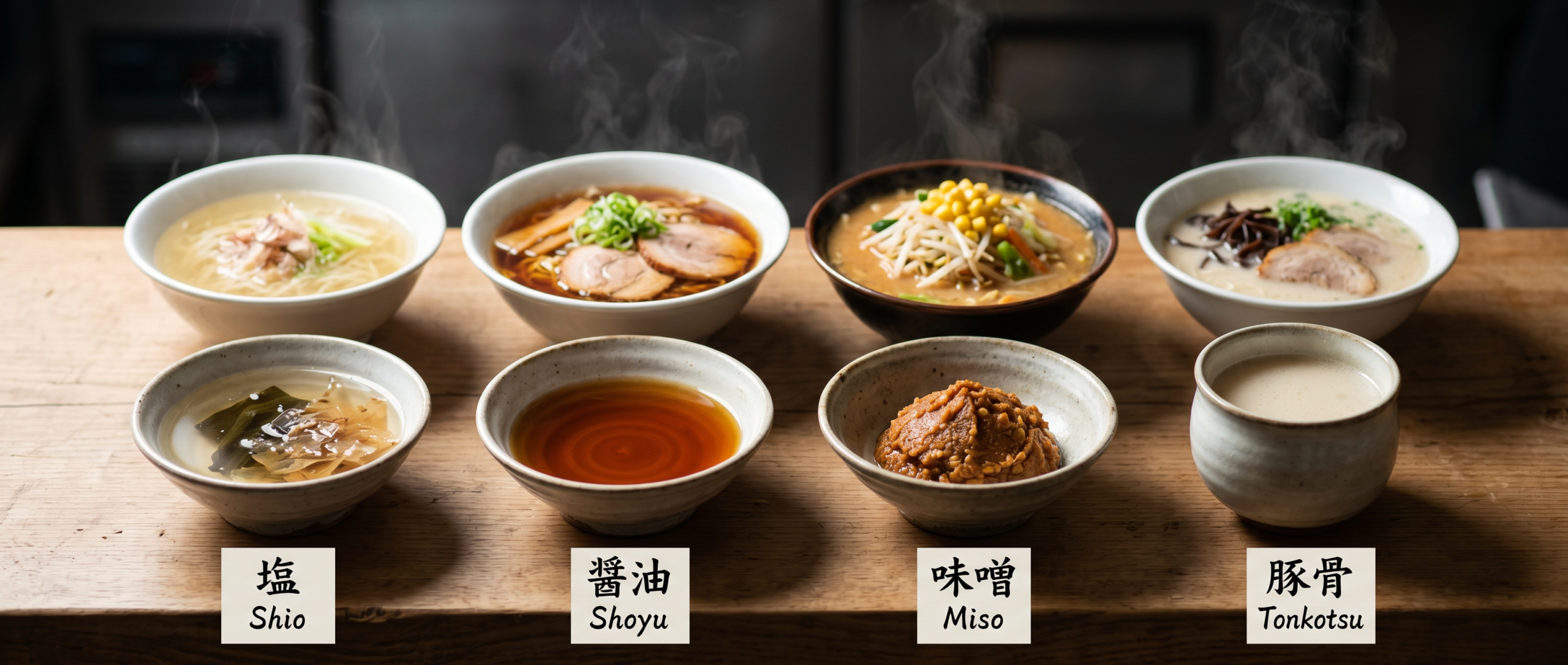
The Four Tares: Shio, Shoyu, Miso & Tonkotsu Explained
Every bowl of ramen is named for one of these four words. But only three of them are the same kind of thing — and understanding why the fourth is different is the clearest way to understand how a bowl of ramen is actually built.
Walk into a ramen shop anywhere in the world and the menu will likely organize itself around four words: shio, shoyu, miso, and tonkotsu. They are presented as if they were four flavors of the same thing — four options on the same axis, like picking a color. Order the shio, order the tonkotsu, and you have chosen your ramen.
This framing is useful, and it is how most people navigate a menu. But it conceals something important about how ramen actually works, because three of these four words describe one component of a bowl, and the fourth describes an entirely different one. Shio, shoyu, and miso are types of tare — the concentrated seasoning that gives a bowl its salinity and its primary identity. Tonkotsu is a type of broth — the stock that forms the body of the soup. They are not alternatives to one another. In fact, a bowl can be both tonkotsu and shio at the same time, and many are.
To understand the four words on the menu, then, is really to understand the architecture of a bowl of ramen: how broth, tare, and aroma oil combine into something greater than any of them alone. We have written elsewhere about how three cities built Japan’s great regional ramen styles, and about how climate and geography shaped the contrast between Hakata and Sapporo. This article goes one level deeper — into the components those styles are assembled from, and the small, concentrated thing in the bottom of the bowl that determines what the whole thing tastes like.
What a Tare Actually Is
A bowl of ramen is built from three core elements. There is the broth (the stock — water in which bones, meat, fish, or kelp have been simmered to extract body and flavor); the aroma oil (a fat added near the end — lard, chicken fat, or a flavored oil — that traps heat and carries fragrance); and the tare (タレ), the concentrated seasoning sauce that is portioned into the bottom of each bowl before the hot broth is poured over it.
The tare is the element that does the most to define a bowl’s character, and it is also the smallest. A typical serving might be only a few tablespoons, sitting at the bottom of the bowl, into which the broth is added to dilute and activate it. This structure is one of the most elegant features of ramen as a system: because the broth itself is often left relatively unseasoned, a single batch of broth can be turned into shio ramen, shoyu ramen, or miso ramen simply by changing the tare in the bowl. The tare is what allows one stock to become many different bowls.
What unites all tare is salt — the tare is the primary source of a bowl’s salinity — but a good tare is far more than salt water. It is a vehicle for umami, built up from ingredients layered for depth: kombu, dried fish, dried mushrooms, soy sauce, sake, mirin, and aromatics, often combined and rested so the flavors marry. The three classic tare are distinguished by what carries that salt and umami: salt itself (shio), soy sauce (shoyu), or fermented soybean paste (miso).
The tare is the smallest element in the bowl and the one that defines it. Change the tare, and the same broth becomes an entirely different ramen.
Shio: The Tare That Hides Nothing
Shio (塩) means salt, and shio tare is the oldest and, in a sense, the most demanding of the three. Where soy sauce and miso arrive with their own deep, pre-built flavor, salt brings salinity and almost nothing else. A shio tare cannot lean on the character of a fermented seasoning to cover for a thin or poorly made broth. The salt amplifies whatever is already in the bowl — and if there is little there, the shio bowl will taste empty.
For this reason, shio tare is often described by ramen cooks as the hardest to make well. Its job is to season the broth while staying out of the way, allowing the stock’s own flavor — chicken, fish, kelp, whatever it is built from — to come through clearly and cleanly. A good shio tare is therefore not just salt dissolved in water. It is salt carried in a base layered with umami: kombu and dried fish are common, sometimes dried scallop or other shellfish, sometimes sake and a touch of mirin, all built to add depth without adding color or asserting a flavor of their own.
The result, in the bowl, is the lightest and most transparent of the classic styles — a clear or pale golden soup that tastes clean, delicate, and direct. Shio ramen is the style in which the quality of the broth has nowhere to hide, which is precisely why a well-made bowl of it can be so impressive.
Shoyu: The Tare That Built Tokyo Ramen
Shoyu (醤油) is soy sauce, and shoyu tare is the seasoning at the historical heart of Japanese ramen. The earliest popular ramen in Japan — the shina soba sold from stalls in early twentieth-century Tokyo, and the classic Tokyo-style ramen that descended from it — was built on a soy sauce tare combined with a chicken-and-vegetable or chicken-and-fish broth. For much of ramen’s history, soy sauce was simply what ramen tasted like.
A shoyu tare begins with soy sauce, but rarely soy sauce alone. It is typically built up with the same umami-bearing ingredients used across all tare — kombu, dried fish such as katsuobushi or niboshi, sometimes dried mushrooms — along with sake and mirin to round out the soy sauce’s sharpness and add a faint sweetness. The soy sauce contributes not only salt but its own fermented depth, its aroma, and its color, which turns the finished broth a clear amber-brown.
Compared to shio, shoyu tare is more assertive: it brings a savory, faintly sweet, recognizably fermented edge that shapes the bowl rather than simply seasoning it. But it is still, at its best, a tare in service of the broth — adding a dimension of flavor and a beautiful color while letting the stock beneath it speak. It is the most versatile of the three, pairing naturally with the widest range of broths, from light chicken stocks to rich pork bones.
Miso: The Tare That Is Almost a Broth in Itself
Miso (味噌) is fermented soybean paste, and miso tare is the youngest and the most substantial of the three classic seasonings. Unlike salt and soy sauce, which are added in small concentrated amounts, miso is a thick paste with enormous flavor and body of its own, and a miso tare brings far more to the bowl than salinity — it brings density, sweetness, a deep fermented savoriness, and a clouded, hearty texture that the lighter tare cannot.
Miso ramen has a precise and well-documented origin. It was created in Sapporo, the capital of Japan’s cold northern island of Hokkaido, and is generally credited to Morito Omiya, founder of the restaurant Aji no Sanpei, who put miso ramen on his menu in 1955. The innovation was significant: before this, most Sapporo ramen — like most ramen across Japan — was built on a shoyu tare. Using miso as the seasoning base for ramen broth was genuinely new.
It also made immediate sense in its climate. A miso tare produces a thick, dense, deeply savory soup, and in Sapporo it is typically enriched further with lard, whose layer of fat at the surface insulates the bowl and holds its heat against the cold — a piece of thermal engineering as much as a flavor choice. The broth is often finished by stir-frying vegetables and aromatics in a wok before the soup is added, building a roasted depth on top of the miso’s fermented richness. The relationship between this style and the city that produced it is one we explore in detail in our comparison of Hakata and Sapporo ramen — a study in how a tare and a climate can shape each other.
Tonkotsu: The Word That Doesn’t Belong on This List
Which brings us to the fourth word — and to the distinction at the center of this article. Tonkotsu (豚骨) means “pork bone,” and it does not name a tare at all. It names a broth.
Tonkotsu broth is made by boiling pork bones — particularly collagen-rich trotters and joints — at a hard, rolling boil for many hours, often from six to eighteen or more. Where most stocks are simmered gently to stay clear, tonkotsu is boiled aggressively and continuously, so that the collagen, fat, and marrow break down and emulsify into the water, turning the broth opaque, milky white, and intensely rich. This cloudiness is the defining feature of tonkotsu: it is what happens when a pork-bone stock is pushed far past the point where an ordinary stock would stop.
The crucial point is that tonkotsu describes how the broth was made and what it was made from — not how it was seasoned. A bowl of tonkotsu ramen still needs a tare. In the Hakata district of Fukuoka, where tonkotsu ramen reached its most famous form, the tare paired with the pork-bone broth is most often a shio or a light shoyu tare. So a classic bowl of Hakata ramen is, properly described, a tonkotsu broth seasoned with a shio (or shoyu) tare. The two words describe two different layers of the same bowl, working together.
This is why putting tonkotsu in a list alongside shio, shoyu, and miso — as nearly every menu does — is a small category error that has become standard usage. It treats a broth as if it were a seasoning. The reason it persists is that tonkotsu broth is so distinctive and so dominant in flavor that, in practice, it functions as a bowl’s headline identity the way a tare does for other styles. But understanding that tonkotsu sits on a different axis than the other three is the key that makes the whole system legible: broth answers what the soup is made from; tare answers how it is seasoned. Every bowl of ramen is an answer to both questions at once.
Broth answers what the soup is made from. Tare answers how it is seasoned. A bowl of tonkotsu shio ramen is the answer to both questions at once — which is why the fourth word never belonged beside the other three.
How the Pieces Fit Together
Once the distinction is clear, the architecture of any bowl of ramen becomes easy to read. Pick a broth — a light chicken stock, a chicken-and-fish blend, a clear kombu-based vegetarian stock, or a rich emulsified tonkotsu. Pick a tare — shio, shoyu, or miso — to season it. Finish with an aroma oil that suits the combination. The result is a matrix, not a list: a tonkotsu broth can be seasoned shio or shoyu or even miso; a miso tare can be matched with a pork broth or a chicken one; a clean chicken stock can be turned into a delicate shio bowl or a deeper shoyu one.
This modular structure is what has allowed ramen to diversify so explosively across Japan, with nearly every region developing its own bowl from the same underlying grammar. The three regional styles that defined ramen’s identity — the miso of Sapporo, the tonkotsu of Hakata, the shoyu of Kitakata and Tokyo — are not arbitrary preferences. They are specific, deliberate combinations of broth and tare, each one a response to a place, a climate, and a history. We trace those three foundational styles and how they came to define a nation’s noodle culture in What Ramen Really Is.
The next time a ramen menu offers you shio, shoyu, miso, and tonkotsu as if they were four versions of the same choice, you will know the truth behind the framing: that you are really being asked two questions at once, and that the small spoonful of tare waiting at the bottom of the bowl — the part you never see — is doing as much to shape what you are about to taste as the hours-long broth poured over it.
Comment