What Ramen Really Is: The Three Styles That Built Japan’s Noodle Culture
The Story of Japan’s Great Ramen
Japan has hundreds of regional ramen styles. Nearly every prefecture has its own interpretation — its own preferred broth base, noodle thickness, tare seasoning, and set of toppings. But three styles have achieved a status that transcends region: Sapporo ramen from Hokkaido, Hakata ramen from Fukuoka, and Kitakata ramen from Fukushima. Together they are known as Japan’s Three Great Ramen (日本三大ラーメン). Each emerged from a specific place, at a specific moment, in response to specific conditions. And each tastes like nowhere else.
What Ramen Actually Is
Ramen is a bowl of Chinese-style alkaline wheat noodles served in hot broth, seasoned with a concentrated sauce called tare, finished with aromatic fat or oil, and topped with various garnishes. That sentence makes it sound simple. It is not.
The noodles are made from wheat flour, water, salt, and kansui — an alkaline solution derived from mineral water containing sodium carbonate and potassium carbonate. It is the kansui that gives ramen noodles their characteristic yellow tint, their firm and springy bite, and their ability to hold up in hot broth without dissolving. Without kansui, the noodles are simply wheat noodles; with it, they become something specific to ramen and to the Chinese culinary tradition from which ramen descends.
The broth — the most labor-intensive and regionally variable component — is built from a combination of stock (dashi) and tare. The stock provides body and depth: pork bones, chicken carcasses, dried fish, kombu, or combinations of these, simmered for hours to extract collagen, fat, and flavor. The tare provides the seasoning signature: soy sauce (shōyu), salt (shio), or miso, each fundamentally different in character. The fat or oil layer, often added last, traps heat, adds richness, and introduces a final aromatic note — rendered lard, chicken fat, sesame oil, garlic oil.
This five-element structure — noodles, stock, tare, fat, toppings — is the grammar of ramen. Every regional style speaks its own dialect within it.
How Ramen Came to Japan
Ramen’s origins lie in China. Wheat noodles served in broth, seasoned with pork-based stock and soy sauce, were a fixture of Chinese cuisine long before they appeared in Japan. The route into Japan ran through the port cities: Yokohama, Kobe, and Nagasaki — cities with Chinese immigrant communities that formed in the late 19th century, following the opening of Japan after the Meiji Restoration of 1868. In Yokohama’s Chinatown, Chinese workers served wheat noodles in seasoned broth, topped with roasted pork, fish cake, and dried seaweed — a combination that forms the backbone of classical ramen toppings to this day.
A noodle shop called Rairaiken, opened in Tokyo’s Asakusa district in 1910 by a Chinese immigrant community, is widely credited with popularizing the dish in Japan’s capital. The shop employed Chinese cooks who served the dish under the name shina soba — Chinese noodles — and introduced it to a growing urban working-class population that needed something cheap, filling, and fast. The dish spread steadily through the early 20th century, sold mainly from street stalls called yatai.
The transformation of ramen from a Chinese immigrant food into a defining Japanese dish accelerated dramatically after World War II. Japan’s defeat in 1945 brought catastrophic food shortages — the rice harvest that year was the worst in four decades, and agricultural output from Japan’s former wartime colonies in China and Taiwan had been cut off. The American occupation forces, managing a country on the edge of famine, flooded Japan with surplus wheat flour. Rice, the foundation of Japanese food culture for millennia, was suddenly scarce; wheat was abundant.
The consequence was an explosion of ramen. Street vendors improvised with the available ingredients, black markets distributed flour widely, and by the early 1950s — as occupation-era restrictions on outdoor food vending were lifted — ramen stalls proliferated across every city in Japan. What had been a working-class Chinese noodle dish became, within a generation, Japan’s most democratically beloved food — eaten at every hour of the day and night, at every economic level, from every regional variation imaginable.
It was in this post-war ferment that the three great regional styles took their definitive forms.
Sapporo Ramen — The Miso North
Sapporo, the capital of Hokkaido — Japan’s northernmost main island — sits in a landscape of volcanic mountains, dairy farms, potato fields, and winters that regularly push temperatures below minus 20 degrees Celsius. The food that developed there reflects that climate: rich, dense, built to sustain and warm. Sapporo ramen is the most cold-weather of the three great styles, and it is no coincidence that it is the only one of the three built on a miso base.
The origin of Sapporo miso ramen is traced to 1955, when Omiya Morito, founder of a restaurant called Aji no Sanpei, added miso to his ramen broth — reportedly in response to a customer’s request for something more substantial. The combination was not obvious: miso, a fermented soybean paste central to Japanese cuisine, had not previously been used as a ramen tare. But in Sapporo it made immediate sense. Miso broth is thick, deeply savory, and resistant to cooling — crucial properties in a region where a bowl of ramen on a winter night can go cold before it is finished.
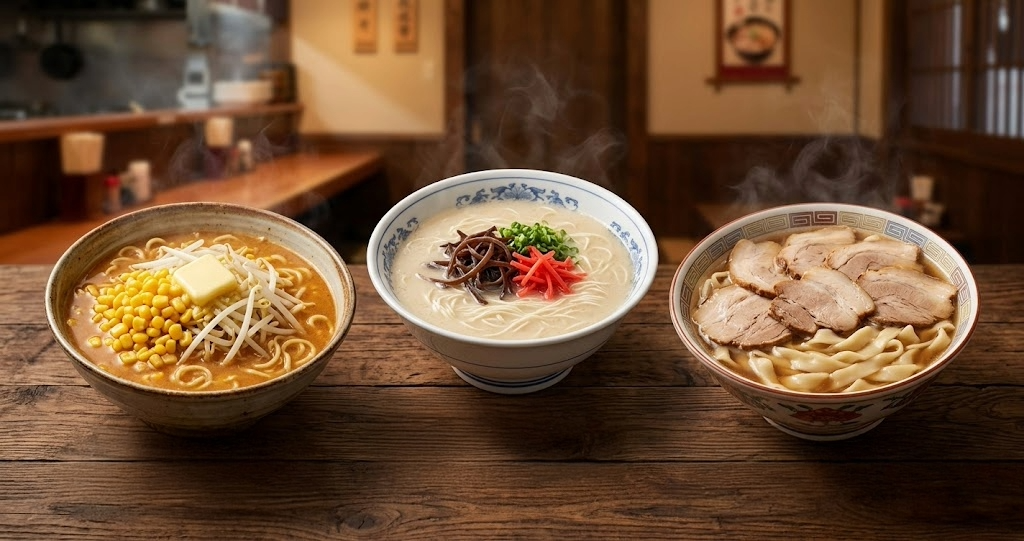
Sapporo miso ramen reached national prominence around 1965, and the style it established has remained remarkably consistent. The broth combines a pork or chicken stock base with a generous quantity of miso, enriched with lard — the layer of rendered fat floats on the surface, forming an insulating seal that holds heat in the bowl. The noodles are medium-thick and curly, with enough body to hold the substantial broth. The standard toppings draw on Hokkaido’s agricultural abundance: sweet corn, a pat of butter (Hokkaido is Japan’s dairy heartland), bean sprouts, finely chopped pork, and often local seafood — scallop, squid, snow crab — that would be out of place in any other regional style.
The result is not a delicate bowl. It is forceful, warming, and deeply satisfying — a bowl built for endurance. The butter melts into the miso broth as you eat, enriching and softening it; the corn adds sweetness; the bean sprouts provide crunch against the otherwise heavy composition. Sapporo ramen is a bowl that changes from first spoonful to last as the components combine.
Hakata Ramen — The White Broth of Kyushu
At the other end of Japan — geographically, climatically, and in terms of flavor profile — is Hakata ramen. It comes from the Hakata district of Fukuoka City, on the northern coast of Kyushu, Japan’s southernmost main island. Where Sapporo ramen is miso-based, layered, and substantial, Hakata ramen is built on a single obsessive foundation: tonkotsu (豚骨) — pork bones, boiled at a rolling boil for six to eighteen hours until the collagen dissolves completely into the broth, turning it opaque, milky white, and intensely porky.
The origins of tonkotsu broth are traced not to Hakata itself but to Kurume, a smaller city in Fukuoka Prefecture. In 1945, a street stall vendor named Tokio Miyamoto, drawing on knowledge of pork bone soup, began serving what became the prototype of tonkotsu ramen. The story of how the broth became so intensely cloudy and rich involves a happy accident: at one early restaurant, a cook left the bones boiling unattended for far longer than intended, only to find that the prolonged high-heat cooking had produced a broth of unprecedented richness. The accident was not undone. It became the technique.
Hakata ramen refined this base into its own distinct identity. The broth is pork-bone at its most concentrated — pale, almost creamy in appearance, with a bold, savory aroma that is unlike any other ramen style. The noodles are deliberately thin and straight, chosen to cook quickly and to slip through the heavy broth rather than absorbing it too fast. They are served firm — the hardness of the noodle (katasa) is a standard order option at most Hakata ramen shops, ranging from yawa (soft) through to barikata (very hard), and regular customers develop firm preferences.
The toppings at a Hakata ramen counter are simple: thin-sliced chashu pork, green onions, wood ear mushrooms, and a soft-boiled egg. But the defining feature of the Hakata ramen experience is the communal condiment tray that sits on every table — pickled red ginger (beni shōga), toasted sesame seeds, crushed garlic, and spicy pickled mustard greens (karashi takana). The diner customizes each bowl mid-meal, adjusting heat, aromatics, and acidity to their preference as they eat.
And then there is kaedama (替え玉) — one of Hakata ramen’s most distinctive customs. When you finish your noodles but still have broth remaining, you call out “kaedama” and receive a fresh portion of noodles to drop into the bowl, priced at a fraction of the original bowl. The broth, still hot and full of flavor, carries a second serving of noodles at no waste. It is an elegant solution to a practical problem: noodles thin enough to cook in ninety seconds are also thin enough to become waterlogged if they sit in broth too long. Kaedama keeps both elements at their best.
Hakata ramen has become, over the past few decades, the most globally exported of the three great styles. The international chains Ichiran and Ippudo — both Fukuoka-origin businesses — have brought tonkotsu ramen to cities across Asia, North America, and Europe, making it the style most likely to be the first encounter a non-Japanese diner has with serious ramen. This global reach has made Hakata the most recognized; it has also, in some circles, made it the most misunderstood — the watered-down versions served internationally bear little resemblance to the intensely concentrated broths of the original Fukuoka shops.
Kitakata Ramen — The Quiet Giant
Of the three great ramen, Kitakata is the one that surprises visitors most. It comes from a small city — population around 45,000 — in the Aizu region of Fukushima Prefecture, in the mountains of northern Honshu. There is no famous chain restaurant carrying its name internationally. There is no dramatic origin story involving industrial-scale cooking or a legendary accidental discovery. Kitakata ramen is famous in Japan for different reasons: it is deeply local, rooted in a specific community and a specific way of life, and it has maintained that character across nearly a hundred years.
The origin is traced to 1927, when a young Chinese man named Pan Qinxing (also recorded as Fan Qinxing in some sources), originally from Zhejiang Province in China, opened a noodle stall in Kitakata called Genraiken. Pan made no secret of his recipe, sharing it freely with the community. The style spread gradually — two restaurants opened in 1945 after the war, and the number grew steadily from there. Today, Kitakata has more ramen shops per capita than any other city in Japan — around 120 shops for a population of under 50,000, roughly one shop for every 400 residents. Locally, the word soba is so commonly used to refer to ramen that the grain-based noodle dish has to be specified as nihon soba to avoid confusion.
The broth is soy sauce-based — not sharp or assertive, but remarkably light and layered, built from a combination of pork bones and niboshi (dried sardines), with a softness that comes in part from the water itself. Kitakata sits near the Tsugamine mountain range, and its groundwater — cold, extremely soft, mineral-gentle — is considered one of Japan’s finest waters and is credited by local ramen makers as essential to the character of the broth. The tare varies from shop to shop: some lean salty, some sweet, some add a hint of miso or blend multiple soy sauce varieties. No two shops are identical, and this diversity within a shared framework is part of what gives Kitakata ramen its character.
The defining element, however, is the noodle. Kitakata ramen uses hirauchi jukusei takasuimen — flat, wide, aged noodles with a high water content, roughly four millimeters across, wavy and curly from the moisture they carry. After manufacturing, the noodles are left to rest — aged — before use, a step that develops their texture and allows the excess moisture to distribute evenly. The result is a noodle that is thick, toothsome, and slightly irregular in curl: it grips the light broth in a way that thinner noodles cannot, and holds its texture long after the bowl has been set down. The combination of a light broth and a substantial noodle is Kitakata’s defining contrast.
Kitakata has one more distinction worth noting: asa-ra (朝ラー) — morning ramen. The local tradition of eating ramen for breakfast is believed to have developed from the city’s history as an industrial and agricultural hub, where factory workers finishing night shifts and seasonal laborers arriving on early morning trains stopped for a warm meal before dawn. Today, several Kitakata ramen shops open as early as seven in the morning, and ordering ramen at eight o’clock on a weekday is entirely unremarkable. It is one of those small, embedded local customs that tells you more about a food’s relationship to a community than any number of guidebook descriptions.
Why These Three
Japan has hundreds of regional ramen styles. Tokyo’s classic shōyu ramen predates all three of these. Wakayama’s milky pork-and-soy broth, Asahikawa’s double-fat soy base, Fukushima’s own Shirakawa ramen with its handmade noodles — all have strong claims on regional significance. So why Sapporo, Hakata, and Kitakata?
The answer is partly historical — all three were among the first regional ramen styles to develop clear, distinctive identities in the post-war period, and all three drew national media attention by the 1970s and 1980s, a period when Japanese food journalism began to codify regional cuisines. It is partly geographic — three regions spread across Japan’s north, south, and mountainous interior represent a natural narrative of diversity. And it is partly culinary — the three styles are genuinely distinct, covering the spectrum of ramen’s core variables: a miso base (Sapporo), a pork-bone base (Hakata), and a soy sauce base (Kitakata); a large modern city, a major regional hub, and a small country town; rich and heavy, intensely savory, and light yet complex.
Together they represent the argument that ramen is not one dish but a framework — a set of principles that Japanese cooks have applied to the specific ingredients, water, climate, and culinary instincts of every corner of the country. What makes ramen extraordinary is precisely this: that the same five-element structure can produce a milky-white Hakata tonkotsu and a light Kitakata shōyu and they are both, unmistakably, ramen.
Quick Reference: Japan’s Three Great Ramen
| Sapporo (札幌ラーメン) | Hakata (博多ラーメン) | Kitakata (喜多方ラーメン) | |
|---|---|---|---|
| Region | Sapporo, Hokkaido | Fukuoka, Kyushu | Kitakata, Fukushima |
| Origin | c. 1955 (miso ramen at Aji no Sanpei) | c. 1945 (tonkotsu in Kurume; refined in Hakata) | 1927 (Genraiken stall by Pan Qinxing) |
| Broth base | Miso (miso tare) | Pork bone (tonkotsu) | Soy sauce (shōyu tare) |
| Stock | Pork / chicken, enriched with lard | Pork bone, high-heat boiled | Pork bone + niboshi (dried sardine) |
| Noodles | Medium-thick, curly | Very thin, straight | Thick, flat, wavy |
| Broth character | Rich, thick, warming | Cloudy white, intensely savory | Light, clear, layered |
| Signature toppings | Butter, corn, bean sprouts | Pickled ginger, sesame, karashi takana | Chashu, naruto, menma, green onion |
| Notable custom | Slotted spoon to preserve broth heat | Kaedama (noodle refill) | Asa-ra (morning ramen culture) |
Ramen arrived in Japan from China, was transformed by post-war scarcity, and became something entirely its own — a dish so regional that the same word means radically different bowls depending on which prefecture you are standing in. Sapporo, Hakata, and Kitakata are not interchangeable. They are the products of different climates, different water, different histories, and different communities. To understand them is to understand that Japanese food culture is not a single tradition but a layered accumulation of local ones — and that a bowl of noodles, at its most serious, can carry all of that weight.
Comment