Ichiban and Niban Dashi: The Two Lives of a Handful of Shavings
A professional kitchen draws two entirely different stocks from the same kombu and the same katsuobushi. The first is made in about a minute and treated as perishable. The second is boiled, pressed, and wrung dry. Neither is a lesser version of the other.
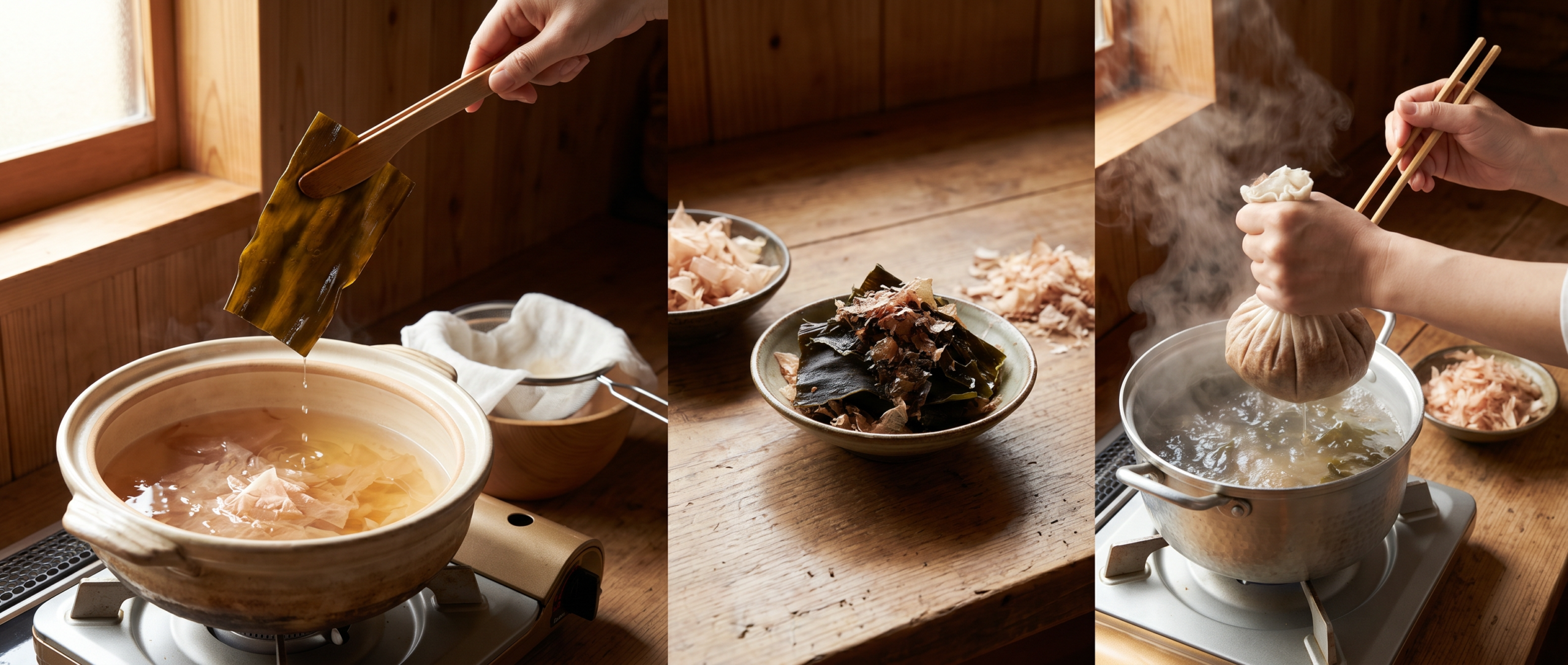
Watch someone strain a first dashi and the strangest moment is the end. The shavings have gone dark and heavy in the sieve, slumped into a wet mound, and there is clearly liquid still in them — you can see it. The cook does not touch them. No spoon, no press, no twist of the cloth. The gold broth drips through at its own pace, and when it stops dripping the cook lifts the sieve away and sets the sodden mass aside.
Not into the bin. Into a bowl, for later.
This is the hinge on which the whole method turns. A Japanese kitchen does not extract everything it can from kombu and katsuobushi in one go. It takes a first pass so brief it barely qualifies as cooking, then comes back to the same exhausted ingredients and takes a second, made by opposite means and destined for entirely different dishes. Ichiban dashi and niban dashi — first stock and second stock. The relationship between them is not the relationship between good and leftover. It is closer to two separate ingredients that happen to share a parent.
The Arithmetic Before the Pot
Proportions in dashi are unglamorous and worth knowing, because most disappointment traces back to using too little of everything. The Japan Kombu Association gives a basic first dashi as ten to twenty grams of kombu and around thirty grams of katsuobushi to a litre of water. The Umami Information Center works to a ratio rather than a weight — kombu at roughly two to five percent of the water’s weight, shavings at one to two percent — which comes out in the same territory. Ninben, the katsuobushi house trading in Tokyo since 1699, specifies ten grams of kombu and twenty grams of shavings per litre for a combination dashi, and notes that a litre of water yields around eight hundred millilitres of finished stock, about four bowls of soup.
The spread between those figures is real and nobody is being careless. Kombu varies enormously by variety and grade, and a cook adjusts to the kelp in hand rather than to a number. But the shape of the thing is consistent: a litre of water, kombu measured in the tens of grams, shavings at roughly twice the kombu. If your dashi tastes like faintly savoury water, the recipe is probably not at fault. The quantity is.
The Kelp, the Fish, and the Two Refusals
The first dashi is two extractions folded into one pot, and the two ingredients are governed by opposite clocks. Kombu gives up its flavour slowly and must be coaxed over half an hour or more. Katsuobushi gives up everything almost at once and must be caught before it does. Nearly every mistake in a first dashi comes from applying one ingredient’s logic to the other.
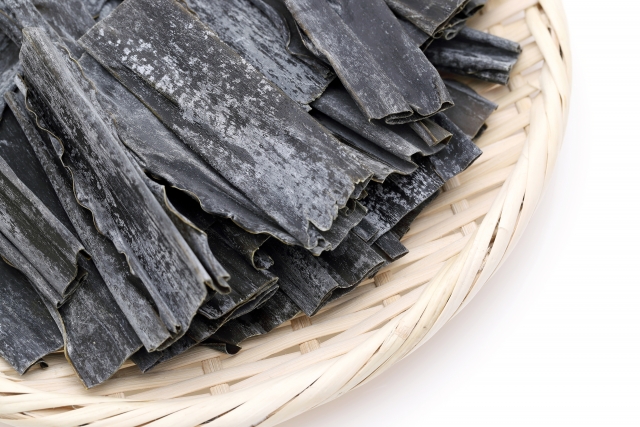
Start with the kelp. Wipe it with a tightly wrung cloth — do not rinse it. The white bloom on the surface is mannitol, and it is flavour, not dust; wash the kelp under a tap and you pour the best of it down the drain. Which kelp you are wiping matters more than most recipes admit, since a sheet of Rishiri and a sheet of Hidaka will not give you the same broth even in identical hands, and we untangled those regional differences in our guide to the kombu coasts of Hokkaido. Steep the wiped kombu in the measured cold water for thirty minutes or so, then bring it up over a medium flame and pull it out just before the boil, at the moment small bubbles begin to rise from the base of the pot.
Now the fish, and the tempo changes completely. Let the water come to a full boil — the shavings need that heat to release their flavour, so this is the one moment in a first dashi where boiling is not only permitted but required. Add the katsuobushi all at once, let the pot lift once more, and take it off the heat immediately.
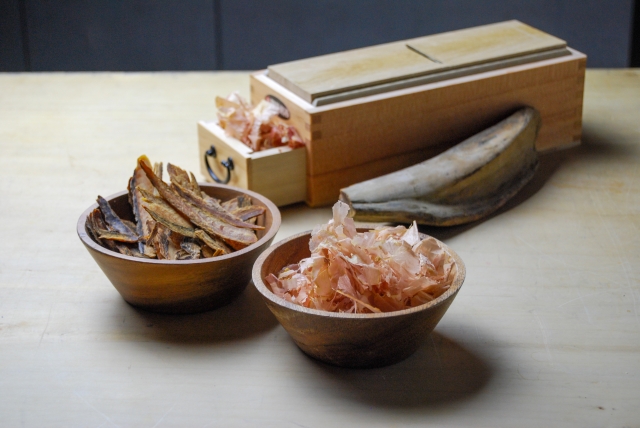
Then do nothing. This is the part that requires more discipline than it sounds. Do not stir the shavings, do not push them under, do not prod them to make them steep faster. Left alone, they absorb liquid and sink on their own, and that sinking is the timer: when they have settled, the extraction is done. Ninben puts it at one to two minutes; the Umami Information Center simply says to wait until the flakes go down. Either way it is over almost before it began. Stirring at this stage does not extract more — it clouds the broth and beats the aroma out of it, which is the whole of what you came for. Then pour everything through a cloth or paper-lined sieve.
So each ingredient is granted one refusal, and both are refusals to take more than is offered. The kombu comes out before boiling, because prolonged heat draws out the kelp’s viscous compounds, which muddy the broth and dull its flavour. And the shavings are never squeezed, because pressing them releases a harsh edge — egumi, that scratchy astringency — into what is supposed to be the cleanest liquid in the kitchen. Ninben’s own guidance is to rest a pair of chopsticks lightly on top of the flakes at most. Nothing more. Pull the kelp early; let the fish go. Everything else in the method follows from those two.
Each ingredient is granted one refusal, and both are refusals to take more than is offered. Pull the kelp before it boils. Never squeeze the fish.
What comes out is clear, amber, intensely fragrant, and fragile. It is for clear soups, for chawanmushi, for dishes where the broth is the thing being tasted rather than a foundation under something else. Its aroma is also its expiry date: made in the morning for lunch service, not made on Sunday for the week. The Umami Information Center’s instruction is blunt — first dashi is all about the aroma of the katsuo, so use it as soon as you make it.
Why the temperature thresholds matter, and why the mineral content of your tap water changes the result, is a longer story that we told separately in the piece on water and the science of softness. It is worth reading before you blame your kombu.
The Argument About Sixty Degrees
There is a rival method, and the disagreement around it is instructive. Around 2002, university researchers working with the Japanese Culinary Academy found that glutamate extraction from kombu peaks when the kelp is held at sixty degrees for one hour. The finding travelled fast, and “sixty for sixty” became the sophisticated way to draw kombu dashi — the Umami Information Center lists it as one of its two standard methods, and the Kombu Association mentions it as an alternative, giving forty minutes at around sixty degrees.
Not everyone is convinced. Konbu Doi, the Osaka kombu merchant, has published a pointed objection: plenty of serious chefs know the research perfectly well and still steep overnight in cold water instead, having tried the sixty-degree method and found it wanting. Their argument is that glutamate is the most prominent component of kombu’s flavour, not the whole of it, and that optimising for a single measurable compound ignores the bitterness, astringency, and everything else unmeasured that separates good kelp from poor. If glutamate concentration were the goal, they point out, you could simply use more kombu — or buy the powder.
Both positions can be held honestly. The research is sound about what it measured. The objection is sound about what it did not measure. For a home cook the practical upshot is liberating rather than confusing: cold steeping overnight, thirty minutes and up to the near-boil, or an hour held at sixty degrees will all give you real kombu dashi, and the differences between them are smaller than the difference between making dashi and not making it.
Coming Back for the Second
The second dashi begins with the sodden mound you set aside. Kombu and shavings go back in the pot with fresh water — the Umami Information Center gives roughly half the original volume, other houses use a full litre again — and this time everything the first dashi forbade is permitted. Bring it to a boil. Keep it there. The Kombu Association simmers for about ten minutes; Ninben, working with a smaller volume, gives three to five. The goal is no longer delicacy but thoroughness: to drive out what remains.
Then comes the move that makes the second dashi work, and it has a name. Oigatsuo — “chasing katsuo” — is the addition of a small quantity of fresh shavings at the very end, off the heat, left to steep a minute or two. Ten grams per litre by the Kombu Association’s count, about five in Ninben’s smaller batch. The logic is precise. The long boil has recovered the residual umami from the spent ingredients, but aroma is volatile and the first dashi took nearly all of it. The chase-katsuo puts the fragrance back. It is a repair, deliberately designed, and it is the difference between a second dashi and dishwater.
And now you squeeze. Press the shavings with chopsticks, wring the cloth, take the last drop. The astringency you were so careful to avoid an hour ago is welcome here, where it reads as body and depth rather than as a flaw. Second dashi comes out slightly cloudy — proteins and fats driven out of the katsuobushi by the boiling — and it is the everyday stock: miso soup, simmered dishes, takikomi gohan, hot pots. In most Japanese homes, on most days, this is what dashi actually means.
The first dashi refuses to squeeze. The second dashi insists on it. The same shavings, the same cook, opposite instincts, an hour apart.
Some cooks go further still. A third dashi — the spent ingredients boiled hard in another litre — is thin in colour and flavour and no use as a broth, but it makes an excellent cooking liquid for noodles or for boiling potatoes and taro, lending a ghost of savour and letting you season with less salt. Then the solids themselves are chopped and simmered down with soy, sugar, and mirin into tsukudani or a rice sprinkle. Nothing that cost money leaves the kitchen unused.
How Thick Is the Shaving
One variable sits upstream of all of this and is easy to overlook: how finely the katsuobushi was shaved. Japanese Agricultural Standards draw the line at 0.2 millimetres. Anything at or below that is usukezuri, thin-shaved — the familiar hanakatsuo, often shaved as fine as three to six hundredths of a millimetre, translucent and almost weightless. Anything thicker is atsukezuri.
The distinction is not a matter of grade but of method, and it decides whether you steep or you simmer. Thin shavings surrender their flavour almost instantly, which is exactly why first dashi takes a minute and why the broth stays clear and aromatic — there is no time for the fragrance to boil off. Thick shavings cannot work that way. They must be simmered, and simmered long: around twenty minutes for a half-millimetre cut, and upward of forty for the millimetre-plus shavings used in commercial kitchens. What emerges is dark, heavy, and deeply savoury, with the aroma largely cooked away — which is precisely why noodle broths, oden, and long-simmered dishes are built on it, and why those kitchens so often finish with a chase-katsuo of thin shavings to restore what the boiling took.
So the two dashi are not merely two stages. They are two philosophies of extraction, and the shaving you buy commits you to one of them before you have boiled any water.
The Dashi With No Fish In It
There is a version of all this that predates none of it but answers to a different rule entirely. Shōjin dashi is the stock of Buddhist temple cuisine, and because flesh is prohibited, katsuobushi is simply unavailable. What remains is kombu, and alongside it dried shiitake, soybeans, kanpyō, dried vegetable peels — the dried larder, standing in for the sea.
Dried shiitake is the centrepiece, and the reason is a genuinely strange piece of chemistry. Fresh shiitake contains almost no guanylate, the nucleotide that gives the mushroom its umami. It is not sitting in the mushroom waiting to be extracted; it has to be manufactured, and the cook manufactures it. Drying ruptures the cell structure, exposing the RNA inside. Soaking allows enzymes to reach it. Nuclease then cleaves that RNA into guanylate — while a second enzyme, phosphatase, works in the opposite direction, degrading guanylate into tasteless guanosine.
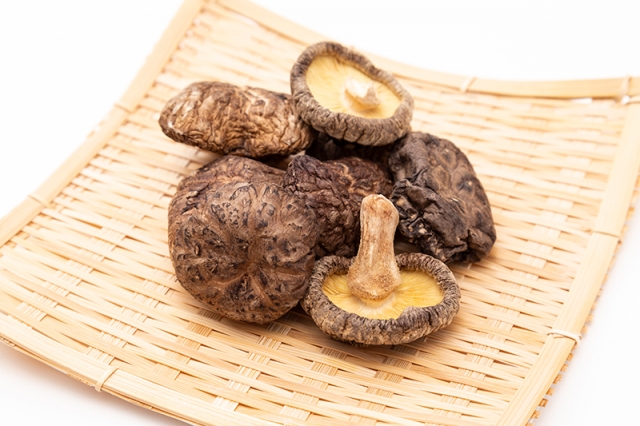
Everything depends on which enzyme you favour, and the lever is temperature. A study by the Aichi Center for Industry and Science Technology soaked dried shiitake three ways and measured what came out: cold water at four degrees for sixteen hours, warm water at forty degrees for three hours, and boiling water for an hour. Guanylate was detected only in the boiling-water sample. More revealing still, when the researchers added pure guanylate to the cold and warm soaks at the start, they could not find it at the end — it had been destroyed. But when the cold-soaked mushrooms were subsequently heated, guanylate appeared. The warm-soaked ones, heated the same way, produced none; their generation and destruction had already run to completion in the bowl.
Which yields a rule that sounds fussy but is simply the two-enzyme story restated. Soak cold, ideally in the refrigerator, for several hours or overnight — the degrading enzyme is most active in the roughly ten-to-forty-degree band, so cold keeps it idle. Then heat, and heat briskly rather than gently, moving through that destructive range fast and holding in the fifty-to-seventy-five-degree window where the generating enzyme does its work. Push past eighty and that enzyme deactivates too. The soaking liquid is not waste water. It is the dashi, and it carries flavour that has not yet fully formed — which is why shiitake dashi must always be heated at some point in cooking, never used raw from the bowl.
The Umami Information Center’s own shōjin formula keeps the two streams separate and combines them at the end: kombu drawn hot, shiitake drawn cold, then blended and strained. It is worth knowing that the resulting stock is assertive rather than delicate. The centre cautions that dried shiitake is powerful and idiosyncratic enough to unbalance a dish if overused, and shiitake specialists note that excessive guanylate concentration begins to register on the tongue as bitterness — a problem solved, mercifully, by dilution.
There is a pleasing symmetry in it. The temple cook, forbidden the fish, reaches for a mushroom that must be dried, soaked cold, and then heated in a precise order before it will give up anything at all. Restriction produced a technique more demanding than the one it replaced.
Why Two, and Not One
It would be simpler to make one dashi. Boil everything hard, squeeze the lot, get a strong stock, move on. Kitchens all over the world do essentially that and produce excellent results.
The two-stage method exists because Japanese cooking asks two incompatible things of the same ingredients. A clear soup needs a broth that is fragrant, transparent, and almost weightless, and the only way to get it is to stop early and take nothing by force. A pot of simmered daikon needs a broth with enough backbone to stand up to soy and mirin over half an hour of heat, and delicacy there is simply wasted. One extraction cannot serve both. So the kitchen runs two, in sequence, and assigns each to the dishes it suits — which also means that a household using thirty grams of good katsuobushi is using it twice, and then eating it. Frugality and precision arriving at the same answer.
That doubling is why the verb matters. Japanese does not say one makes dashi; one draws it, hiku, and we followed that word into its philosophy in our article on dashi as Japan’s invisible foundation. Standing at the pot, the word turns practical. Drawing is something you can do more than once, in more than one way, taking what the ingredient will give on its own terms the first time and going back for the rest on different terms the second. The cook decides not how much flavour to extract but when to stop — and then, an hour later, when to stop being gentle.
Read, then taste. This article is part of Waden’s Technique series — exploring the craft, philosophy, and practice behind Japanese culinary methods. Read more at waden.umamibako.com.
Waden is an editorial journal exploring the depth and beauty of Japanese food culture — its history, ingredients, artisans, and traditions. Story first, always. waden.umamibako.com
Comment