The Uni Coast: Sea Urchin and the Geography of Japan’s Cold Shores
Four out of every five sea urchins landed in Japan come from two stretches of coastline. It is not an accident of fishing effort. It is a map of where kelp grows — and uni is, in the most literal sense, kelp that has been eaten and rearranged.
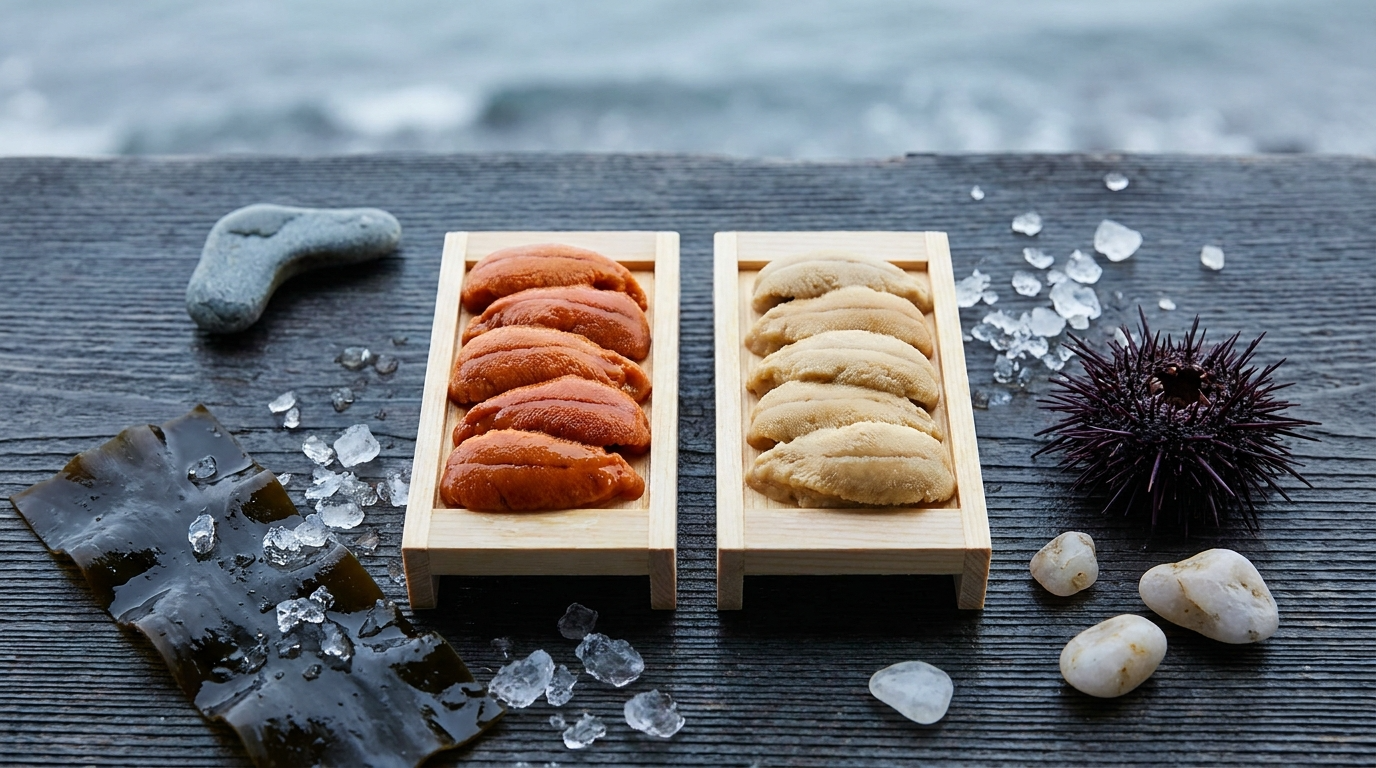
On a good counter, uni arrives on a small wooden tray, still in the shape it held inside the shell: five plump lobes, laid out like the petals of something. Look closely at two trays side by side and you will often see that they are not the same color. One is deep orange, almost red-brown, dense-looking. The other is pale, closer to cream than to gold. A chef who cares will tell you these are different animals, and probably different coastlines, and possibly different months.
Almost everything interesting about uni is contained in that difference. Because uni is not really a seafood in the way a fish is. A fish swims across a range. A sea urchin sits on a rock and eats whatever drifts within reach of it for years. What ends up on the tray is a slow accumulation of one specific patch of seabed — which is why, of all the things Japan pulls out of the ocean, uni may be the one most completely determined by geography.
Two Coastlines, Eighty Percent of the Catch
The numbers are unusually stark. In 2023, Japan’s total sea urchin catch came to 7,204 tonnes. Hokkaido alone accounted for 4,091 of them — 56.8 percent. Iwate contributed 17.9 percent and Miyagi 9.1 percent. Add those three together and more than 83 percent of Japan’s uni comes from Hokkaido and the Sanriku coast that runs south from it. The previous year’s figures tell the same story: 6,518 tonnes nationally, with Hokkaido at 56.1 percent.
Uni is eaten enthusiastically all over Japan. It is caught, essentially, in the north.
The reason is the same reason those waters produce anything else worth eating. The Oyashio current runs cold and heavy with nutrients down the eastern side of Hokkaido and along Sanriku; the Sea of Japan side gets its own cold, mineral-rich water. Cold, nutrient-dense water on rocky substrate grows kelp. Kelp forests feed sea urchins. The uni coast and the kombu coast are the same coast, and that is not a coincidence but a food chain.
What You Are Actually Eating
It helps to be precise about the part of the animal on the tray, because almost everyone gets it wrong at first.
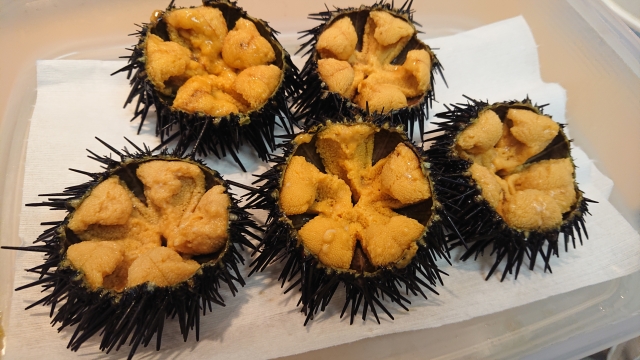
The five lobes are gonads — ovaries in females, testes in males. They are not roe. Japanese cooks and fisheries scientists do not sort uni by sex, and there is a good empirical reason: work by Murata Yuko and colleagues at the Japan Fisheries Research and Education Agency, published in Fisheries Science in 2020, compared free amino acid profiles across the six commercially eaten Japanese species and found the composition of male and female gonads to be very nearly identical at the stage when they are harvested. You cannot taste the difference because, at that stage, there is essentially no difference to taste.
That phrase — at that stage — is the crux of the whole subject. A sea urchin’s gonad is not primarily a reproductive organ for most of the year. It is a warehouse. The animal stockpiles nutrients in specialised storage cells inside the gonad, and only later converts that reserve into eggs or sperm as spawning approaches. The same study found that the species split cleanly into two harvest strategies: bafun uni and aka uni are eaten before gamete formation begins at all, while murasaki uni, kita-murasaki uni, ezo-bafun uni and shirahige uni are eaten at its earliest stage.
What we prize as uni, in other words, is stored food that has not yet been spent. Once the animal commits that reserve to reproduction, the flesh turns watery, bitter, and structurally soft. This is why uni has one of the hardest deadlines of any Japanese ingredient — a real biological window rather than a matter of taste, and one of the clearest illustrations of what shun actually means.
Inside that window, the flavor comes down to a short list of free amino acids. Glycine and alanine, both sweet, dominate. Glutamic acid supplies umami. Valine contributes bitterness. Methionine, present in small amounts, is generally credited with the specific marine note that makes uni taste like uni and not like anything else. Adjust the ratios and you adjust the eating experience — a fact that turns out to matter enormously later in this story.
Six Species, and the Two That Rule the North
Japan commercially harvests six edible urchins, but the northern trade runs on two.
Ezo-bafun uni (Strongylocentrotus intermedius) is the small one with the green-brown shell and short spines, and it produces the deep orange gonad — the color you see in the expensive box. It is generally the richer, sweeter, more concentrated of the two, and it commands the higher price. Its peak in Hokkaido runs roughly July through September.
Kita-murasaki uni (Mesocentrotus nudus) is the larger, longer-spined urchin whose gonads run pale yellow to light cream. Its flavor is cleaner and lighter, less overwhelming, and many people prefer it precisely for that. It peaks a little earlier, roughly June to August. Despite the name, it is more closely related to ezo-bafun uni than to the southern murasaki uni it resembles.
Further south the cast changes. Bafun uni (Hemicentrotus pulcherrimus), the small one behind much of the famous uni of western Japan, peaks in early spring — around March and April — which is why “uni is a summer food” is only true for the north. Murasaki uni (Heliocidaris crassispina) is the common warm-water species, peaking in early summer. Aka uni and shirahige uni round out the six, the latter mostly a southern and Okinawan proposition.
Two species, two colors, two seasons, two prices — on one counter, in one tasting, if you are lucky.
The Kelp Argument
Walk into a shop in Rishiri or Rebun, the two islands off Hokkaido’s northern tip, and you will be told the same thing you will be told in Shakotan and Hakodate: our uni is good because our urchins eat good kombu.
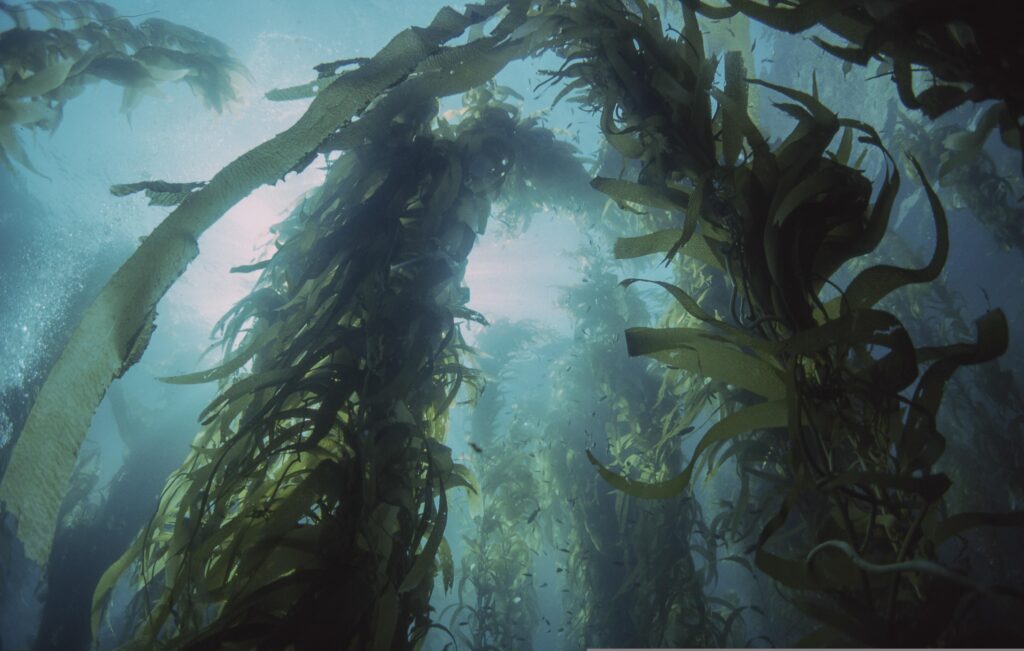
Rishiri kombu is one of the premium kelps of Japan, the one favored in Kyoto kaiseki kitchens for the clarity of the dashi it gives — a variety we cover in detail in our guide to the kelps of the Hokkaido coast. The urchins grazing beneath those kelp beds are eating, quite literally, the raw material of Japanese umami. The islands sell their summer uni under the name shima-uni, island urchin, and the marketing writes itself.
How much of this is romance? Less than you might assume. The specific claim that Rishiri kombu confers a distinctive flavor is not something anyone has isolated in a laboratory. But the general claim — that what an urchin eats determines how its gonads taste — is not folklore at all. It is the operating principle of an entire field of applied fisheries research. Controlled feeding trials in Hokkaido and elsewhere have repeatedly shown that diet changes gonad size, gonad color, and the free amino acid profile of the flesh. Feed an urchin differently and it tastes different, measurably. The fishermen are right about the mechanism even where they are unprovable about the particulars.
The Pasture at Hirono
The most literal expression of that idea sits on the Iwate coast, and it is roughly sixty years old.
The town of Hirono, at the northern end of Sanriku, has a wide, shallow bedrock shelf offshore — good rock, but so shallow that at low tide the water drains off it and the seaweed dries out and dies. In the late 1960s local fishermen responded by cutting channels into the bedrock: 178 of them, running roughly 17 to 18 kilometres in total length along the shore. The grooves hold seawater when the tide falls, and they catch the kelp and wakame that drift in from offshore, concentrating it where urchins can reach it.
They are called uni bokujō — urchin pastures. The fishermen dug feeding troughs into the coast of Japan and let the sea fill them.
The system that grew around them runs on a four-year clock. Juvenile urchins are raised for their first year at a hatchery in Taneichi port, then released to open fishing grounds for about two years, then moved into the channels for a final year of concentrated grazing before harvest. The product is sold, accurately, as yonen-uni — four-year uni. It is one of the few cases anywhere in Japanese fisheries where you can name the specific trench a piece of seafood grew up in.
The Ninety Days
Northern uni seasons are short and locally legislated, and they organise the entire summer of the towns that hold them. On the Shakotan Peninsula west of Otaru — the coast of the famously blue water — the fishery opens around June 1 and closes at the end of August: roughly ninety days, minus every day the sea is too rough for the small boats to go out. Rishiri and Rebun run through the same high summer. Rausu, Nemuro and Hakodate each keep their own calendars.
The gear has barely modernised, because it cannot. Uni are picked one at a time from a small boat, the fisherman leaning over the side with a wooden box-glass pressed to the surface to see through the chop, working a long-handled hook or net down onto the rocks. It is a fishery conducted by hand, in a three-month window, by people who can only work on calm days. That is a substantial part of why uni costs what it does — and why, when it arrives as a gunkan-maki on a band of nori, the rice beneath it has to be judged as carefully as the uni itself.
When the Kelp Goes
There is a dark version of the same food chain, and it now shapes the industry as much as the good version does.
Isoyake — literally “burnt shore” — is the Japanese term for the collapse of a kelp forest into bare, urchin-covered rock. Elsewhere it is called an urchin barren. The mechanism is a trap: when kelp beds thin out, whether from warming water, nutrient changes, or grazing pressure, the urchins do not starve and die off. They persist for years in a semi-fasting state, eating any new sprout before it can establish, and their gonads stay small, pale, and worthless. You end up with a seabed carpeted in sea urchins and no sea urchin worth harvesting.
Japan’s Fisheries Agency treats isoyake as a national problem and publishes formal countermeasure guidelines; Hokkaido convenes a standing prefectural conference on it. In northern Japan urchins are the principal culprits; in the west it is more often herbivorous fish like aigo and parrotfish, whose ranges are expanding northward as the sea warms. The standard response has been urchin removal, and researchers at Hokkaido’s own research organisation have noted a discouraging pattern in recent years: in a growing number of sites, removing the urchins no longer brings the seaweed back. The system has shifted into a state that does not simply reverse.
The Cabbage Urchins
Out of that problem came one of the more elegant ideas in recent Japanese fisheries.
In 2017, Usui Kazushige at the Kanagawa Prefectural Fisheries Technology Center made a straightforward observation about the murasaki uni being culled from barrens: they were large, they were healthy enough, they were simply empty — and they are omnivores that will eat almost anything. So he fed them cabbage. Specifically, off-grade cabbage that could not be sold, from a prefecture that grows a great deal of it.
It worked. The urchins filled out; the gonads developed; measurements of the key amino acids — sweet glycine and alanine, umami glutamate, bitter valine — confirmed that the flesh was not merely present but palatable. Kanagawa describes it as the first vegetable-only urchin rearing in Japan, and kyabetsu-uni became a minor national story. Variations have since spread: Tokushima has run trials using unused parts of agricultural produce, and similar ranching schemes have appeared in Oita and elsewhere. Hirono’s own producers now fold reclaimed barren urchins into their operation.
The logic is almost too neat. A creature that destroys kelp forests is removed from the sea, fed a crop that would have been thrown away, and sold as a delicacy. It does not solve isoyake. But it converts part of the damage into value, and it demonstrates the underlying point about uni with unusual clarity: the animal is a vessel. What goes in determines what comes out.
Alum, Seawater, and the Bitterness Problem
One more thing stands between the coast and the plate, and it accounts for most bad uni experiences.
Uni gonads have no skin. Removed from the shell, they slump and dissolve. The traditional solution for the flat wooden trays of ita-uni is a dip in a dilute solution of potassium alum — myōban — which firms the surface and holds the lobes in shape for transport. It works, and it costs something: alum brings its own bitter, astringent edge, and the lower the quality of the urchin, the more of it tends to be used to keep the pieces intact.
The alternatives have been gaining ground. Shiosui-uni is packed in sterilised seawater at natural salinity, no alum at all, at the cost of a much shorter shelf life. Whole urchins sold in the shell, split at the counter, are the purest version and the most trouble. If you have eaten uni and found it metallic or bitter and concluded you dislike uni, there is a reasonable chance you have never actually tasted it.
A Small, Specific Piece of Sea
Japan eats a large share of the world’s sea urchin — by most industry accounts, the majority of everything traded — and it cannot begin to catch what it eats. Estimates of the imported share of Japanese consumption vary considerably, generally landing somewhere between roughly sixty and eighty percent, with Russia, Chile, the United States, Canada, and China supplying the bulk. Chilean frozen uni arrives in quantity; Russian uni has recently dominated by value.
Which puts those 7,204 domestic tonnes in perspective. The uni coast is not Japan’s supply. It is a narrow, seasonal, hand-picked fraction of it, produced in a three-month window by people working small boats over specific rocks, from an animal whose entire flavor is a record of the kelp growing directly above it.
That is what you are tasting on the wooden tray: not a fish that swam past, but a place that was slowly eaten and stored. Cold current, bare rock, a forest of kelp overhead, and four years of grazing — compressed into five orange lobes and a window of about ninety days.
Read, then Taste.
This article is part of Waden’s Origin series — tracing Japanese ingredients back to the land and water that made them. Read more at waden.umamibako.com.
Waden is an editorial journal exploring the depth and beauty of Japanese food culture — its history, ingredients, artisans, and traditions. Story first, always. waden.umamibako.com
Comment