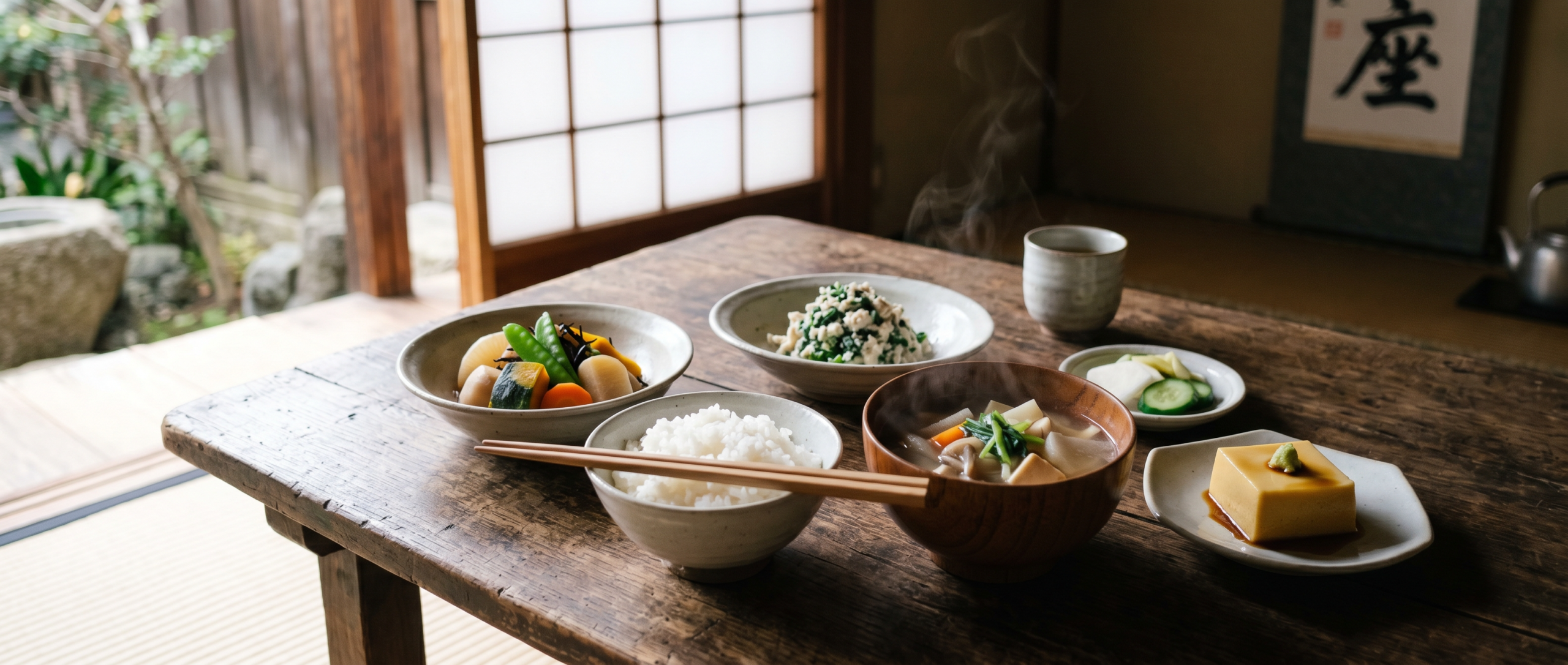
Cooking as Devotion: A Guide to Japan’s Zen Temple Cuisine
The Zen Spirit of Shōjin Ryōri
In 1237, a Zen master named Dōgen wrote a short text about cooking. It is not a recipe book. It contains no precise measurements, no seasonal menus, no instructions for specific dishes. What it contains instead is a philosophy: that the act of preparing food and the act of pursuing enlightenment are not two different activities but one. That the monk assigned to the temple kitchen holds a role of equal spiritual weight to the monk seated in meditation. That a poorly washed rice pot is a failure of concentration, and a meal prepared with full attention is an act of devotion as complete as prayer. That text — the Tenzo Kyokun, “Instructions for the Cook” — became the foundation of shōjin ryōri, Japan’s tradition of Buddhist temple cuisine, which has now been practiced continuously for eight hundred years.
What the Words Mean
Shōjin ryōri (精進料理) is composed of two terms. Ryōri (料理) means cooking or cuisine — straightforward. Shōjin (精進) is harder to render in English. It denotes devotion, diligence, and the progressive effort of following a spiritual path — an active, disciplined commitment to practice rather than a passive state of virtue. The meaning of shōjin in Buddhism is to make an “effort” and “progress” in pursuit of the Buddha’s teachings. Food prepared or consumed without such commitment could not be labeled as shōjin, even if it consisted of only plant-based ingredients.
This is the first and most important thing to understand about shōjin ryōri: it is not simply vegetarian food. Vegetarian food is defined by what it excludes — meat, fish, animal products. Shōjin ryōri is defined by the quality of attention brought to every aspect of its preparation and consumption. The vegetables, tofu, and grains of the temple kitchen become shōjin ryōri not through their ingredients alone but through the mind that selects, prepares, and serves them. A meal of identical ingredients, made without that intention, would be something else — ordinary food that happens to be plant-based.
A History of Eight Centuries
Buddhism arrived in Japan in the 6th century CE — traditionally dated to 552, recorded in the Nihon Shoki — and with it came the foundational dietary precept of ahimsa: non-harm, the prohibition against taking life. Japanese Emperor Tenmu formalized this principle in 675, issuing an edict that prohibited the consumption of meat by priests, and the prohibition gradually shaped the food culture of Japan’s temples and aristocratic classes through the following centuries. Vegetarian food was already being prepared in temples during the Nara period (710–794), but it was not yet systematized, and it had not yet acquired the philosophical depth that would make it into shōjin ryōri.
That transformation came with Zen Buddhism and with one remarkable figure. Dōgen Zenji (1200–1253) traveled to China in the early 13th century to study Zen, and returned to Japan carrying not only the practice of zazen seated meditation but also a fully developed philosophy of the kitchen. In 1237, he wrote the Tenzo Kyokun — ten years after his return from China. In 1244, he founded Eiheiji temple in what is now Fukui Prefecture, which became one of the two head temples of the Soto school of Zen Buddhism and remains today one of the primary centers of living shōjin ryōri practice.
Dōgen’s teaching was specific and demanding. The tenzo — the head cook of the Zen temple — was not a servant assigned to a mundane task. The tenzo held a position of high spiritual responsibility, selected for maturity, experience, and quality of mind. Dōgen wrote that the tenzo should approach the rice and vegetables in the kitchen with the same care that a great Zen master handles the finest ingredients for a feast — not because the ingredients themselves require reverence, but because full attention and care are the point, regardless of what they are applied to. “Without ‘the Way-seeking mind’,” Dōgen wrote, cooking “is nothing but a vain struggle and hardship, without benefit in the end.”
During the Muromachi period (1336–1573), shōjin ryōri was refined alongside the development of the tea ceremony, whose aesthetic overlapped substantially with the temple kitchen’s emphasis on simplicity and seasonal awareness. By the Edo period (1603–1868), the cuisine had spread well beyond the monastery walls: it became conventional at Buddhist memorial services and funerary rites, where it remains common practice across Japan today, meaning that most Japanese people have encountered shōjin ryōri at some point in their lives, typically at a ceremony honoring the dead.
What Cannot Be Used — And Why
The restrictions of shōjin ryōri are well known in outline: no meat, no fish, no animal products. But the full set of prohibitions is more nuanced, and understanding them reveals something about the philosophy behind the cuisine.
The exclusion of animal products follows directly from the ahimsa principle — the prohibition against taking life. This extends to fish and shellfish, which are living creatures, and to eggs, which are potential life. Dashi — the foundational stock of most Japanese cooking — is typically made from katsuobushi (dried bonito flakes) or niboshi (dried sardines), both animal products; shōjin ryōri replaces these with kombu dashi, produced by steeping dried kelp in cold water, or with shiitake dashi from dried mushrooms. The resulting stock is lighter and more restrained than fish-based dashi, but its umami — derived from the glutamates naturally present in kombu and shiitake — is substantial.
Less obviously, shōjin ryōri also prohibits five pungent vegetables called the gokun (五葷): garlic, onions, leeks, chives, and rakkyō (Chinese scallions). The prohibition comes from Chinese Buddhist tradition and has both spiritual and physiological rationale: these vegetables were believed to agitate the mind, disturb sleep, and inflame physical desire — qualities incompatible with the mental clarity that meditation requires. Raw, they were said to arouse anger; cooked, to arouse desire. Whatever the modern reader makes of this reasoning, the practical consequence is a cuisine that builds its flavor without the aromatic foundation that garlic and onion provide in nearly every other world cuisine — a constraint that makes shōjin ryōri’s flavor achievements more remarkable, not less.
The principle of not wasting is equally fundamental. Dōgen was explicit on this point: every part of every ingredient must be used. The outer leaves of a cabbage, the scraping from the inside of a sesame mortar, the trimmed ends of vegetables — none of this is discarded. This principle produces a cuisine that treats ingredients with the kind of thoroughness that modern restaurant cooking often lacks: skins are cooked as a separate component, trimmings become stock or seasoning, and what is left after a dish is prepared finds its way into the next one.
The Rule of Five: Goshoku, Gomi, Gohō
Shōjin ryōri is built on a structural framework called the “rule of five” — a set of principles that guides how a meal is composed across its courses. The framework operates on three axes simultaneously: color, flavor, and cooking method.
Goshoku (五色) — Five Colors: Every shōjin ryōri meal aims to include all five colors: white (rice, tofu, daikon — representing purity and clarity), black (sesame, seaweed, shiitake — representing depth and grounding), red (pickled plum, carrots, azuki beans — representing vitality and warmth), green (leafy vegetables, edamame, matcha — representing growth and renewal), and yellow (pumpkin, yuzu, miso — representing earth energy). This is not decoration for its own sake. The Buddhist understanding is that visual harmony supports physical and spiritual health — that eating with the eyes is part of eating fully. In practice, it functions as a nutritional guide that produces broad variety without requiring explicit dietary calculation.
Gomi (五味) — Five Flavors: The five tastes — sweet, sour, salty, bitter, and umami — must all be present across the courses of a meal, with no single flavor dominating. The ideal of tan-mi (淡味, “light flavor”) runs through shōjin cuisine: the natural taste of each ingredient is the standard, not the intensity of seasoning applied to it. A carrot properly prepared expresses its sweetness; a well-made kombu dashi expresses its umami. Shōjin ryōri does not employ strong seasonings or heavy sauces that override the true flavors of individual ingredients. The food is refined and flavorful because the ingredients are local and fresh, prepared with care rather than concealed by force.
Gohō (五法) — Five Cooking Methods: A complete shōjin ryōri meal uses all five techniques across its courses: raw (nama), simmered (niru), grilled (yaku), steamed (musu), and fried (ageru). This ensures textural variety and demonstrates the cook’s skill in drawing different qualities from the same limited palette of ingredients. The same piece of tofu can be silken and cold in one course, lightly grilled and scored in another, crumbled and sautéed in a third. The technique is the variable; the ingredient is the constant; the variation is the point.
Together, these three axes — fifteen elements in total — aim to produce what the tradition calls perfect nutritional and sensory harmony. The framework is simultaneously a spiritual practice and a remarkably sophisticated system of dietary balance, developed without modern nutritional science but producing, in practice, meals that contemporary dietitians would recognize as comprehensive.
The Ingredients: Protein Without Animals
One of the most significant contributions of shōjin ryōri to Japanese food culture as a whole is the development of plant-based protein sources of extraordinary variety and refinement. Faced with the prohibition against animal products and the need to sustain monks engaged in demanding physical and mental training, the temple kitchen became the primary laboratory for Japanese soybean cuisine.
Tofu in its many forms — fresh silken, firm pressed, grilled, and freeze-dried as kōya-dōfu — provides both protein and textural variety. Kōya-dōfu, frozen and dried and then rehydrated in seasoned dashi, becomes spongy and deeply absorbent, soaking up the flavors of whatever it is cooked with — a quality prized in shōjin cooking where the interaction between the ingredient and its cooking liquid is the primary means of developing flavor.
Yuba (湯葉) — the skin that forms on the surface of soy milk as it is heated — is lifted and either served fresh, draped over a dish with its delicate sweetness intact, or dried and used as a wrapping material or textural element. Yuba is one of the most refined expressions of soybean flavor available in any cuisine, and its development as a serious ingredient is almost entirely the product of shōjin ryōri practice. Kyoto, with its exceptional soft water and long tradition of temple cooking, remains the center of yuba production.
Fu (麩) — wheat gluten — provides a protein-rich ingredient with a remarkably meat-like texture when prepared correctly. Namafu (生麩, fresh wheat gluten) is made by washing the starch from wheat dough until only the gluten proteins remain, then shaping and cooking the result. It absorbs flavors with efficiency and takes on a tender, slightly chewy texture that makes it one of the most satisfying of shōjin ryōri’s non-animal proteins. Seasonal varieties of namafu — colored with matcha, sakura, or seasonal vegetables — are among the most visually striking elements of Kyoto’s temple cooking.
Sesame is the fat source and one of the primary flavor elements of shōjin ryōri. Ground sesame paste mixed with kuzu starch and water, set into a firm custard and served chilled with wasabi and soy sauce, becomes goma-dōfu (胡麻豆腐) — sesame tofu — the single most iconic dish of the tradition. Despite its name, it contains no soy. It is made entirely from sesame and starch, which together produce a texture of extraordinary smoothness and a nutty, clean flavor that is unlike anything in any other cuisine. Making authentic gomadofu requires grinding the sesame by hand in a mortar for thirty to forty minutes — an act that is itself a form of meditation.
The Meal: Ichijū Sansai and Its Expansions
The standard format of a shōjin ryōri meal is ichijū sansai (一汁三菜) — one soup and three side dishes, served with rice and pickles. This format, which predates shōjin ryōri and runs through Japanese food culture at every level, provides the structural framework within which the rule of five is applied. At more elaborate temple meals — for special occasions or guests — the format expands to ichijū gosai (one soup, five dishes) or beyond, though the organizing principles remain constant.
The soup is almost always kenchinjiru (けんちん汁) — a clear kombu-based broth with root vegetables, mushrooms, and tofu, seasoned with soy sauce and mirin. Its origin is traditionally traced to Kenchoji temple in Kamakura, one of Japan’s most important Zen monasteries, where it was said to have developed from the practice of using broken tofu — pieces too imperfect for other preparations — in a vegetable soup. The story is probably legend, but it reflects the shōjin principle of waste-nothing precisely.
The side dishes rotate around the five-color and five-method frameworks: a nimono (simmered dish) of seasonal vegetables in dashi; a shira-ae (白和え), vegetables dressed in seasoned mashed tofu; pickled or vinegared preparations for acidity; and grilled or fried elements for textural contrast. Each course is served in its own vessel, chosen with the same care given to the food — the selection of tableware in shōjin ryōri follows the same seasonal and aesthetic logic as kaiseki.
The meal is eaten in silence, or in the attentive near-silence of a community that understands eating as practice. Before eating, the traditional five-part reflection — the gokan no ge — is recited or contemplated: considering how the food arrived, whether one’s own virtue merits it, releasing the mind from greed, receiving the food as medicine for the body, and dedicating oneself to the path. The recitation takes less than a minute. What it establishes is an orientation: this meal is not a break from practice. It is practice.
Shōjin Ryōri’s Legacy in Japanese Cuisine
The influence of shōjin ryōri on the broader history of Japanese food is difficult to overstate. The cuisine arrived at a moment when Japan had no systematic culinary tradition for plant-based cooking, and over eight centuries it produced techniques, ingredients, and aesthetic principles that spread far beyond the monastery walls.
The development of tofu cuisine in Japan is almost entirely a product of temple cooking — the dozens of tofu preparations that now constitute ordinary Japanese home cooking were developed by monks seeking variety within constraint. The tempura technique — vegetables and seafood coated in batter and briefly deep-fried — is believed to have entered Japan through the influence of Portuguese missionaries in the 16th century, but its refinement into the precise, light-battered form associated with Japanese tempura today was partly the work of temple cooks producing vegetable tempura within shōjin precepts. The seasonal structure of Japanese cuisine, its emphasis on the intrinsic flavor of individual ingredients rather than the masking effect of strong sauces, and its integration of aesthetic consideration into everyday cooking all reflect principles that shōjin ryōri articulated most clearly and practiced most consistently.
Kaiseki ryōri — the haute cuisine of Kyoto and the tea ceremony — shares with shōjin ryōri its seasonal framework, its rule of five, and its conviction that the vessel and the presentation are as much a part of the meal as the food itself. Both share an emphasis on seasonality, presentation, and the Rule of Five, but their purposes differ: kaiseki aims to delight; shōjin ryōri aims, first and last, to awaken.
Experiencing Shōjin Ryōri Today
Shōjin ryōri is still served in active Zen monasteries across Japan, where monks prepare it daily in temple kitchens and eat in the same style, as they have for centuries. The most historically significant places to experience it are Eiheiji in Fukui Prefecture — the temple Dōgen founded in 1244, still one of Japan’s most important Zen training monasteries — and Kōyasan in Wakayama Prefecture, the mountain complex that is the center of Shingon esoteric Buddhism, where temple lodgings (shukubō) offer overnight stays with morning shōjin meals.
In Kyoto, which has preserved both the physical infrastructure and the culinary culture of temple life more completely than any other Japanese city, several temple restaurants and secular establishments serve shōjin ryōri in settings designed to communicate the spirit of the tradition as well as its flavors. Tenryūji’s Shigetsu restaurant in Arashiyama, overlooking a famous garden, is one of the most accessible; Daitokuji temple complex in northern Kyoto offers one of the most complete traditional experiences.
In recent years, shōjin ryōri has attracted international attention from chefs, nutritionists, and those interested in plant-based eating — drawn to a tradition that solved, centuries ago, the challenge of making plant-based food not merely adequate but genuinely profound. The principles behind it — waste nothing, use everything, attend to what is in front of you, let the ingredient speak — are as useful in a contemporary kitchen as they were in Dōgen’s temple. They were never really about monks. They were about what cooking is, when it is done with full attention.
Quick Reference: The Rule of Five in Shōjin Ryōri
| Axis | Japanese Term | The Five Elements | Purpose |
|---|---|---|---|
| Color | Goshoku (五色) | White, black, red, green, yellow | Visual harmony; nutritional breadth; seasonal balance |
| Flavor | Gomi (五味) | Sweet, sour, salty, bitter, umami | Sensory completeness; no single taste dominates |
| Technique | Gohō (五法) | Raw, simmered, grilled, steamed, fried | Textural variety; full expression of each ingredient |
Dōgen’s question — why should preparing and eating food not be regarded as a form of meditation? — was not rhetorical. He meant it literally: that the attention brought to washing rice, to trimming a root vegetable, to seasoning a soup, is the same attention that meditation cultivates, applied to different material. Shōjin ryōri is eight centuries of practical exploration of that answer. What it has produced is a cuisine of radical simplicity and genuine depth — food that does not try to overwhelm or impress, but to arrive at the table with the same quality of attention that it was prepared with. That, in the end, is what the food tastes like.
Comment