Harder Than Rock Salt: Katsuobushi and the Mould That Dries a Fish From the Inside
Known in English as bonito flakes, a finished block of katsuobushi rings when you strike it. Getting there takes six months, ten fires, and four generations of a fungus that thrives in conditions close to a desert — and whose entire job is to take things away.
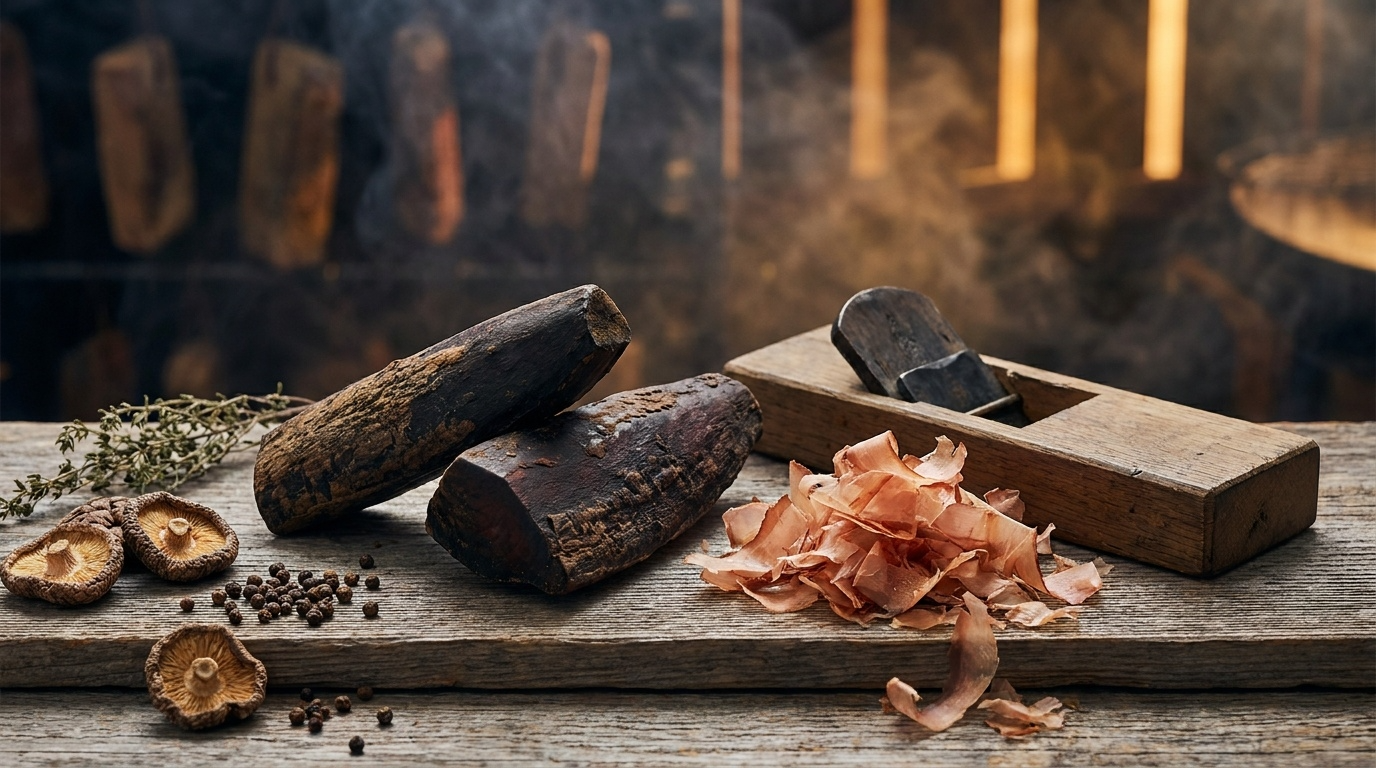
Knock two finished blocks of katsuobushi together and they do not thud. They ring — a dry, bright, carrying note, closer to two pieces of slate than to anything you would expect from a fish. Makers use the sound as a test. If it rings, it is done.
What is making that noise began as a skipjack tuna weighing five kilograms, roughly seventy percent water, and it has spent the better part of half a year being dismantled by heat, smoke and a fungus. It now weighs about eight hundred grams. Almost everything that could be removed from it has been.
That is the thing worth holding onto about katsuobushi, and the reason it belongs in a series about fermentation rather than a series about preservation. Most fermentations are additive. Yeast makes alcohol; koji makes sugar and glutamate; lactic acid bacteria make acid. The mould on a block of katsuobushi is one of the very few food fungi in the world whose principal contribution is subtraction. It takes out water. It takes out fat. It takes out the harshness. What is left is not a preserved fish so much as a mineral version of one.
Ten Fires and the Art of Resting
Long before the mould arrives, the fish has to survive being cooked and smoked into something almost inedible.
Selection comes first, and it is unromantic. Ninben, the katsuobushi house that has traded in Nihonbashi since 1699, specifies fish of four and a half to six kilograms for the four-piece honbushi cut — anything larger and the centre cannot be dried through — and a fat content in the raw flesh of only one to three percent. Fat is the enemy here. It oxidises over months of drying and turns the finished block rancid, which is why the fish used is overwhelmingly the lean spring migrant rather than the fat autumn one, a distinction we followed in our piece on the two seasons of katsuo.
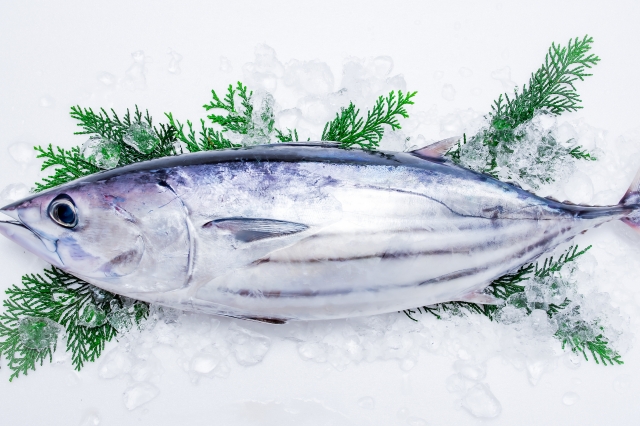
The fish is beheaded, gutted, filleted and split along the dark bloodline into four pieces — two back cuts and two belly cuts, called the male and female節 respectively. These are laid into metal baskets, and the baskets are lowered into water held between seventy-five and ninety-eight degrees for an hour to an hour and a half. Ninben is explicit about why the water is never brought to a boil: at a hundred degrees, large bubbles rise from the base of the kettle and jostle the fillets until they break apart. The point of the simmering is to coagulate the protein so that water can later diffuse out of the muscle easily. Then the bones are pulled by hand, one piece at a time, and the skin is deliberately left partly on — partly to stop the flesh collapsing during smoking, and partly because the wrinkles the skin forms as it shrinks are how a maker reads the dryness of the block by eye.
At this point the fillet still holds around sixty-eight percent water. Almost as much as when it was swimming.
The smoking that follows is called baikan, and it is not one operation but ten to fifteen, over roughly a fortnight, using oak and sawtooth oak as fuel. The technique that matters is not the fire but the pause between fires. Between smokings the fillets are laid aside to rest, a stage called anjō, and the Japan Katsuobushi Association is blunt about what happens without it: smoke the fish continuously and only the surface hardens, sealing the water inside. The moisture has to be given time to migrate outward from the centre before the next fire can take it. Ten fires with rest between them will bring a fillet to about twenty percent water. Ten fires without would produce a case-hardened shell around a wet core.
What comes out is black, rough-surfaced, tarry, and called arabushi — rough fillet — or, less kindly, onibushi, demon fillet. It keeps well. It smells strongly of smoke. And it is, by the industry’s own reckoning, not yet a fermented food at all.
Ten fires with rest between them will dry a fillet through. Ten fires without will seal the water inside a hardened shell. The technique that matters is not the smoke but the pause.
Making the Fish Hospitable
Before anything can be persuaded to grow on the block, the block has to be made livable.
The arabushi is sunned for half a day and then left for two or three days until the surface draws in enough humidity to soften. Then it is shaved — the tar deposited by the smoke and the fat that has wept out during baikan are cut away, and the warped, knobbled shape left by the heat is trued up. What emerges is a smooth reddish-brown block called hadakabushi, the naked fillet, and it is the first time in the process that the fish looks like the object most people picture.
The shaving is not cosmetic. Smoke residue is antimicrobial, which is the whole point of smoking, and a mould cannot colonise a surface still coated in it. The maker spends a stage of the process deliberately removing the protection just applied, in order to invite something in.
A Fungus That Prefers Deserts
What gets invited in is a xerophile — one of a small guild of moulds that grow where there is almost no available water, in conditions that would starve nearly anything else.
The organism has been referred to for a century as Aspergillus glaucus and relatives, but the composition of the community was only pinned down recently. Work by Takenaka Shinji at Kobe University, sampling karebushi from sixteen different producers and separating the fungal DNA by gene fragment, isolated five species from the surface of finished blocks — Aspergillus pseudoglaucus, A. chevalieri, A. amstelodami, A. ruber and A. sydowii — and found that the first two dominate almost everywhere, with the others rising and falling depending on the moisture and fat content of the particular fillet. In one producer’s blocks the two dominant species converged on a roughly one-to-one balance as the curing progressed.
The curing itself runs on a schedule that reads more like a laboratory protocol than a fishery. The naked fillets are sprayed with a pure culture — historically the mould arrived on its own, and the discovery of its usefulness was accidental, but for decades now producers have used a strain propagated by the Yaizu katsuobushi cooperative and sprayed deliberately. The blocks then go into a curing room. For the first two rounds the room is held at around twenty-seven degrees and eighty-five to eighty-eight percent humidity; for the third and fourth, humidity is dropped to fifty or sixty percent. In summer the first bloom appears in six to ten days. Then the blocks come out into the sun, are dried hard, and are brushed clean of mould by hand, one at a time — and then sent back in to be colonised again.
Four rounds is the traditional count, spread across about six months. Japanese Agricultural Standards recognise a block as karebushi after the second mould; Ninben reserves the name honkarebushi for blocks that have been through four or more. Late in the process the fillets become absurdly delicate to weather — a single raindrop leaves a permanent spot — so the whole final stage is run with one eye on the sky.
The fungus, meanwhile, is turning out to be stranger than anyone assumed. In 2024 a team led by researchers at the University of Tokyo reported in Virus Research the first mycoviruses ever found in katsuobushi mould — seven of them, in A. chevalieri and A. sulphureus, including a fusarivirus with a split genome unlike any previously described. When they stripped one of the viruses out with antiviral drugs, the fungus grew faster in its early phase, suggesting the virus had been holding it back. There are, in other words, passengers inside the organism inside the fish, and nobody had looked before.
What the Mould Is Actually For
Ask what the fermentation does and the honest answer is that it does four things, and only one of them is the one people assume.
The first and most important is water. Smoking can take a fillet to about twenty percent moisture and then it stalls, because surface drying outpaces internal diffusion. The mould does not have that problem: its mycelium draws water evenly out of the centre of the block as it grows, and four cycles of colonising and sun-drying bring the finished honkarebushi down to twelve to fifteen percent. That last few percent is what the fungus is really for, and there is no mechanical way to get it.
The second is fat. The moulds secrete lipase, which hydrolyses the residual fat in the flesh, and this is the reason an intensely animal product yields a broth with no slick on it at all. A clear, transparent dashi drawn from a dried fish is a slightly improbable object, and it exists because a fungus ate the oil first. The Kobe work also measured aspartic protease at high activity, which Takenaka links to the lightening of the flesh’s colour, and found something counterintuitive: the enzymes were generally more active in cultures grown at the lower water activity. The organism does its best work under the conditions that ought to be hardest for it.
The third is exclusion. A block deliberately covered in a controlled, well-characterised mould is a block that a less welcome one cannot get to.
And the fourth is flavour — which is where the popular account tends to overreach. It is often said that mould-curing simply loads the block with more umami. The picture is less tidy than that. The Umami Information Center notes that inosinate, the nucleotide that makes katsuobushi the inosinate half of Japan’s great flavour pairing, does rise through smoking and curing relative to the raw fish. But published analyses of the extractive components of differently processed blocks have found free amino acids in the flesh actually decreasing across the moulding stages. What curing reliably buys is not raw intensity but character: a rounder, quieter, less smoky aroma and a cleaner broth. The chemistry of why the pairing works at all — glutamate from kelp, inosinate from fish, and the multiplication that occurs when they meet — is a story we told in the article on the fifth taste Japan named.
An intensely animal ingredient that yields a broth with no oil on its surface at all. The clarity is not a technique. It is a fungus that ate the fat first.
Harder Than Rock Salt
By the end, a five-kilogram fish has become eight hundred to nine hundred grams of block, roughly a sixth of its landed weight, after a hundred and fifty to a hundred and eighty days. Water has gone from about seventy percent to about thirteen. The Japan Katsuobushi Association’s own definition requires anything called katsuobushi to be below twenty-six percent moisture; honkarebushi sits at half that.
Which brings us to the claim in every article ever written about this ingredient — that katsuobushi is the hardest food in the world. It deserves better handling than it usually gets.
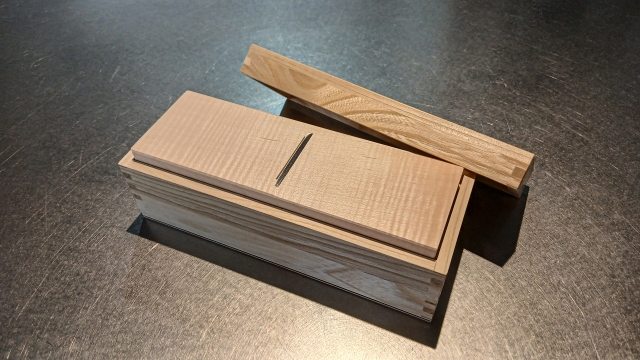
Somebody has actually checked. A Japanese dashi retailer ran a prize-winning honkarebushi against a Mohs mineral scale, scratching the shaved interior with reference minerals, and put it at 2.5: harder than rock salt, softer than a ten-yen coin. They also went looking for the Guinness record everyone cites and found that no such record exists. So the superlative is folklore. The underlying fact is not. A block at thirteen percent moisture, compressed to a sixth of its original mass, is dense enough that you cannot cut it with a knife in any useful way — which is precisely why the Japanese kitchen does not cut it. It planes it, against a blade set into a wooden box, and the thickness of that shaving decides everything about the broth that follows, a relationship we worked through in the piece on first and second dashi.
Arabushi Runs the Country
It is tempting to treat honkarebushi as the real thing and everything else as a compromise. The production figures argue otherwise.
The Ministry of Agriculture’s fisheries processing statistics put national katsuobushi output at 26,493 tonnes in 2024. Kagoshima alone made 20,193 of those — more than three-quarters of the country’s supply, concentrated in Makurazaki and Yamakawa on the southern tip of the Satsuma Peninsula — with Shizuoka, and specifically Yaizu, accounting for a further 6,114. Of the shaved product, a separate 14,989 tonnes, the largest producer is not a fishing prefecture at all but Ehime, where the shaving and packing industry sits.
Within that, fully cured blocks are a minority; trade estimates put honkarebushi at somewhere around a fifth or less of what circulates, and the Japan Katsuobushi Association describes karebushi output flatly as small. What is in the overwhelming majority of packets sold in Japanese supermarkets is arabushi — smoked, never moulded, cheaper, faster, and perfectly legitimate.
It is also, importantly, a different tool rather than a worse one. Arabushi carries the smoke forward; its dashi is darker, sharper, more assertive, and it is the right choice under miso, over okonomiyaki, in anything where the broth has to hold its own against strong seasoning. Honkarebushi gives a paler, rounder, more fragrant broth with the smoke pushed into the background, and it earns its price in clear soups where there is nothing to hide behind — the register of cooking where dashi is the dish rather than the foundation, which is the argument we made at length in our essay on dashi as Japan’s invisible foundation. Pair either with good kelp and the synergy does its work regardless, though which kelp you reach for changes the result more than most cooks expect, as our guide to the kombu coasts of Hokkaido sets out.
The Block, the Plane, and the Packet
Shaved katsuobushi is old. The word hanagatsuo, flower bonito, for the blossom-thin curls of a well-planed block, appears as early as 1489, in a Muromachi-period text on the etiquette of the knife. For most of the centuries that followed, the shaving happened at home, on a katsuobushi kezuriki — a plane blade set upside down into a small wooden box with a drawer beneath to catch the flakes — and it was one of the ordinary morning noises of a Japanese kitchen.
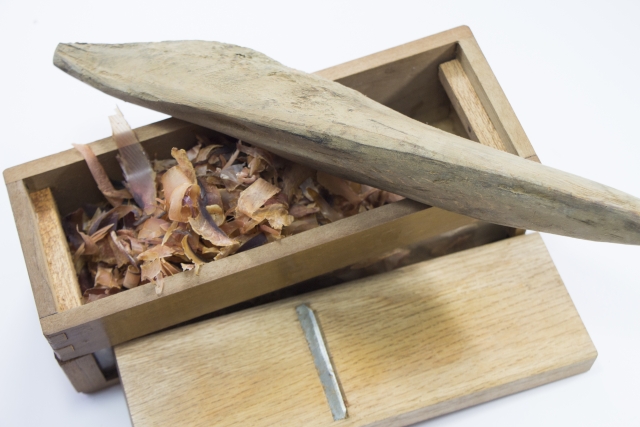
That has largely ended, and it ended for a good reason. The aroma of katsuobushi is volatile and begins leaving the moment the block is opened; shavings sitting in air go flat within days. In 1969, after eleven years of development beginning in 1958, Ninben launched Fresh Pack, a small sealed sachet in a newly available transparent barrier film that kept the shavings away from oxygen. It solved the staleness problem completely, and in doing so it separated the household from the block. A 2020 consumer survey by a katsuobushi retailer found that only around twenty-three percent of respondents had ever used a shaving plane at all.
Something real was traded. A sachet is fresher than week-old shavings in a jar and less fresh than shavings made thirty seconds ago, and the difference is entirely aroma — which, for a first dashi, is most of the point.
The Smoke That Could Not Clear Customs
There is a final irony in the process, and it involves the part of it that has nothing to do with the mould.
Baikan is smoking, and smoking generates polycyclic aromatic hydrocarbons, including benzo[a]pyrene, which the European Union regulates strictly as a carcinogen. Traditionally made katsuobushi could not clear those limits, which meant that one of the foundational ingredients of Japanese cuisine was effectively barred from Europe at exactly the moment Japanese food was becoming fashionable there.
The response was to move the process. Producers from Makurazaki, together with a group of related companies, incorporated Makurazaki France Katsuobushi in April 2014 and built a plant in Concarneau, a fishing port in Brittany, which began operating on the thirty-first of August 2016. It runs the full sequence — raw fish in, shaved packs out — on European soil, to European standards, staffed by French workers. A four-hundred-year-old fermentation emigrated because its smoke would not fit through a regulatory door.
What Six Months Buys
Set katsuobushi beside the other great Japanese fermentations and it sits oddly. Miso, soy sauce and sake are all constructive: koji breaks down starch and protein into sugars and amino acids, and the result is a substance richer and more complex than what went in. Katsuobushi is the opposite. Over six months of controlled colonisation, the fungus removes the last of the water, digests away the fat, softens the colour, quiets the smoke, and hands back a smaller, harder, plainer object than the one it was given.
Japanese cooking has been described as an art of subtraction — the discipline of taking away until what remains can be heard clearly. Usually that describes something a cook does. Here it describes something a mould does, at twenty-seven degrees, in a dark room, over half a year, four times in succession, while the maker stands outside watching the weather.
And then a block comes out that rings when you strike it, and someone shaves off two grams of it into hot water, and the whole apparatus disappears into a bowl of soup that tastes, above all, restrained.
Read, then Taste.
This article is part of Waden’s Fermentation series — exploring the microbes, moulds, and long patience behind Japan’s transformed foods. Read more at waden.umamibako.com.
Waden is an editorial journal exploring the depth and beauty of Japanese food culture — its history, ingredients, artisans, and traditions. Story first, always. waden.umamibako.com
Comment