The National Fungus: Koji and the Mould That Built the Japanese Kitchen
In 2006 a scientific society in Japan formally declared a mould to be the national fungus. It sounds like a joke. It is closer to a statement of fact — remove this one organism and most of what the world recognises as Japanese flavour disappears with it.
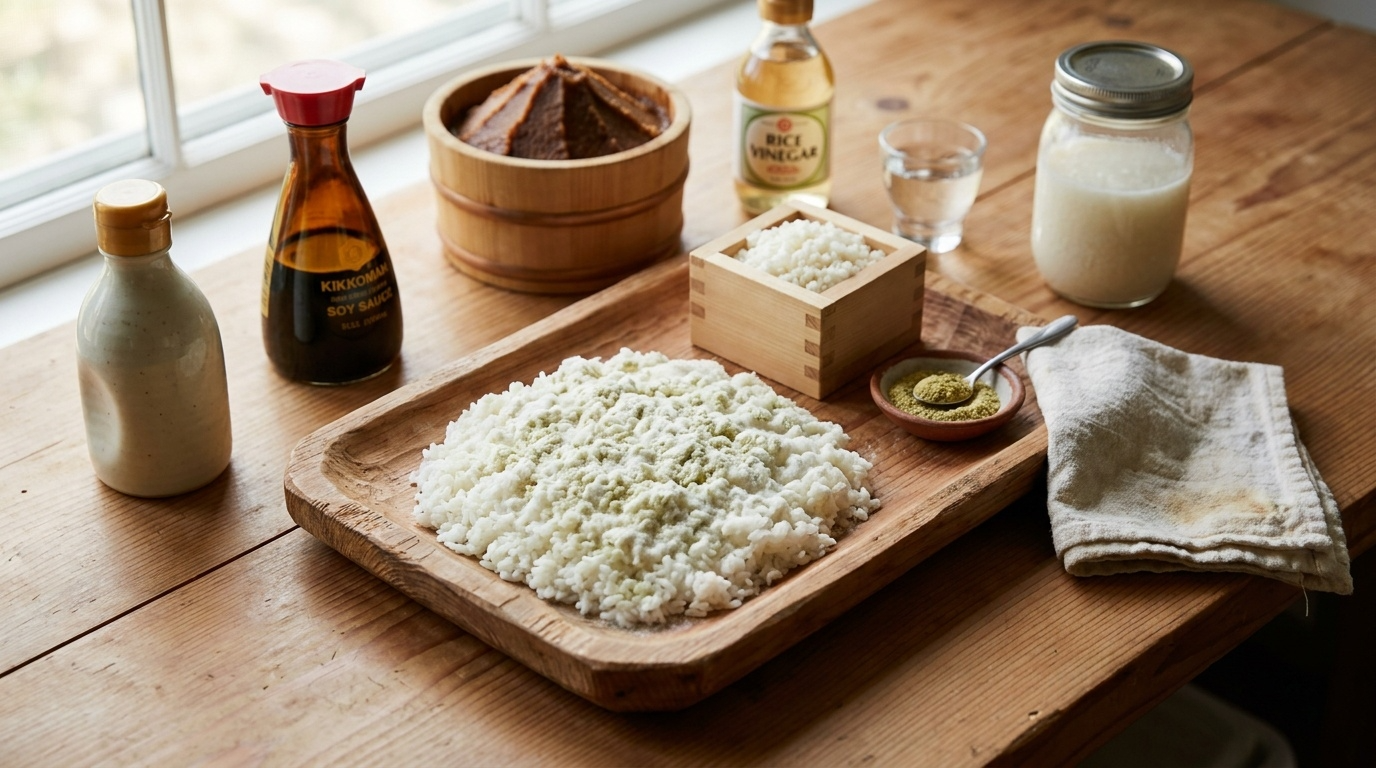
Open a Japanese refrigerator and take an inventory. Miso in a tub. A bottle of soy sauce. Mirin next to the cooking sake. Rice vinegar somewhere at the back. Perhaps a jar of something cloudy and pale. Four or five separate products, made by different companies in different prefectures, sold in different aisles of the supermarket, tasting nothing like one another.
Every one of them was made by the same organism.
It is a filamentous fungus — a mould — called Aspergillus oryzae, and in Japanese it is kōji-kin, the koji mould. It grows as a fine white fur on steamed grain and then, as it matures, dusts itself in yellow-green spores. It has been cultivated in Japan for well over a thousand years. It has no significant role in the cuisine of Europe, Africa or the Americas. And on 12 October 2006, the Brewing Society of Japan formally designated it kokkin — the national fungus.
No other country has done anything comparable. That is worth sitting with for a moment, because it says something specific about how Japanese food is built.
What Koji Actually Is
The vocabulary trips people up, so it is worth being precise. Kōji-kin is the mould itself, the living organism. Kōji — without the -kin — is the finished product: grain that has been steamed, inoculated with the mould, and incubated for roughly two days until the mycelium has grown all the way through it. Rice treated this way is kome-kōji; barley is mugi-kōji; whole soybeans give mame-kōji. When a Japanese recipe calls for koji, it means the grain, not the spores.
Finished koji is one of the more surprising things to encounter in person. It looks like ordinary steamed rice that has been lightly frosted, the grains bound loosely together by white threads. It is warm to the touch, because the fungus generates heat as it grows. It smells faintly of chestnuts and sweet fruit. And it tastes sweet, straightforwardly sweet, though nothing has been added to it.
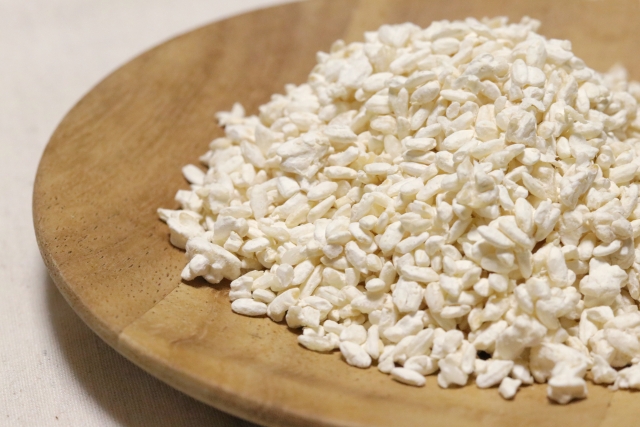
That sweetness is the whole point. As it grows, A. oryzae secretes a formidable battery of enzymes, of which two matter most: amylase, which cuts starch into sugar, and protease, which cuts protein into amino acids. Sugar is what yeast needs to make alcohol. Amino acids — glutamic acid above all — are what the tongue reads as umami. One organism, two reactions, and between them the raw material for both a drink and a seasoning. Our piece on shio koji follows those two enzymes in detail as they work on a piece of meat overnight; here the interest is in what happens when you point them at other things and wait considerably longer.
Because this is the trick. Japanese fermentation is not a set of unrelated crafts. It is one biological move — dismantle grain and beans into sugar and amino acids — applied over and over with different substrates, different salt levels and different time scales.
Point the enzymes at soybeans and salt and wait a year, and you get miso. Add wheat and more water, and you get soy sauce. Add yeast and skip the salt, and you get sake. Stop the process early with distilled spirit, and you get mirin. Let sake go sour on purpose, and you get vinegar.
Every one of those is a Waden article in its own right — miso, soy sauce, mirin, rice vinegar — and each has its own history, its own regional geography, its own arguments about method. But they are branches. This is the trunk.
Rice That Went Mouldy in a Shrine
The earliest account of koji in Japan is also, characteristically, an account of an accident.
The Harima no Kuni Fudoki, a provincial gazetteer compiled in the early eighth century, records that in Niwato village in Shisawa district, rice offered to the deity became damp and grew mould. Rather than discard it, the people used it to brew sake, offered the sake to the god in turn, and held a banquet. The passage is short and entirely matter-of-fact, and it is generally read as the oldest surviving Japanese description of brewing with mould. The relationship between sake and the divine that it takes for granted is the subject of our history of sake as a sacred drink.
Two centuries later the Engishiki, a vast compilation of court regulations completed in 927, uses the phrase yone no moyashi — roughly, “sprouted rice”, rice from which something has emerged. It is describing rice koji, and the word moyashi is going to matter later.
For most of this early period, koji was propagated by what is called tomodane: you keep back a portion of a good batch and use it to seed the next one. It works, in the sense that people brewed with it for centuries. It also drifts. Every generation is an opportunity for a competing mould to establish itself, and there is no way to correct course except to hope the next batch comes out better.
The War Over Who Was Allowed to Make It
By the medieval period, koji had become valuable enough to fight over — and in Kyoto, people did.
Under the authority of the Kitano Tenmangū shrine, the makers of koji had organised themselves into a guild, the Kitano kōji-za, holding a monopoly on the production and sale of koji in the capital and its surroundings. Brewers wanting to make sake had to buy their koji from the guild. This was an excellent arrangement for the guild, and it lasted until the wealthier sake houses worked out that they could simply make their own.
The guild resisted, and pressed the Muromachi shogunate to enforce its monopoly. The dispute escalated when the powerful Enryakuji temple sided with the brewers, and it ended in violence. In 1444 the guild members barricaded themselves inside the Kitano shrine precincts; the shogunate’s forces put the resistance down, the shrine buildings burned, and the guild collapsed. The episode is known as the Bun’an Koji Disturbance.
Its consequence shaped the Japanese kitchen permanently. Koji making stopped being an independent trade and was absorbed into the breweries — every sake house, miso house and soy sauce house would henceforth grow its own koji as one internal step among many. That is still how it works. When a soy sauce maker inoculates steamed soybeans and roasted wheat in a humid room called a kōjimuro, it is doing in-house what a Kyoto guild once sold at the gate.
But it left a question. If every brewery now grows its own koji, where do they get the mould from?
Wood Ash, and the Oldest Biotechnology Business in the World
The answer was invented at roughly the same historical moment, and it involves ash.
Sometime in the Muromachi period, koji makers discovered that mixing wood ash into the grain during cultivation had a remarkable effect. Wood ash dissolved in water is alkaline, and the resulting environment suppresses most competing bacteria and moulds while A. oryzae tolerates it comfortably. The ash also supplies potassium and other minerals, and mid-twentieth-century Japanese research found that spores grown with ash survive poor storage conditions markedly better than those grown without it, retaining their germination rate.
What this made possible was not better koji. It was something conceptually new: the ability to cultivate the microorganism on its own, separately from the food, in a different place and at a different time, and then transport it. The product is called tane-kōji — seed koji — and it is not grain for making miso. It is a concentrated crop of spores, grown for five days rather than two, until the surface is dense with yellow-green dust.
The people who make it are tane-kōji-ya, seed koji makers, known in the trade by the older nickname moyashi-ya. The word has nothing to do with bean sprouts, despite being spelled the same way in modern Japanese; it comes from moyasu, to cause something to sprout, the same word used in the Engishiki a thousand years ago. Whether this business deserves the label sometimes attached to it — the world’s oldest biotechnology industry — depends on how generously you define the term. The claim is made most often by the firms themselves. But the underlying description is accurate: these are companies whose entire product is a living microorganism, isolated, maintained and sold, and some of them have been doing it since before Columbus sailed.
Kōjiya Sanzaemon, now operating with a research arm in Aichi, dates its founding to the 1390s. Higuchi Matsunosuke Shōten in Osaka was founded in 1855. Hishiroku in Kyoto cannot establish its founding date at all; the current head of the family says he does not know which generation he represents. What he does have is a copy of a 1769 manuscript on koji-making technique in which the name Hishiroku already appears, which puts the business at three centuries and more.
Ten Companies
Here is the part of the story that ought to give anyone pause.
A trade directory from around 1953 lists somewhere over thirty seed koji makers in Japan. Today there are roughly ten. Hishiroku is the only one left in Kyoto, the city where the trade began. The remaining firms supply, between them, essentially the entire Japanese fermentation industry — sake breweries, miso and soy sauce makers, shōchū distilleries, vinegar producers, pickle manufacturers. One of them reports over two thousand customer accounts. Another has supplied more than three thousand.
They are not large businesses, and the arithmetic explains why. A hundred grams of seed koji is enough to inoculate one to two hundred kilograms of grain. The product is so efficient that almost nobody needs very much of it, and no young entrant is joining an industry whose principal asset is several centuries of accumulated strain-keeping.
The work itself is a strange hybrid of laboratory and workshop. Master strains are kept as living cultures and transferred to fresh medium every few years, checked in a laboratory for any drift in their properties, and — at Hishiroku, at least — stored in two physically separate locations, on the reasonable grounds that a single fire should not be able to end a three-hundred-year lineage. Production runs in a humid cultivation room held near 30°C and 98 per cent humidity for around 120 hours, roughly double the time a brewery spends making ordinary koji. The finished spores are graded so that upward of 95 per cent will germinate.
Strains are sold by intended use, and you can tell them apart by colour. Olive-green strains go to sake, mirin and some vinegars. White strains go to miso, amazake and shio koji. Black strains go to Okinawan awamori, and brown ones to shōchū — these last two being a different species, Aspergillus luchuensis, which produces protective citric acid and is essential for fermenting safely in a subtropical climate. The 2006 national fungus declaration was careful to include them: the designation covers the yellow koji mould A. oryzae, its close relative A. sojae used in soy sauce, the black koji mould and its white mutant. It specifically excludes Aspergillus niger, an unrelated black mould with which the koji species is often confused.
An Organism That Cannot Live Without Us
All of which raises the obvious question: where did this mould come from?
The honest answer is that nobody has found it living wild. A. oryzae exists, as far as anyone can demonstrate, only in human custody — in breweries, in seed koji cultures, in laboratory collections. It is a domesticate, in the same sense that maize and the dog are domesticates, and it is the only fungus of which this is convincingly claimed.
Its nearest relative is Aspergillus flavus, an extremely common soil mould whose genome is around 99.5 per cent identical, and some strains of which produce aflatoxin — one of the most potent naturally occurring carcinogens known. This is an uncomfortable family resemblance, and it has produced a tidy story that circulates widely in English: that Japanese brewers, over centuries of selection, domesticated a poisonous mould into a safe one.
It is a good story, and the genomic evidence does not really support it. A 2019 study at the Tokyo Institute of Technology sequenced 82 industrial strains collected from five seed koji companies and found that the phylogeny of the aflatoxin gene cluster does not track the phylogeny of the genome as a whole — which is what you would expect to see if detoxification had been the driving event. The simple domestication-of-a-poison narrative was not borne out.
What the same study did find is more interesting. The industrial strains sort into clades that correspond to what they are used for — soy sauce strains here, sake and miso strains there — and not to which company supplied them. The trade has converged on the same solutions independently. There are traces of sexual reproduction among the ancestral strains, in an organism long assumed to be strictly asexual, but none at all after domestication began. And when the researchers looked at where mutations had accumulated during the domesticated period, they found changes in genes governing growth, pigment and secondary metabolism — and almost none in the genes for the digestive enzymes that make the mould commercially useful.
That last finding is the one worth dwelling on. It is a genomic record of what the seed koji makers were doing. They bred for the qualities they could see and smell, and they protected, without any way of knowing they were doing it, precisely the machinery that mattered.
On safety, the position is settled independently of the evolutionary question. Japan’s National Research Institute of Brewing examined its collection of brewing strains and demonstrated at the molecular level that they lack the capacity to produce aflatoxin; the soy sauce industry has published equivalent work on its own strains. The relevant genes are present in vestigial, non-functional form. The mould carries the ruins of a weapon it can no longer fire.
From the Brewery to the Pharmacy
There is a coda to this that most people never connect to the miso tub.
In the 1890s a Japanese chemist named Takamine Jōkichi, working in the United States, was trying to persuade American whiskey distillers to use koji instead of malted barley to convert their starch. The venture ran into commercial and political trouble and eventually failed. But in the course of it, Takamine worked out how to grow the mould on wheat bran and extract its enzymes directly, and in 1894 he patented the resulting digestive preparation under the name Takadiastase. It became a commercial success and made him wealthy enough to fund the research in which he went on to isolate adrenaline.
That is the point at which koji stopped being purely a Japanese food tradition and became an industrial platform. A. oryzae secretes protein at a rate that few organisms can match, which is exactly the property you want in a factory. It is now used worldwide to manufacture industrial enzymes, and the 2005 publication of its full genome sequence — the achievement the Brewing Society explicitly cited when it made the national fungus declaration the following year — turned it into a serious candidate for producing pharmaceutical proteins as well. Its genome runs to about 37 megabases across eight chromosomes, and what stands out in comparison with its relatives is the sheer expansion of genes for secreted, digestive enzymes. It is built to eat things and to do it generously.
What Koji Is Not
It would be easy to conclude from all this that Japanese fermentation simply is koji, and that would be wrong in a way that matters.
Natto is made by a bacterium, Bacillus subtilis, and has nothing to do with koji at all. The rice bran pickling bed runs on lactic acid bacteria and yeasts. Narezushi, the thousand-year-old ancestor of sushi, preserves fish through lactic acid fermentation. The fish sauces that preceded soy sauce worked by letting the fish’s own enzymes and salt do the job. And katsuobushi, the dried bonito at the heart of dashi, is finished with an entirely different mould from a different group of Aspergillus, farmed for its ability to draw moisture out of a block of fish rather than to break starch down.
Japan has several fermentation traditions. Koji is the largest and the most structurally important, but it is not the only one, and the national fungus designation was a statement about scale and contribution rather than about exclusivity.
The Character Made of Rice and Flowers
A small linguistic detail closes the circle.
The standard character for koji, 麹, came from China, where the technique of cultivating moulds on grain originated considerably earlier than in Japan. But there is a second character in Japanese use: 糀. It is a kokuji, a character invented in Japan rather than imported, which appeared in the Edo period and came into general use in the Meiji era. It is built from the radical for rice on the left and the character for flower on the right, and it means specifically rice koji, as distinct from koji made on barley or beans.
Someone looking at a tray of finished rice koji decided that what the mould was doing looked like blossom opening across the grain, and made a character to say so. It is not a scientific description. But it is an accurate one, and it tells you how the relationship was understood by the people who spent their lives inside it — not as contamination held at bay, but as something cultivated and admired.
That is the sense in which the 2006 declaration was less eccentric than it sounds. Japan did not name a national fungus because it has an unusual enthusiasm for mould. It named one because the alternative was to leave unacknowledged the organism sitting underneath the soup, the seasoning, the marinade, the pickle and the drink — an organism that no longer exists anywhere except in the hands that kept it, and that has been kept, for a thousand years, by people who could not have told you what it was.
Read, then Taste.
This article is part of Waden’s Fermentation series. To follow this mould into individual foods, see miso, soy sauce, mirin, rice vinegar and shio koji. For sake, begin with A First Map of Sake. Read more at waden.umamibako.com.
Waden is an editorial journal exploring the depth and beauty of Japanese food culture — its history, ingredients, artisans, and traditions. Story first, always.
Comment