The Rice Ball That Wasn’t: Onigiri and Two Thousand Years of Food You Can Hold
Japan’s oldest rice ball is not quite a rice ball. Its seaweed wrapper only became the norm about a century ago, and its triangle was standardized by the convenience-store industry. The one thing that has lasted is the hand.
In November 1987, archaeologists digging a hilltop village site on the Noto Peninsula found a small, blackened lump of rice by the wall of a pit dwelling. It was roughly triangular, about 8 cm (3 in) along its long sides and 3.5 cm (1.4 in) thick, and the grains were still visible, fused into a single mass by carbonisation. The press called it “Japan’s oldest onigiri.” The town renamed itself, informally, the village of onigiri. Archaeologists, more carefully, gave it a name that translates as “chimaki-like carbonised rice mass.” The gap between those two names is a good place to start, because the history of the Japanese rice ball turns out to have more gaps in it than its reputation suggests.
First, some vocabulary. An onigiri is rice pressed by hand into a portable shape, usually salted, often filled, and these days usually wrapped in seaweed. The word comes from nigiru, “to grip” or “to press.” Japanese has two older relatives for the same thing. Nigiri-meshi is the plain, slightly blunt term, meaning “gripped rice.” Omusubi comes from musubu, “to tie” or “to bind.” This article also uses kowaii — read kowa-ii, literally “firm rice” — rice cooked by steaming instead of boiling, which was the prestige form of rice for much of early Japanese history.And it uses nori, the dried seaweed sold in thin sheets. All of them can be traced. What nobody can quite trace is when people first squeezed a handful of rice and walked off with it.
The Rice Ball That Wasn’t
The Noto object is real, and it is remarkable. The Ishikawa Prefectural Archaeological Center dates it to the second half of the middle Yayoi period, around 100 BCE. That was the era when wet-field rice farming took hold across the archipelago, a story we follow in how rice made Japan. Grain analysis showed that the rice was a short-grain Japanese type, a late-ripening glutinous variety, and that it had probably been steamed rather than boiled. Steamed glutinous rice, shaped and set aside, is not quite what most people mean by onigiri. It is closer to chimaki, sticky rice wrapped in leaves, which is why the archaeologists chose that name. The way it was found suggests it may have hung from the eaves or the inside of the house before it fell. The Center’s suggestions for its purpose include everyday preserved food, travelling food, and an offering to the spirits or a charm against misfortune.
None of that makes it less interesting. It does make “oldest onigiri” a local nickname, not a classification. What the lump proves is that two thousand years ago someone on the Sea of Japan coast was shaping cooked rice into a compact, carryable form. Whether they thought of it as food for the road or food for the gods, we cannot say. That uncertainty turns out to be typical.
A Proverb for a Province
The first time the word appears in writing, it is not describing a meal. The Hitachi Fudoki is a gazetteer of the province that is now Ibaraki, northeast of Tokyo, compiled in the early eighth century on imperial orders. In its entry on Tsukuba it records a local saying: nigiri-ii Tsukuba no kuni, “Tsukuba, land of gripped rice.” The phrase works like a fixed epithet, the kind of formula that attaches itself to a place name. Japanese poetry is full of them. The text does not explain it.
Food historians have filled the silence generously. Some picture villagers carrying balls of red rice and millet up Mount Tsukuba for spring and autumn outings. That may be true, but it is a reconstruction. The fudoki tells us only that by around 720 the phrase “gripped rice” existed and was attached to a place. Everything else is an attractive guess.
Egg-Shaped, and Left in the Courtyard
The Heian period (794–1185) gives us the first rice balls with a social setting, and that setting is not flattering. At banquets in the imperial palace and noble houses, food called tonjiki was set out in the courtyard for the attendants, grooms and lower officials who had no place inside. Classical dictionaries describe tonjiki as steamed kowaii pressed into egg-shaped masses. In the opening chapter of The Tale of Genji, written in the early eleventh century, tonjiki is laid out in quantity for the household staff at the young Genji’s coming-of-age ceremony.
One caution belongs here. The word tonjiki also referred to the trays or stands on which the food was served, and Japanese reference works treat “egg-shaped rice ball” as one reading among several. The safest statement is this: at Heian banquets, people of low rank were fed shaped rice outdoors, and the egg-shaped mass is the form later tradition remembered.
For most of its early history, the rice ball was food for the people who were not invited to sit down.
That inversion is the most useful thing to carry forward. The meal that mattered was eaten seated, from trays, in a fixed order. That structure eventually settled into the pattern we describe in one soup, three dishes. The rice ball was what existed outside that structure: food for the courtyard, the field, the road, the people still working.
Three Days at the Waist
War made the rice ball respectable, or at least necessary. During the Sengoku period, the century of civil war that ran roughly from the 1460s to the 1590s, soldiers carried a personal ration called koshi-hyōrō, “waist provisions.” This was a long, bottomless cloth tube tied around the body, filled with rice balls, rice cakes, grilled miso and hoshi-ii, cooked rice dried so it would keep. Several period sources describe a rule of thumb that each man should carry three days’ worth. After that, the army was expected to supply him, or he supplied himself from the countryside. Some of those rice balls were coated in miso and grilled. The salty, fermented paste we trace in our piece on miso was as much a preservative crust as a seasoning. Hoshi-ii, the bento’s oldest ancestor, has its own chapter in the history of the Japanese bento.
You will often read that the pickled plum, umeboshi, became the standard onigiri filling because of a single event. In 1221, the story goes, the shogunate’s power broker Hōjō Masako handed out rice and pickled plums to rally warriors against a rebellious retired emperor. The story is everywhere, including on the websites of industry bodies. We could not find it in any contemporary source, and we have left it out of the history. The pairing of salt-cured plum and rice has a simpler explanation: both keep, and each makes the other easier to eat. It needs no founding myth.
Salt Water on the Palms
The clearest early description of the rice ball comes from the Edo period (1603–1868). It appears in the Morisada Mankō, an encyclopaedia of urban customs that the Osaka-born writer Kitagawa Morisada finished around 1853. He notes that rice balls are made by wetting the palms with salt water before pressing. That small gesture seasons the outside of the ball and keeps the rice from sticking to the hand. It also explains why a good onigiri tastes saltier on the surface than in the middle. The salt itself has a strange history in Japan, which we follow in the country that forgot how to make salt.
Then Morisada gives the first real account of regional difference. In none of the three great cities, he writes, is the shape fixed. In Kyoto and Osaka they are usually made in a tawara shape, the short cylinder of a rice bale, sometimes with a little black sesame scattered on top. In Edo they are round or triangular, about 4.5 cm (1¾ in) across and 1.5 to 1.8 cm (about ⅔ in) thick, sesame is rarely used, and many are grilled after shaping. Read that size again. The typical Edo rice ball was a small, flat, toasted disc, much closer to a rice cracker than to the fist-sized triangle you buy today.
Travellers on the great highways of the period took rice balls with them. Inns packed them for the day’s walk with umeboshi and a few slices of takuan, yellow pickled daikon radish, wrapped in a sheet of bamboo sheath. Pickles were the natural companion, for reasons we explore in what tsukemono reveals about Japanese eating. The bamboo was chosen because it breathes, the same logic behind the cedar boxes in our piece on the magewappa, which were designed to keep cold rice worth eating hours later.
The verb is worth a moment here. Nigiri in nigiri-zushi and nigiri in onigiri are the same word, and visitors reasonably assume the two are cousins. They are related only by the hand. Sushi is defined by vinegared rice, as we set out in our guide to the types of sushi. An onigiri is never vinegared. It is plain rice and salt, a staple made portable, not a dish built on seasoned rice.
Two Names, No Verdict
Ask in Japan whether onigiri and omusubi are different things and you will get confident answers that contradict each other. One says omusubi must be triangular. Another says the eastern word is one and the western word the other. A third says omusubi is the polite form. The documentary record is less dramatic. Morisada already notes that musubi is a women’s word. Modern dictionaries record it as nyōbō kotoba, the refined vocabulary of women serving at the imperial court, who habitually softened plain words with prefixes and elegant substitutes. Onigiri is listed in Japan’s largest historical dictionary as a polite form of nigiri-meshi, originally used by women and children. Both words, in other words, began as gentler versions of a blunter one.
There is also a popular etymology that links omusubi to Musubi, the creative deities of the earliest Japanese chronicles, and reads the rice ball as an offering shaped like a sacred mountain. It is a lovely idea. We found no historical evidence for it, and Waden treats it as a later explanation, not an origin. The best evidence that the two words do not mean different things comes from industry. Japan’s largest convenience-store chain calls the rice balls you wrap yourself, with the pull-apart film, temaki onigiri, and nearly everything else — pre-wrapped, nori-free, premium — omusubi. Asked about it, the company says it draws no firm distinction between the two words. The split is for the shelf, not for the food.
The Seaweed Came Late
The image of an onigiri now includes a black band of nori, so it surprises people that for most of history there wasn’t one. Seaweed itself is ancient in Japan. It appears among the tax goods in the legal codes of 701. But nori as a thin, square, paper-like sheet came only in the Kyōhō era (1716–1736). Edo producers then borrowed the papermaking technique used for Asakusa recycled paper and began straining chopped seaweed into frames. The result was a luxury and a famous Edo souvenir. Sushi rolls used it first.
Some sources claim that nori-wrapped rice balls date from the Genroku era (1688–1704). We have not adopted that claim. It comes before the sheet-making technique itself, and Morisada’s careful survey of 1853 does not mention nori on rice balls at all. Researchers at the Yokohama History Museum place the habit of wrapping rice balls in nori later still, after nori production surged in the years following the First World War. The real breakthrough came from an unlikely place. In 1949 the British phycologist Kathleen Drew-Baker worked out that the nori plant spends its summers as a thread-like phase hidden inside seashells. Japanese growers used her discovery to seed nori artificially, and production became reliable for the first time. Fishermen on the Ariake Sea in Kyushu still hold an annual festival in her honour. A standard sheet measuring 21 by 19 cm (about 8¼ by 7½ in) was fixed nationally only in the late 1960s and early 1970s. The seaweed that makes an onigiri look ancient is, in its everyday form, a twentieth-century fixture.
Rice for Children Who Brought None
The modern state picked up the rice ball almost immediately. In 1885, when the railway reached Utsunomiya north of Tokyo, a local innkeeper sold what is usually counted as Japan’s first ekiben, or station meal. It was two rice balls with takuan wrapped in bamboo sheath, for five sen, a small coin of the era. Accounts differ on whether the rice balls were filled with umeboshi or rolled in sesame. Four years later, in 1889, a private primary school in Tsuruoka, Yamagata Prefecture, began feeding pupils who could not bring lunch from home. The school had been founded with donations from local Buddhist priests. The menu that is remembered as the start of Japanese school lunch was a rice ball, a piece of grilled salted salmon and pickled greens.
Look at what those two firsts share. The rice ball was the meal you gave someone who was away from home, or who had nothing at home to bring. It was food as provision, and that is also the quality Japan protected when it described washoku to UNESCO as a social practice, not a list of dishes, a distinction we unpack in what Japan actually registered. Few Japanese adults remember their mother’s cooking more precisely than her rice balls: their size, their saltiness, how hard she pressed. It is also the one rice dish where the rules in the etiquette of chopsticks step aside. It is meant to be eaten by hand.
On 17 January 1995 the Great Hanshin earthquake struck Kobe and the surrounding region, killing more than six thousand people. In the days that followed, volunteers cooked rice in the streets and handed out rice balls by the tens of thousands. In 2000 a Hyogo-based rice promotion council declared 17 January to be Omusubi Day. They chose that word on purpose, for its sense of binding people together. A national rice organisation took over the observance in 2018. It is one of the few food days in the world that marks a disaster.
The Problem of the Wet Wrapper
When 7-Eleven opened its first Japanese store in 1974, it began selling rice balls soon after, and almost nobody bought them. The company says sales were two or three a day. Buying something every household made for itself seemed odd. There was also a technical flaw. Nori wrapped around warm rice turns limp and chewy within hours, and nobody wanted a soggy wrapper.
The fix, in 1978, was packaging. A film sealed the nori away from the rice until you pulled it apart, so the seaweed stayed crisp. Then came tuna with mayonnaise in 1983, a filling no grandmother would have recognised and the one that became the national favourite. In 1984 a “parachute” wrapper opened by pulling a tab from the tip. In 1995 the company added a pre-wrapped style for people who preferred their nori soft. The chain says it passed one billion rice balls a year in 2003 and sold about 2.1 billion in the 2022 financial year. Across all convenience stores the annual figure is reported at over three billion.
That machinery also settled the question of shape. You will read many explanations for the triangle. One says it imitates a sacred mountain. Another says it suited travellers on the Tōkaidō highway. A third credits the first shogun’s road network. None of them has firm evidence behind it. What the record does show is that triangles already existed in nineteenth-century Edo alongside rounds, and that Osaka preferred bales. For the triangle to become the national default, it took machines that could form it at scale and a film wrapper designed to fit it. A form that was once one regional option among several became, within a generation, the shape the whole country draws when it draws a rice ball.
The convenience-store rice ball has also become a quiet gauge of Japan’s rice supply. When a shortage that the press called the “Reiwa rice crisis” pushed retail prices above 4,000 yen per 5 kg (11 lb) bag in early 2025, chains raised onigiri prices. Lawson experimented with nori-free versions to hold costs down. As rice prices eased, Lawson announced a 10-yen cut on its whole hand-rolled range from 29 September 2026. Its tuna-mayonnaise ball dropped from 181 to 171 yen. Lawson pointed to the falling market price of rice, and framed the cut as a way to win back a country that had been eating less of it. 7-Eleven trimmed two of its own lines by 19 yen from 8 September. A food that began as a servant’s ration now gets a corporate press release when its price moves by ten yen.
What the Hand Keeps
Japan also has rice-ball shops older than the convenience store. Onigiri Yadoroku in Asakusa opened in 1954 and is generally called the oldest in Tokyo. Onigiri Bongo in Otsuka opened in 1960, offers dozens of fillings and has queues measured in hours. Regional inventions keep arriving too. Tenmusu, a small rice ball holding a shrimp tempura, was created in the 1950s at a restaurant in Tsu, Mie Prefecture, and became a Nagoya signature. And at the end of a night at the izakaya, Japan’s drinking-and-eating pub, a grilled rice ball brushed with soy sauce is still one of the classic ways to close.
The form has also left the country. By the mid-2020s Paris alone had dozens of onigiri shops, and rice-ball counters had spread through London, Sydney and New York. The Onigiri Society, an industry group founded in 2014, now promotes the food abroad. Its chair, Yusuke Nakamura, has given the most generous definition anyone could offer: if it contains rice and a filling and can be eaten with one hand, you can call it an onigiri. He also has one rule: never pour soy sauce over it.
That definition is, in its way, the whole history. The rice has changed: steamed glutinous grain in the Yayoi village, kowaii at the Heian court, then the boiled short-grain rice of today. The question of which varieties hold together best at room temperature has its own answers in how Japan matches grain to dish. The fillings have gone from miso crusts and pickled plum to tuna and mayonnaise, with the thrifty classics surviving in between. One is okaka, shaved katsuobushi moistened with soy sauce. Another is kombu simmered sweet and salty after it has done its work in the stock pot. The wrapper went from bamboo sheath to nothing, to nori, to a three-part plastic film. The shape went from egg to disc to bale to triangle.
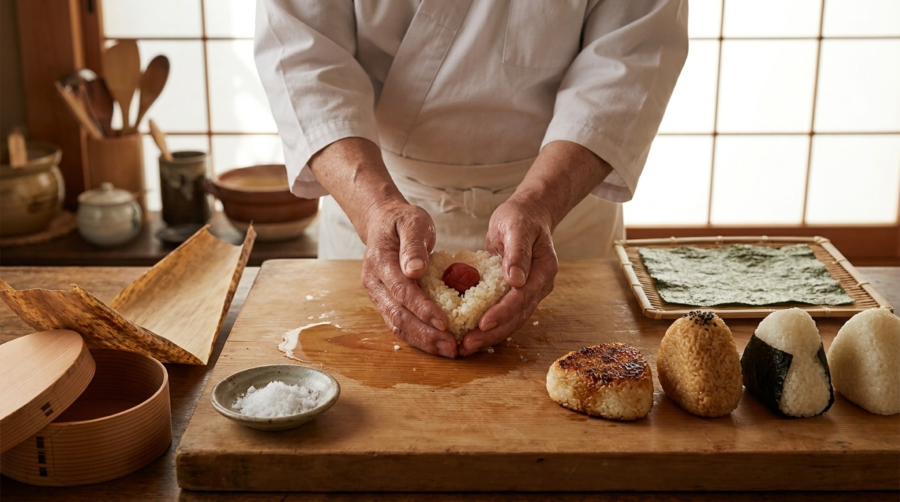
What has not changed is the gesture, and you can repeat it at home in about a minute. Start with rice that was cooked with some care, still warm enough to bind. Wet your palms, touch them to a little salt, and press only as hard as you need to hold the shape. Firm on the outside, loose inside, so it falls apart in the mouth and not in the hand. Wrap the nori just before eating if you want it crisp. That lesson took the convenience-store industry until 1978 to work out. If you can, make the first ones of the year with autumn’s new-crop rice, shinmai, which is the clearest small lesson in eating by the season that Japan offers. Then you are doing what someone on the Noto coast did two thousand years ago, with steamed rice, before anyone had a word for it.
Read, then Taste.
This article is part of Waden’s Heritage series. For the grain behind every rice ball, start with The Grain at the Center: How Rice Made Japan. For choosing the right variety, read Not All Rice Is the Same. For the box the rice ball so often travels in, read The Box That Traveled. Read more at waden.umamibako.com.
Waden is an editorial journal exploring the depth and beauty of Japanese food culture — its history, ingredients, artisans, and traditions. Story first, always.
Comment