The Geography of Soba: How Place Shapes a Noodle
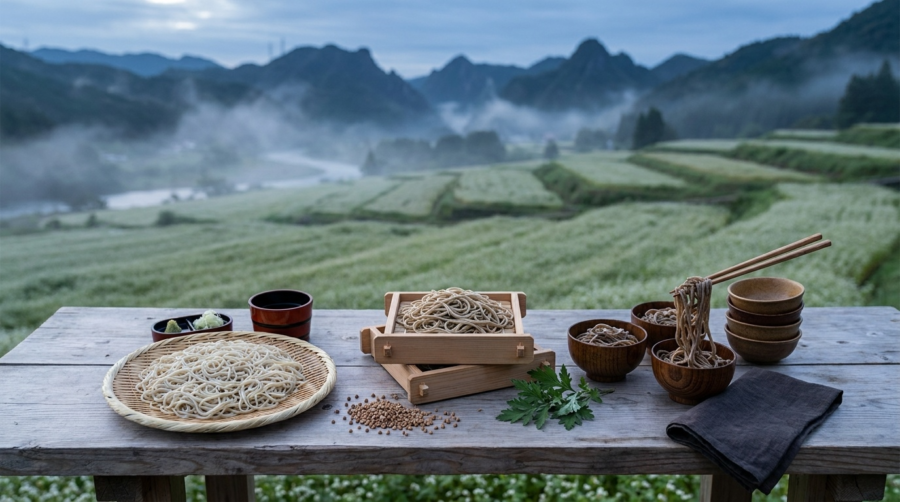
Buckwheat grows where rice cannot — in cold highlands, volcanic soils, and mountain villages that have shaped some of Japan’s most distinctive regional food cultures. To eat soba is to eat a landscape.
Order a bowl of soba in Tokyo and you will receive something quite different from what arrives in Shimane. The color will be different. The texture will be different. The way the noodles are served — in a stack of lacquer boxes, on a flat wooden board, in a small ceramic bowl, or in a cascade of successive tiny servings — will tell you something immediately about where this tradition comes from. The dipping sauce may be poured over the noodles rather than served alongside them. There may be no dipping sauce at all. And at the end of the meal, someone may bring you a pitcher of cloudy hot water and expect you to drink it.
Soba is often described as a single dish, but it is more accurately a family of regional traditions that share one ingredient — buckwheat — and diverge in almost every other respect. The divergence is not random. It follows the geography and history of the places where soba culture took root: the altitude of the highland, the temperature range of the mountain, the character of the local water, the textile industry that happened to exist in the same valley, and the individual lords who carried their preferences from one domain to another.
This article is about place. If you want to understand what happens inside the dough itself — what the ratio of buckwheat to wheat costs the person making it — that is a separate story, and a technical one. Here we are travelling.
Buckwheat and the Mountains
Buckwheat — soba in Japanese, a word that refers to both the plant and the noodle — is a cold-hardy pseudocereal that thrives where rice fails. It tolerates thin soil, cool temperatures, and short growing seasons, and it matures with unusual speed: sown in midsummer, it flowers white across the hillsides in September and is ready to harvest by mid-October. (Some regions grow a summer crop as well, sown in spring and harvested in early summer, though the autumn harvest is the one that soba culture celebrates.) These qualities made buckwheat indispensable in Japan’s mountainous interior, where altitude and climate made rice cultivation difficult or impossible. It was, for centuries, an insurance crop — grown so that a village could survive a bad year.
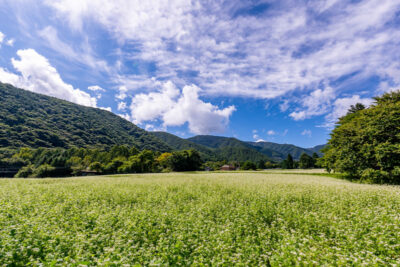
This agricultural history is the first reason why Japan’s finest soba tends to come from highland regions rather than lowland plains. The same cold nights and wide day-to-night temperature swings that make mountain life demanding also produce buckwheat with a denser, more concentrated starchiness and a more pronounced nutty aroma. The connection between terroir and flavor, so familiar in wine, is no less real here — and it is bound up with the Japanese conviction that an ingredient has a right moment. The arrival of shin-soba, the first flour of the new harvest, is one of the genuine events of the Japanese autumn.
Three regional traditions are widely cited as Japan’s greatest: wanko soba from Iwate, Izumo soba from Shimane, and Togakushi soba from Nagano. The grouping is a popular convention rather than an official designation — other lists substitute Takatō soba or the soba of Yamagata — but it is a useful starting point, because the three represent genuinely different answers to the same question: what should eating soba feel like?
Shinshū and Togakushi: The Birthplace of the Noodle
Nagano Prefecture — historically Shinshū — occupies the central position in the story of Japanese soba. Volcanic soil, sharp diurnal temperature swings, and long cold winters create conditions unusually suited to buckwheat. The name “Shinshū soba” is protected by a voluntary standard: dried noodles sold under it are expected to contain at least forty percent buckwheat flour, a bar the local producers’ cooperative set for itself. Japan sets no legal floor at all for how much buckwheat a dried noodle must contain: thirty percent is merely the line above which the maker is excused from printing the ratio, and packets below it must declare how little they hold. The Shinshū bar is voluntary, and it is higher than anything the law asks for.
Within Shinshū, the Togakushi district — a highland area northwest of Nagano City, centered on an ancient shrine complex — holds a particular place. Mount Togakushi was a training ground for shugendō, the demanding ascetic tradition that fused Shinto and Buddhist practice, and its practitioners valued buckwheat flour as portable fuel that could sustain long exertion. They ate it as sobagaki: flour kneaded with hot water into a thick paste, a food that predates the noodle entirely and that still belongs to the same lineage as the flesh-free cooking of the temple kitchen.
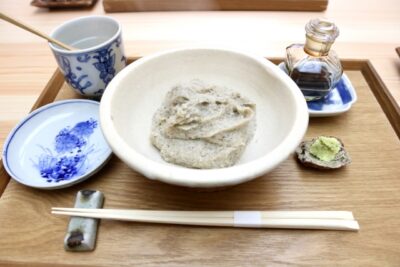
Cut noodles came later. The techniques of soba-uchi — mixing and kneading — and soba-kiri, the cutting that requires a single-purpose blade of its own, reached Togakushi during the Edo period, and the practice of feeding soba to pilgrims gradually hardened into what we now call Togakushi soba. At Chūsha, the middle shrine, the New Soba Offering Festival is still held each November: craftsmen make noodles from the freshly harvested crop and offer them to the gods before anyone eats.
Togakushi soba is milled hikigurumi — a term used loosely across Japan, but which here means grinding the seed whole rather than sifting out only the pale inner core. The result is a darker noodle with an assertive buckwheat fragrance. It is served bocchi-mori: a single portion divided into five loose bundles arranged in a basket woven from local nemagari-dake bamboo, the five bundles traditionally understood to correspond to the five shrines of Togakushi. The condiment is Togakushi daikon, a local radish. Flour, basket, radish — every element comes off the same mountain, which may make Togakushi soba the most completely local food in Japan.
Izumo: Darkness and Depth
Travel west across Honshū to Shimane and the noodle changes dramatically. Izumo soba is darker than almost any other soba in Japan, ranging from deep brown to near-black and flecked visibly with fragments of hull. Here hikigurumi is taken to its conclusion: the seed is milled with the hull included, producing flour that carries all the layers of the grain rather than the refined pale core that Tokyo shops prefer. The noodle that results is robust, faintly earthy, higher in fiber, and unmistakable from the first breath over the bowl.
The historical link to Shinshū is direct. Soba is said to have arrived in the Izumo region when Matsudaira Naomasa, first lord of the Matsue domain, transferred from Matsumoto in Shinshū in 1638 and brought soba craftsmen with him. The technique travelled with the lord; the local buckwheat and the local milling gave it an entirely new character.
Izumo soba is served in one of two ways. Wariko soba — the cold form — arrives as a stack of three round lacquer containers, each holding a portion of noodles. The sauce is poured directly onto the top portion; when it is finished, what remains is decanted into the second container, and then the third, gathering flavor as it descends. The stacking, the round lacquerware, the pouring rather than dipping — all of it is specific to this region.
Kama-age soba, the hot form, does something that will strike anyone trained on Italian pasta or Tokyo soba as an error: it skips the cold-water rinse entirely, lifting the noodles straight from the boiling pot into their broth along with some of the cooking water. The style is said to have begun at the food stalls serving pilgrims near Izumo Taisha, where omitting a step meant serving faster. The consequence is a cloudier, starchier, softer bowl — and it is the clearest illustration of a principle that governs the end of nearly every soba meal in Japan, which we come to below.
Wanko Soba: Hospitality as a Serving Style
North in Iwate Prefecture, the tradition is defined less by the noodle than by the ritual around it. Wanko soba consists of small servings dropped into a small wooden bowl by a server who refills it the instant it is emptied, chanting encouragement — “Hai, jan-jan!” — until the diner claps the lid on to signal surrender.
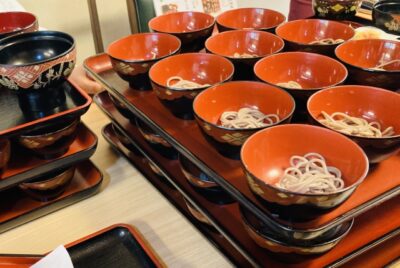
Wanko is Iwate dialect for a small wooden bowl. The custom is traced to soba furumai, the practice of serving soba to guests as a gesture of welcome, in which the small-bowl format allowed one pot to be distributed quickly among many people. Ten to fifteen bowls is roughly equivalent to one ordinary serving, which turns the stack of empties into a visible measure of the meal. In December 1957 the first competitive tournament was held at the Hanamaki Cultural Centre as a way of promoting the dish; it continues annually and now draws competitors from outside Japan. It is worth saying plainly that wanko soba is hospitality made theatrical — the same impulse that governs the Japanese drinking house, expressed through buckwheat.
Yamagata: A Prefecture of Soba Roads
Yamagata holds no place among the three great traditions, yet its soba culture may be the most internally varied in Japan — a patchwork reflecting the prefecture’s four historically distinct regions of Murayama, Okitama, Shōnai, and Mogami. Whatever else divides them, all four eat soba.
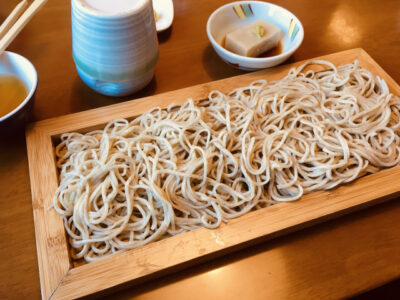
The signature local form is ita soba: noodles laid out on long wooden boards rather than in boxes or bowls, a format that also descends from soba furumai, the communal meal after shared farm labor, where a board let many people eat from one surface at once. Ita soba is made from coarsely milled, unrefined flour and cut wider than standard soba, and it is unapologetically rustic — closer to field food than to the refined seiro of a Tokyo specialist. It is at its best alongside the wild mountain vegetables gathered on the same slopes.
Yamagata also has a documented debt to Shinshū. The kanzarashi method — buckwheat seeds steeped in cold river water and dried in winter wind before milling — is said to have been introduced by Hoshina Masayuki, the Takatō lord who was transferred to the Yamagata domain in 1636 and later to Aizu. Masayuki, a son of the second shogun Hidetada and half-brother of the third, Iemitsu, carried the soba of his home domain with him wherever the shogunate sent him, and in doing so became an instrument of its spread. Districts with high concentrations of soba restaurants are still called soba kaidō — soba roads — and Yamagata has more than ten of them, each with its own map and festival calendar.
Fukui and Niigata: A Radish and a Seaweed
Two further regions answer the same question in ways that no list of three can accommodate.
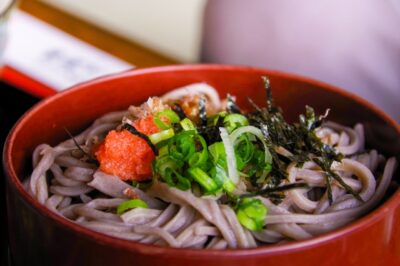
In Fukui, soba is eaten with grated daikon — Echizen oroshi soba, cold noodles under a mound of sharp grated radish, bonito flakes, and scallion, with the sauce poured over rather than served beside. The custom is traced to 1601, when Honda Tomimasa took up the lordship of Fuchū, in what is now Echizen City, and brought with him a soba craftsman from Fushimi in Kyoto. The pairing with radish is said to have been settled in consultation with the local physician. The dish acquired its national name much later: in 1947, Emperor Shōwa ate two servings of it on a visit to the prefecture and spoke fondly years afterward of “that Echizen soba.” Fukui remains one of the few places in Japan where the default soba is served with something pungent rather than something subtle.
In the Uonuma district of Niigata — Ojiya and Tōkamachi — the binder is not wheat at all. Hegi soba is bound with funori, a red seaweed, which gives the noodle a glassy translucency, an unusual slipperiness, and a faint marine note beneath the buckwheat. The reason is industrial rather than culinary: funori was the sizing used on the warp threads of Ojiya-chijimi, the region’s celebrated crimped ramie cloth, so it was simply the material at hand. Hegi comes from hagu, to strip — the board of stripped wood on which the noodles are laid. They are arranged in neat one-bite coils called tefuri, a motion said to echo the winding of thread. A noodle held together by seaweed because the village wove cloth is about as literal as terroir gets — and it raises a question the ratio article takes up directly: what, other than wheat, can hold buckwheat together at all.
Hokkaidō: Where the Grain Actually Comes From
An honest account has to acknowledge the gap between cultural geography and agricultural geography. Nagano, Shimane, Yamagata, Niigata, and Iwate are the heartlands of soba tradition. Hokkaidō is where the buckwheat is grown. Japan’s northernmost island produced about 13,700 tonnes in a recent year — roughly thirty-eight percent of the national harvest, far more than any other prefecture, though not the majority figure sometimes claimed. The cold climate, volcanic soils, and open acreage suit buckwheat at scale, and the Etanbetsu district near Asahikawa has a named variety of its own. The same island supplies most of Japan’s kombu, which makes Hokkaidō the quiet origin of both halves of a bowl of hot soba.
There is a second, larger gap. Japan’s buckwheat self-sufficiency runs at roughly twenty percent; the remainder is imported — around half of it from China, with the United States next and Russia behind that, its share swinging with export policy. A bowl of soba in Tokyo is statistically more likely to have begun in Inner Mongolia than in Nagano.
This does not invalidate regional soba culture — the milling, the ratio, the water, the cutting, and the serving all still happen where they always did — but it does mean that “domestic buckwheat” on a menu is a specific claim worth noticing, and one that shops charge for.
Mori, Zaru, Kake: What You Actually Order
Wariko, ita, bocchi, and hegi are the forms that make a region famous. They are not the forms most Japanese people eat. Everyday soba comes down to three words on a menu.
Mori soba is cold noodles served drained on a bamboo-slatted seiro or a plate, with a cup of concentrated tsuyu alongside for dipping, plus scallion and wasabi. This is the baseline. Zaru soba began, in the mid-Edo period, as nothing more than the same noodles presented in a bamboo basket — a zaru — at a shop in Fukagawa Susaki that wanted to distinguish itself. Only from the Meiji era did the difference become one of substance: zaru acquired a scattering of shredded nori, and its sauce was enriched, made sweeter with more mirin and sugar so that it could stand up to the seaweed. One old convention held that zaru was dressed with the first, clearer extraction of dashi and mori with the second. Today the gap is usually nori and a hundred yen.
Kake soba is the hot bowl: noodles in a thin, hot broth, with no dipping cup at all. The name is a contraction of bukkake — “thrown over” — which is exactly what impatient Edo laborers did with the sauce rather than dip noodle by noodle. The broth itself is where regional difference reasserts itself. The broth drawn from kombu and katsuobushi is the foundation everywhere, but eastern Japan finishes it dark with koikuchi soy sauce into something almost black, while the Kansai kitchen uses pale usukuchi and a heavier hand with kombu, producing a broth you can see the noodles through. The concentrate at the base of both is kaeshi, soy sauce cooked down with sugar and mirin and then rested for days before it ever meets dashi. Two shops can use identical ratios of kaeshi to dashi and still produce bowls that taste like different countries — which is partly a matter of the water they start from. Add a prawn to a hot bowl and you have tempura soba, a marriage of two foods that grew up at the same Edo street stalls.
Sobayu: The Cup at the End
When you finish a cold serving, the server may bring a small lacquer or ceramic pitcher of cloudy, faintly grey hot water. This is sobayu — the water the noodles were boiled in. It is not a mistake and it is not for washing anything. Pour it into the tsuyu left in your cup, dilute to taste, and drink it as a thin, warm, faintly nutty soup. The custom is said to have begun in Shinshū, on the sound instinct that buckwheat’s water-soluble compounds end up in the pot rather than the noodle; it is also a small refusal to waste what has been extracted. It is the same logic that lets Izumo serve kama-age soba unrinsed, starch and all — nothing that came out of the buckwheat is treated as a loss. Drinking the sobayu is how a soba meal is understood to end.
What Soba Is Not
Because “soba” appears on so many menus, it is worth marking the borders.
Soba is not udon, which is wheat, thick, white, and pursuing a completely different idea of texture; nor sōmen, wheat stretched with oil into threads; nor ramen, wheat made springy with alkaline salts and belonging to a modern lineage entirely — a lineage in which, as it happens, the city rather than the mountain does the shaping.
Nor does everything called soba contain buckwheat. Okinawa soba is a wheat noodle with none at all; when national labeling rules threatened the name in the 1970s, the Fair Trade Commission granted a formal exemption on 17 October 1978, permitting the name honba Okinawa soba. In 1997 the local noodle makers’ cooperative turned the date into a holiday.
Yakisoba, likewise, is made from steamed wheat ramen noodles. And sobagaki, the ascetics’ paste on Mount Togakushi, is buckwheat without being a noodle at all — proof that in Japanese the word points to a grain first and a shape second.
The Noodle and the Place
What connects these traditions, beyond the grain, is a conviction that the noodle should express the place that made it. The altitude of Togakushi is in the flour. The hull of the Izumo buckwheat is in the color. The communal harvest of Yamagata is in the board. The hospitality of Iwate is in the small bowl and the server’s call. The looms of Ojiya are in the seaweed that holds the dough together. The physician’s advice in a Fukui castle town is in the radish.
This is what it means to say that Japanese cooking is rooted in place — not as a marketing phrase but as a physical and historical fact, and one built into the structure of washoku itself. It is also why soba is the noodle Japan eats on the last night of the year, cut long and eaten to see the old year out, hours before the lacquer boxes of the New Year are opened.
The soba in your bowl grew somewhere specific, was milled by someone who knew that grain, and was prepared according to a tradition that formed in answer to a particular landscape. Taste it with that in mind and something else arrives alongside the buckwheat: the cold mountain air it ripened in. Then drink the sobayu.
Read, then Taste
This article is part of Waden’s Origin series — travelling to the landscapes and regions where Japan’s finest ingredients begin. Read more at waden.umamibako.com.
Comment