Wagashi and the Calendar: A Year in Sweet Form
Before the matcha is prepared, a small sweet arrives. It is shaped like a plum blossom, or a maple leaf, or a crescent moon. It tells you, in the most delicate possible way, exactly what time of year it is.
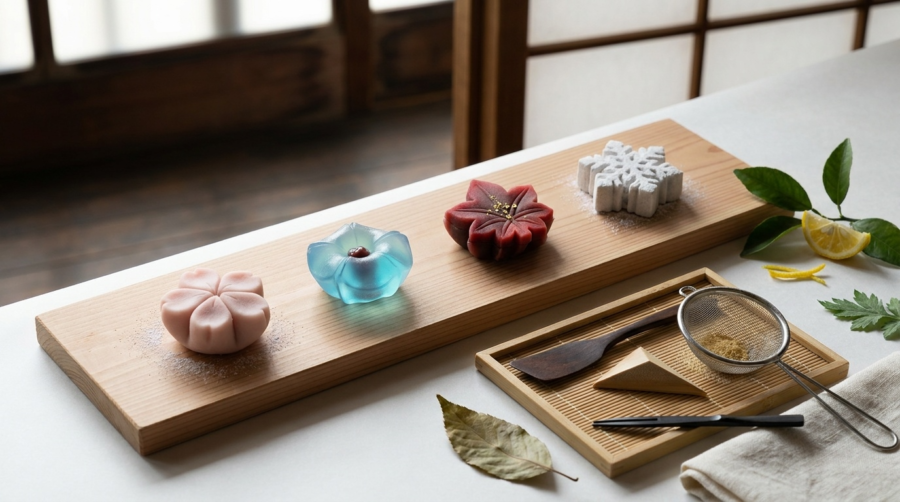
Place a piece of nerikiri in your hand and look at it carefully. It is small — two or three bites at most — and its surface has a quality difficult to describe: smooth and slightly yielding, with a matte finish that catches the light like the skin of a ripe fruit. Its color is the pale pink of a cherry blossom in its third or fourth day of bloom, before the petals begin to brown at the edges. Its shape is a single five-petaled flower, pressed from the inside out by the thumb of the artisan who made it, the seam at the back the only evidence of the hands that formed it.
You eat it before the tea arrives. The sweetness is quiet — present but never aggressive, a clean bean-paste sweetness that coats the tongue with gentle warmth. Then the matcha comes, bitter and grassy and deeply green, and the two flavors meet in the mouth and make sense of each other in a way that neither could alone.
This is wagashi, and that small transaction of sweetness before bitterness is one of the most precisely designed sensory experiences anywhere. But the design is not only about flavor. It is about time — and behind it sits the same conviction that governs the rest of the Japanese table, that every ingredient has one true moment and the cook’s job is to catch it. Wagashi takes that conviction and does something stranger with it. It does not merely use what is in season. It depicts the season, in sugar and beans, and then withdraws the depiction when the season ends.
A Word Younger Than the Sweets
Begin with the word, because it is misleading. Wagashi (和菓子) joins wa, Japanese, to kashi, confectionery — which sounds like an ancient term for an ancient craft. It is nothing of the sort. Nobody called these things wagashi until the country had something to contrast them with.
When Western confectionery arrived in the Meiji era and was labeled yōgashi, Japan found itself needing a word for everything that was already here. Several were tried — wasei-gashi, Japanese-made confectionery; nihon-gashi; hōka — and the one that settled, according to the reference literature on the question, did not settle until the end of the Taishō era and the beginning of Shōwa. The sweets are centuries old. The category is roughly a hundred.
The older word underneath it has drifted just as far. Kashi was written with characters meaning fruit and seed, and it meant exactly that: fruits and nuts, the sweet things available before anyone was manufacturing sweetness. As confectionery became an industry, kashi was annexed by the made thing and fruit had to be renamed — which is how fruit ended up being called mizugashi, water-confection, and got pushed out of its own word. Read the history of wagashi through its vocabulary and you get a compressed account of the whole thing: something grown, displaced by something built.
Four Arrivals
What makes wagashi genuinely interesting as a history is that almost none of it is originally Japanese. It is a craft assembled out of four foreign arrivals, each absorbed so thoroughly that the seams have disappeared.
The first came in the eighth century, when envoys to Tang China brought back karagashi — eight types of karakudamono and fourteen kahei, by the traditional count. These were mostly rice or wheat flour kneaded, shaped, and deep-fried in oil, and they were not eaten for pleasure so much as offered: to the court at seasonal banquets, and on the altars of great temples and shrines. A handful survive in that ceremonial form to this day at shrines in Kyoto. From them descend, by long and untidy routes, the dango, the manjū, and the senbei.
The second arrival, and the decisive one, came with Zen. Monks who trained in Song and Yuan China returned with tenjin — the between-meal light food that in Chinese is dianxin, and in Cantonese, eventually, dim sum. Two of the central forms of wagashi enter Japan through this door. In 1349 a Chinese immigrant named Rin Jōin arrived in the company of the returning monk Ryūzan Tokken, settled in Nara, and began making a filled bun adapted to a clientele that did not eat meat: bean paste instead of pork. His descendants, sheltering from war in a village called Shiose in Mikawa, took its name as their own, and the confectionery house founded on that substitution still exists.
Yōkan, the dense block of sweetened bean jelly, arrived by the same route and carries the substitution in its name. The characters mean sheep and broth: in China it was a soup of mutton, and the gelatin that set when it cooled was the point. Given to monks forbidden to eat the animal, it was rebuilt out of azuki beans and wheat flour and steamed — and a lamb stew became a sweet. Nothing in the Japanese repertoire illustrates better what the temple kitchen did to foreign food.
Yōkan is written with the characters for sheep and broth. It was a mutton soup in China. Monks who could not eat meat rebuilt it out of beans, and Japan has been eating the substitute for six hundred years.
The third arrival came by sea in the late sixteenth century, when Portuguese traders brought nanban-gashi: castella, konpeitō, bōro — and, crucially, sugar in quantity and the technique of baking with eggs. These were the same ships that left behind the batter-fried fish that became tempura, and the two stories run exactly parallel: an imported technique, localized so completely that four centuries later it reads as native. Castella is sold today in Nagasaki as a local specialty, which, by any reasonable standard, it now is.
The fourth arrival was not a food but an economic policy, and it is the one that made everything else possible. Sugar had to be imported and was ruinously expensive; before it, sweetness in Japan came from boiled-down grain syrup, from dried persimmon, from honey, and from the sugars koji quietly makes out of rice. Under the eighth shogun, Tokugawa Yoshimune, domestic sugar cultivation was actively encouraged as part of the Kyōhō reforms, and in Sanuki — modern Kagawa — a long chain of experimenters worked their way toward fine white sugar from local cane: the raw brown sugar that is its precursor by 1790, the refined white sugar itself only at the very end of the century. The result was wasanbon: pale, faintly grainy, dissolving instantly, and still the sugar used in the best higashi. Only once sweetness became affordable could confectioners start competing on subtlety instead of scarcity. The great flowering of Kyoto’s wagashi culture, which we tend to imagine as timeless, is substantially the product of this two-century sugar economy.
The Tea Ceremony and the Logic of the Sweet
All of it converges on one room. To understand why wagashi takes the form it does, you have to understand its primary context: chadō (茶道), the way of tea.
What served as tea sweets in the sixteenth century was startlingly plain. The earliest tea-gathering records list, as the confection of the day, kelp, roasted chestnuts, and arrowhead bulbs — not a shaped sweet in sight. Rikyū served fu-no-yaki — a thin wheat-flour crêpe brushed with miso and rolled — at sixty-eight of the eighty-eight gatherings collected in the Rikyū Hyakkaiki. The nerikiri that people now picture when they hear “tea ceremony sweet” did not yet exist, and would not for another century and a half.
What has not changed is the sequence. The sweet is eaten before the tea, never alongside it. The reason is physiological as much as philosophical: sweetness primes the palate so that the concentrated bitterness and umami of whole powdered leaf register as depth rather than as harshness. Which sweet you get tells you which tea is coming. Thick koicha is preceded by omogashi — a moist, fresh, seasonal confection, the nerikiri or the kinton. The lighter thin, frothy bowl of usucha takes higashi, small dry sweets of pressed wasanbon. The sweet is a piece of information before it is a pleasure.
And within that framework, nothing is chosen at random. The tea room already speaks the season through the scroll on the wall, the single flower in the alcove, the glaze of the bowl. The wagashi adds its voice to that conversation. A host who serves the wrong seasonal sweet has made an error not of taste but of attention — a failure to read the moment with the precision the form demands.
Each sweet also carries a kamei, a poetic name, and the name does as much work as the shape. Hatsushigure — first winter rain. Yuki no Asa — snowy morning. Many are drawn from waka poetry or classical literature, so that a guest who knows the allusion receives something a guest who does not will miss entirely. The confection is the size of a plum and it is functioning, simultaneously, as a seasonal marker, a literary quotation, and a piece of etiquette.
Nerikiri, Konashi, and a Line Down the Middle of Japan
The shaped, colored, sculpted sweets — collectively jō-namagashi — are what most people mean by wagashi, and they are made from one of two doughs that look nearly identical and are not.
In the Kantō region the dough is nerikiri: white bean paste bound with a little gyūhi — a soft, sweetened mochi — and kneaded until it is pliable and takes color cleanly. In the Kansai region, and especially in Kyoto, the dough is konashi: white bean paste combined with wheat flour and rice flour, steamed, and then worked by hand — the verb konasu, to knead down, gives it its name. Nerikiri is more elastic and holds fine detail, which is why the most intricate modern work tends to be nerikiri. Konashi is firmer, chewier, and carries the faint flavor of the steaming. The distinction is blurring as confectioners in both regions use both, but it remains one of those quiet east–west divisions that runs through nearly everything in Japanese food.
Underneath both sits the ingredient that actually defines the craft: azuki. Almost all of it comes from one place — roughly ninety-four percent of Japan’s domestic crop is grown in Hokkaido — and that crop, swinging between about thirty and seventy thousand tonnes a year against a national appetite closer to eighty, is volatile enough that imports fill the gap in lean years. The confectioner’s most basic material is a northern field crop with a bad harvest risk, which is not the impression the finished object gives.
Rice is the other foundation, and here the distinction that governs so much Japanese cooking applies again: glutinous and non-glutinous rice behave as different ingredients, and wagashi exploits the difference precisely. Jōshinko, milled from ordinary rice, gives the firm, clean-cutting body of a kashiwamochi. Dōmyōji-ko, coarsely ground from steamed glutinous rice, gives the bumpy, chewy dome of the Kansai sakuramochi. Change the flour and you change the entire sweet. That a culture organized around a single grain would develop this many ways to grind it is, on reflection, unsurprising.
One technical distinction is worth having, because Japanese shops rely on it: wagashi are classified by water content. Above thirty percent they are namagashi, fresh sweets, which is where the nerikiri and the mochi sit and which is why they are meant to be eaten the day they are bought. Between ten and thirty percent they are han-namagashi. Below ten percent they are higashi, dry sweets, which keep for months. Shelf life, in wagashi, is not a detail of packaging. It determines what a sweet is for.
The Materials of the Season
Wagashi expresses time in two parallel languages — through what it is made of, and through what it is shaped into — and skilled artisans attend to both.
The ingredient speaks first. Mugwort in spring, giving kusamochi its green and the same faint bitterness the wild mountain vegetables bring to the spring plate. Kudzu in summer, valued less for taste than for the cool transparency it produces. Chestnuts in autumn, in a kurikinton that is essentially nothing but chestnut. Yuzu in winter, the aromatic citrus that ripens as everything else shuts down, hollowed and filled and set to harden in the cold. Before any shaping occurs, the material itself has already declared the month.
The shapes are a second language, and the tools are unglamorous: a hera, a wooden spatula, for smoothing; a sankakubō, a triangular stick, for scoring petal lines and veins; a fine sieve pressed through to make the thousand threads of a kinton; the maker’s own thumb, which does more than any of them. The results run to overlapping petals with visible veins, morning glories in translucent blue, maple leaves in the exact reds of late October, snow crystals that look as though they had just landed on the palm.
Color is calibrated as tightly as form. Spring works in pink, white, and pale green. Summer turns to blue and purple and clear things, on the same principle the whole summer table follows — coolness produced by translucency rather than temperature. Autumn takes the warm reds, oranges, and browns of harvest. Winter goes white and silver for snow, deep green for pine, and quiets down. What is being represented is never an object so much as a condition of light.
A Year in the Shop Window
The most immediate way to experience all of this is also the cheapest: stand in front of a good confectionery shop and watch what appears in the window across a year. The sequence is remarkably consistent nationwide. Hanabiramochi in January. Uguisumochi, shaped and dusted to resemble a bush warbler, in February. Kusamochi and sakuramochi in March. Hanami-dango in April. Kashiwamochi and chimaki in May. Wakaayu, a folded pancake shaped like a young sweetfish, in June. Kuzuzakura and mizu-yōkan in July.
Each carries its own history. Hanabiramochi — a flat white mochi folded over sweetened burdock root and miso-an, with a pink disc showing faintly through — is usually described as an ancient imperial sweet, which is not quite right and is more interesting than the myth. Its ancestor is hishi-hanabira, a New Year food of the imperial court. The confection came later: in the early Meiji era the eleventh Urasenke grand master, Gengensai, received it at a court tea presentation and was granted permission to adapt it for the year’s first tea gathering, commissioning the court confectioner Kawabata Dōki to make it. A court ritual became a tea sweet, and only then a January staple in every shop in the country. The burdock and the miso in the filling are the surviving evidence of the ritual dish it came from — a savory fossil inside a sweet.
Sakuramochi arrives in late March, and is really two sweets sharing a name: a thin crêpe-like wrapper in Tokyo, a chewy dome of coarse glutinous rice in Kansai, each with its own temple origin story and its own partisans. We have told that argument, and the salted cherry leaf at the center of it, in full elsewhere. Kashiwamochi, wrapped in an oak leaf for Children’s Day on the fifth of May, carries its own logic: the oak does not drop its old leaves until the new ones appear, which made it a symbol of family continuity.
Then they vanish. Kashiwamochi disappears from the shelves the week after the fifth of May and does not return for eleven months. This is not an accident of supply; almost all of it could be made year-round. The scarcity is the product. A sweet available in every month cannot announce the arrival of one, and the appearance of the right sweet in the right week is itself the statement — the same statement the first bonito of spring makes, or the first matsutake of autumn. Walk the twenty-four solar terms in order and the shop window turns out to be running the same calendar as the fish market.
Two dates sit slightly outside the flow. The sixteenth of June is Wagashi Day, commemorating an event in 848 — the year that became Kajō 1 — when the Emperor Ninmyō is said to have offered sixteen sweets and rice cakes at a shrine to drive out an epidemic, and changed the era name in consequence. The observance as it exists now was established in 1979 by the national confectioners’ association — a thousand-year-old story, revived as a modern trade holiday, which is a very ordinary way for traditions to work. And the New Year brings the most elaborate sweets of the year to a table that is already a set of lacquer boxes in which every item means something. In both cases the sweet is not marking a season. It is doing a job the season cannot do alone.
What Wagashi Is Not
Three corrections, because wagashi is routinely translated into Western categories it does not fit.
It is not dessert. A dessert is the final movement of a meal, and wagashi has almost nothing to do with meals. It belongs to the tea break, the guest’s arrival, the temple offering, the seasonal observance — occasions that sit entirely outside the one-soup-three-dishes structure that organizes the Japanese meal. A formal kaiseki does end with something sweet, but the sweet that matters most in Japanese culture is the one eaten at four in the afternoon with tea, in a room where no meal is happening.
It is not a sugar craft. Western confectionery is built on dairy, eggs, wheat, and chocolate; wagashi is built on beans, rice, and agar, with sugar as a seasoning rather than a structure. The fat content is close to zero in most of it. This is why wagashi tastes restrained to a palate trained on European pastry, and why the comparison flatters neither: they are solving different problems with different materials, and the frequent claim that wagashi is “healthier” mostly means that it is made of starch and sugar rather than of butter and sugar.
And it is not all Kyoto. The exquisite jō-namagashi is the summit of the craft and a small fraction of the volume. Most of what Japan actually eats is dagashi — the cheap, bright, unpretentious sweets of the neighborhood shop — and the regional specialties that every prefecture defends: Ishikawa’s, Shimane’s, Kumamoto’s. A survey of wagashi that stops at the tea room has described the ceiling and skipped the building.
The Five Senses, in Two Bites
What finally distinguishes wagashi is not its restraint with sweetness, or its vegetable materials, or even its formal beauty. It is the scope of what it asks of the person eating it.
Confectioners describe their work as addressed to all five senses: taste; sight, in shape and color; smell, in the cherry leaf or the yuzu peel; touch, in the give of the dough against the small wooden pick and against the tongue; and hearing. That last one is the remarkable claim, because there is nothing to hear. What is meant is the kamei — the name that asks you to listen for a winter rain that is not falling, and to complete the experience internally, out of memory and association. The sweet is small and brief. It is designed to open onto something much larger than itself, and it will only do so if you already know the poem.
Even the setting participates. The confection arrives on a lacquered tray or a small dish chosen for it, eaten with a damp black-wood pick cut from spicebush, whose faint scent is part of the design. Nothing in the sequence is accidental, and none of it is expensive. It is simply the result of a very long time spent paying attention.
Pick up the cherry blossom nerikiri again. Consider what has gone into it: a Chinese bean-paste substitution made by monks who could not eat meat, Portuguese sugar, a shogun’s agricultural policy, a court ritual adapted for a tea room in 1870, a northern field crop, and a name borrowed from a poem written a thousand years ago. It is one of the clearest illustrations of what Japan actually registered with UNESCO — not a fixed cuisine, but a practice of absorbing things and tying them to the turning of a year.
Now eat it. The matcha is coming.
Read, then taste.
This article is part of Waden’s Seasons series, following the rhythm of the Japanese culinary year. For the whole turning year in order, read A Year at the Japanese Table; for the philosophy beneath it, read Shun: How Japan Learned to Eat by the Calendar.
Waden is an editorial journal exploring the depth and beauty of Japanese food culture — its history, ingredients, artisans, and traditions. Story first, always. waden.umamibako.com
Comment