Most of It Was Never Eaten: A History of Himono, Japan’s Dried Fish
For most of Japanese history, the dried fish that mattered went into the soil, onto ships bound for China, and before the gods. The soft, glistening fillet on today’s breakfast tray is the newest thing in the story, and it is hardly dried at all.
Pick up a gift envelope in any Japanese stationery shop, the kind used for wedding money or a formal present, and look at the top right corner. Most will have a small printed emblem there: a narrow strip folded inside a hexagon of red and white paper. Nearly everyone in Japan recognises it, and very few could tell you what it shows. It is a drawing of a dried abalone. More precisely, it is a ribbon of abalone flesh, peeled, stretched and dried, the way it was once wrapped with formal gifts among the samurai. The symbol survived. The shellfish dropped out of the envelope long ago.
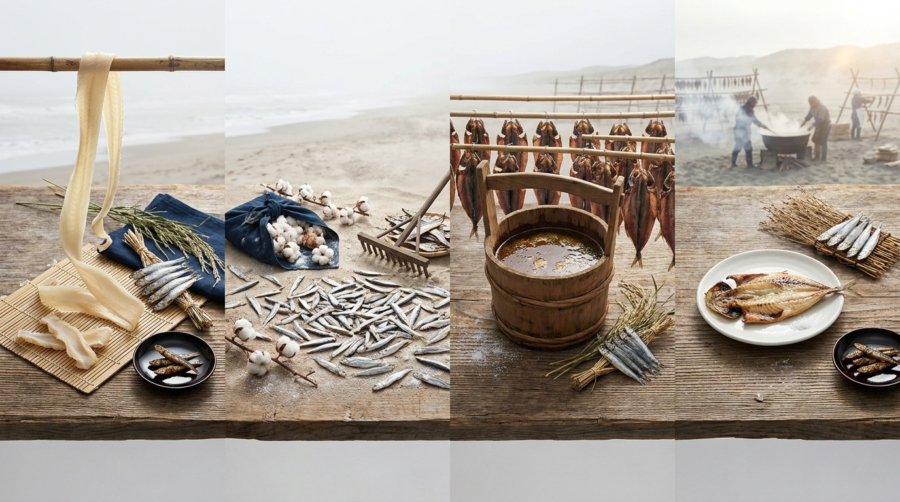
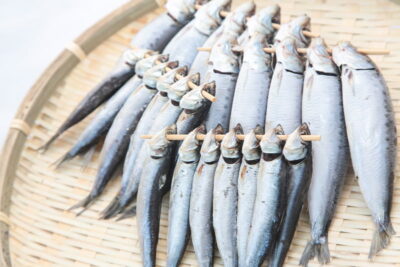
That is a good way into the subject, because the history of dried fish in Japan is mostly about fish that nobody ate. A few terms first. Himono is the everyday word for dried seafood, from a whole sardine to a split horse mackerel. A hiraki is a fish split open and flattened before drying, the shape most visitors meet at breakfast. Niboshi are small fish boiled and then dried, used mainly to make stock. Hoshika, a word few Japanese people under seventy would know, means dried sardines used as fertiliser. And tawaramono, “baled goods”, was the shogunate’s name for the dried seafood it shipped to China. Keep those five in mind and the rest of the story follows.
Drying is also only one of the ways Japan kept fish from rotting, and it is the only one this article follows. Fish packed in rice and left to sour for a year is narezushi, the ancestor of sushi. Fish salted until it dissolves into liquid is the fish sauce that came before soy sauce. Fish buried for days in miso or sake lees belongs to the tradition of fermented marinades. And one dried fish, boiled, smoked ten times and grown over with mould, became something else entirely: katsuobushi, the block that rings when you strike it. What follows is everything else that went out on the racks.
A Ribbon of Abalone for the Gods
On the coast of Toba in Mie Prefecture, in the fishing village of Kuzaki, a small workshop prepares dried abalone for the Grand Shrine of Ise, the most sacred site of Shinto, Japan’s native religion. Local tradition says the village has done this for two thousand years. In the legend, Princess Yamatohime, searching for a worthy place to found the shrine, chose Kuzaki as the source of the goddess’s food after a woman diver offered her abalone. That figure is a legend, not a date. The work itself is real, and the prefecture’s own description of it is precise. Elders of the village pare a medium-sized abalone into one continuous strip several metres long, the way a cook peels a daikon into a sheet, then dry it, cut it and tie it into bundles. These are offered at the shrine’s three great festivals each year. The workshop is closed to visitors.
That dried strip is noshi-awabi, “stretched abalone”. It began as food for a deity. According to Mie Prefecture, by the Warring States period of the fifteenth and sixteenth centuries it was served at the ceremonies before a campaign and exchanged among high-ranking samurai households as a gift for happy occasions. Gradually the real strip was replaced by a paper fold, and the paper fold by a printed symbol. The emblem on the envelope is what remains of a dried shellfish. Its job is to say that the gift is auspicious, and also that it is not connected with a funeral, since the Buddhist mourning period was traditionally meatless and fishless.
Dried squid followed the same path. Surume, a whole squid split and dried until stiff, is still listed among the formal betrothal gifts exchanged between families, written with characters that mean roughly “long-lasting wife”. The same squid sold as a bar snack often goes by a different name, atarime. Suru can also mean to lose money, as at a gambling table, so merchants and drinkers swapped the syllable for atari, a win. One dried squid has two names: one for a wedding, one for the izakaya, Japan’s drinking-and-eating pub.
Dry Things at the Heian Banquet
Japanese archaeologists generally believe that Jōmon-period people (roughly 14,000 to 300 BCE) were already drying shellfish. Some argue that the largest shell mounds were processing sites, not kitchen rubbish heaps, and that dried shellfish travelled inland to be traded. That interpretation is debated. The written evidence is firmer. Documents preserved in the Shōsōin, the eighth-century imperial treasury in Nara, list dried seafood among offerings to the gods. In the Heian period (794–1185), dried fish and shellfish, called karamono, “dry things”, appear in court literature as snacks for aristocratic drinking parties.
Note who is eating. Fresh sea fish could not reach the capital at Kyoto, which lay inland behind mountains, and dried seafood was the form in which the coast reached the court, in small and valuable amounts. Ordinary people ate fish when they lived near the water. The dried forms that moved long distances moved upward, as tax, tribute and offering. That pattern held for a thousand years, and then it reversed, though not in the way you might expect.
Sardines for Cotton
In the late sixteenth and early seventeenth centuries, fishermen from Kishū, the peninsula south of Osaka now called Wakayama, began travelling east each spring to the long, flat beaches of Kujūkuri on the Pacific coast near present-day Tokyo. The local story credits a single shipwrecked Kishū fisherman with teaching the villagers the jibiki-ami, a huge seine net hauled up onto the sand from the shore. The beach was ideal for it. The sardine shoals were enormous. And the fishermen did something with the catch that sounds wasteful today. They spread most of it across the sand to dry and sold it as fertiliser.
That was hoshika. According to the Tokyo museum run by the Japan fisheries promotion foundation, the sardines lay on the beach for ten to fifteen days in spring and summer and up to a month in winter. A second product, shimekasu, was made by boiling the fish in great cauldrons and pressing out the oil before drying the cake that remained. The buyers were farmers of cash crops, above all cotton and indigo, in the Osaka region and later across the country. Cotton is a hungry plant. One estimate for early modern Osaka puts its fertiliser needs at one and a half to two times those of rice. Fish meal was fast-acting and expensive, and by the mid-Edo period it was known as kinpi, “money fertiliser”, because farmers had to buy it with cash instead of gathering it themselves.
The consequences went well beyond the fields. Cheap cotton replaced hemp in ordinary clothing and made the padded futon possible. Cotton sailcloth let ships carry more cargo. Cotton nets let fishermen catch more sardines. The pressed-out fish oil, at less than half the price of rapeseed oil, lit the paper lanterns of ordinary homes. The museum adds a nice detail: this is why Japanese ghost stories show the monster cat licking the lamp. The oil was made from fish. The Kujūkuri towns sang of hauling in “a thousand gold pieces, ten thousand” in their nets. The trade did not end at once. It was squeezed from the late Meiji era (1868–1912) onward — first by herring cake from Hokkaido, then by soybean cake from Manchuria, and finally by chemical fertiliser — until the sardines no longer had anywhere to go.
One small piece of that economy survives on the most formal table in the Japanese year. The New Year box of osechi always contains tazukuri, tiny dried sardines glazed with soy and sugar. The name means “making the rice field”, and it is usually explained by the sardines’ former life as fertiliser, as we noted in our piece on osechi. The dish’s other name, gomame, is often written with characters meaning “fifty thousand bales of rice”. That reading is a later pun on an older word whose meaning is uncertain. The fertiliser history, however, is entirely real.
A Herring Economy
In the nineteenth century the centre of gravity moved north. Every spring, herring arrived off the western coast of Hokkaido in such numbers that the sea turned milky with spawn. Around the turn of the twentieth century, Hokkaido’s annual catch reached seven hundred thousand to a million tonnes, and herring made up about seventy percent of it, according to the Hokkaido Museum. The museum is equally clear about where it went. Only a small fraction of the freshest fish became migaki nishin, split and hard-dried herring for eating. The rest, which had lost freshness before it could be processed, was boiled in iron cauldrons, pressed and dried into herring cake. The cake was packed in straw bales and shipped south on the kitamaebune, the merchant ships of the Japan Sea route, to fertilise indigo in Tokushima, cotton in Aichi and Okayama, mandarins in Wakayama and rice in Toyama.
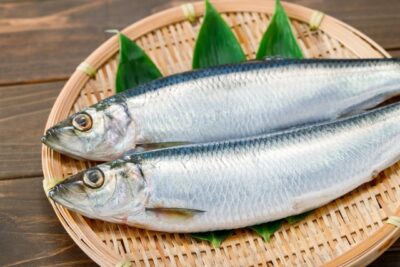
The herring that people did eat found its way into the cooking of a city as far from the sea as Kyoto could be. Hard-dried herring, soaked for days and then simmered sweet, kept well in the inland heat. In 1882, Matsuno Yosakichi, second-generation owner of a soba shop opened in 1861 beside the Minamiza theatre, laid a piece of it on a bowl of hot soba. Matsuba still serves that nishin soba today, and it remains the signature noodle dish of a city famous for refinement, one of the stranger chapters in Japan’s regional soba traditions. The same ships carried Hokkaido kelp south on the route traced in our guide to the kombu coasts. Wrapped around a piece of herring, it became the kelp roll in the New Year box.
Paying for Silk in Sea Cucumber
The third destination was abroad. Throughout the Edo period (1603–1868), Japan’s only sanctioned trade with China ran through Nagasaki, and Japan bought silk and medicines with gold, silver and copper. By the early eighteenth century the outflow of metal alarmed the shogunate. Its 1715 trade regulations encouraged a substitute: dried seafood that Chinese cooks prized and could not get enough of. Dried sea cucumber, dried abalone and shark fin, the “three baled goods”, were packed in straw bales and shipped from Nagasaki. Kelp, katsuobushi and dried squid followed as lesser categories. Fishing villages from Hokkaido to Kyushu were assigned quotas. Later in the century the shogunate built an office to collect the bales directly.
There is a linguistic trap here that confuses even Japanese readers. The dried sea cucumber on those ships was called iriko. In western Japan today, iriko is the everyday name for dried sardines used for stock. They are different words written with different characters that happen to sound the same. In the eighteenth century, one kind of iriko went to Chinese banquets and the other kind of sardine went to cotton fields. That is the historical pattern in miniature. The most valuable dried seafood Japan produced went into somebody else’s cuisine.
Salt Was the Tax
Not every dried fish had an export market. Some had only a problem to solve. About 150 km (95 miles) south of Tokyo, on Niijima in the Izu Islands, the rocky soil would not grow rice. According to the Tokyo Metropolitan Government’s account, in the early Edo period the islanders paid their tax to the shogunate in salt, which they boiled from seawater themselves. Salt was the one thing they could not afford to waste. So when they soaked split fish in brine before drying, they kept the brine, topped it up and used it again, year after year.
Over generations the brine turned. Proteins from the fish leached into it, bacteria moved in, and the liquid thickened into a brown, viscous culture with a smell that clears a room. Fish soaked in it overnight and then dried came out savoury and long-keeping. One test cited by the metropolitan government found it lasted more than twice as long as ordinary dried fish. Before the Meiji era it was called shotchiru-boshi, “salt-liquid dried”, a name related to the Akita fish sauce shottsuru. The modern name, kusaya, is usually read as “the stinking one”, although other origins have been proposed. The dominant bacterium has been named Corynebacterium kusaya, but researchers are still identifying the full community, and nobody yet knows exactly what each organism contributes.
The brine was kept because salt was the tax. The flavour was an accident of thrift that people chose to keep.
Islanders tended the brine like a sourdough starter. Unused, it was fed scraps of fish to keep it alive. A family’s brine went with a daughter when she married. In modern workshops it sits in underground tanks — on most islands at roughly the salinity of seawater, on Hachijō at two or three times that — and batches are rested in turn, because a brine worked continuously loses the balance of bacteria that makes it good. Some of that liquid, the metropolitan government says, has been maintained without a break for more than two hundred years. The scarcity behind it has its own history, told in the country that forgot how to make salt. The producers’ worry today is not salt but successors. Young islanders eat less kusaya than their parents did, and the workshops have trouble finding people willing to move to a small island to make it.
The Stock That Moved East
The sardine had one more future, and it took Japan a surprisingly long time to find it. Small sardines boiled and dried as niboshi were being made around the Seto Inland Sea by the early eighteenth century. The National Diet Library’s survey of Japanese stock notes that in western Japan, in the Edo period, they served as the everyday substitute for katsuobushi, which ordinary households saved for New Year and festivals. The library also notes that the record is thin. Sardines were caught in such numbers that they were looked down on as a low fish, and low fish rarely got written about.
Eastern Japan barely used them. One Japanese niboshi wholesaler’s history notes that the first production record in the Kanto region is a figure of two tonnes from Chiba in 1895. As long as the eastern sardine catch was going to the fields, there was no reason to boil it for soup. Once the fertiliser trade let go of the fish, niboshi spread nationwide, and the same wholesaler puts wartime production in 1942 at about 92,000 tonnes. Today the toasty, frankly fishy stock it makes is the default of home cooking across much of the west and Kyushu, one of the alternatives to kelp and bonito described in our account of how dashi was invented. Nagasaki is now the largest producer, with more than a quarter of the national supply. The anchovy shoals it depends on have thinned, and processors there are experimenting with substitute species.
Barely Dried at All
Which brings us at last to the plate, and to the object most visitors picture when they hear “Japanese dried fish”: a split horse mackerel, glossy and plump, grilled for breakfast beside rice and miso soup. In the structure set out in one soup, three dishes, it is the main dish. It is also, historically speaking, almost brand new.
Until the twentieth century, eating dried fish meant eating something hard and very salty, built to survive weeks without refrigeration. The soft, lightly salted, still-moist style the Japanese call ichiya-boshi, “dried for one night”, emerged in the middle of the Shōwa period (1926–1989). It depended on the freezer and the refrigerated truck. The Ministry of Agriculture describes it plainly: traditional technique combined with modern cold storage to make a low-salt, high-moisture product. In other words, the drying is no longer what keeps the fish. The cold does that. The brief brine and the hours in moving air are there for flavour and texture: firmer, more concentrated flesh, and a surface that browns readily over heat. A modern himono is closer to a cured fresh fish than to a preserved one. Keep it in the freezer, not the cupboard.
Numazu, on Suruga Bay at the foot of Mount Fuji, became the capital of the new style. At its peak, according to one fourth-generation producer, about 250 himono workshops crowded around the port, and in the 1950s his family’s firm alone split thirty to fifty thousand local horse mackerel a day. The figures are still striking. Of Japan’s 16,659 tonnes of dried horse mackerel in 2024, Shizuoka Prefecture produced 8,131, almost half, according to the Ministry of Agriculture’s processing statistics. The local fish no longer meets the demand. Warming seas have left the nearby horse mackerel leaner than processors want, and the larger Numazu firms now buy suitable fish from around the world and dry them in Japan.
One regional habit is worth pointing out, and it belongs to the coast just east of Numazu. Most Japanese dried fish are split along the belly, but a few, such as barracuda and halfbeak, are traditionally split along the back with the head left on, a style called Odawara-biraki. The Ministry of Agriculture’s explanation is that the samurai of Odawara disliked belly-splitting because it suggested ritual suicide, and disliked headless fish because they suggested defeat. That is exactly the story told about Tokyo-style eel, and as we argued in our piece on Japanese grilling, there is reason to suspect it is a later explanation for a cut that has more to do with the fish than the warrior. The same article explains the useful part: a strong fire held at a distance, and the side that will face the diner — for a split fish, the flesh — put to the heat first and given most of the time.
The humblest dried fish of all had a moment in the national spotlight. Mezashi, “eye-skewered”, are small whole sardines threaded on straw or bamboo through the eyes in bunches of four or five, salted and dried hard. In 1982 an NHK documentary followed Toshio Dokō, the 85-year-old industrialist then leading a national campaign to cut government spending. In one scene he sits in the kitchen of his modest home and eats mezashi for dinner with his wife. The few seconds of film made him “Mezashi Dokō-san” for the rest of his life. Japan’s broadcasting archive credits the image with boosting public support for the whole reform effort. The fish that once fed cotton fields had become a national shorthand for frugality.
What the Wind Still Keeps
The old forms have not disappeared. They have become regional. In Murakami, in northern Niigata, whole salmon are salted for about a week, washed, then hung for some three weeks in the cold winter wind off the Sea of Japan. The salted salmon of that cold coast is the cousin of the grilled salt salmon in Japan’s first school lunch, remembered in our history of the rice ball. The small smelt known as shishamo, dried at temperatures below 10°C (50°F), was a preserved food of the Ainu, Hokkaido’s Indigenous people, before it became a supermarket staple. Karasumi, salted and dried mullet roe, came from China through Nagasaki in the Edo period and is still made there. In autumn, when the saury that defines the Japanese autumn table arrives in quantity, the Numazu workshops split and dry it like everything else.
Japan’s dried fish ended up in strange places: in the cotton of a farmer’s clothes, in the lamp oil that lit a ghost story, in a Chinese banquet paid for in sea cucumber, in a soba bowl in Kyoto, on the corner of an envelope. For most of its history the dried fish that ordinary people ate was the leftover: the sardines too small to sell, the herring that came in fresh enough, the fish soaked in brine that islanders could not afford to throw away. That the most prestigious dried seafood in Japan’s past went to gods and foreigners, while the most familiar one today is barely dried at all, says a good deal about how the country’s relationship with the sea changed once it no longer needed to make fish last.
The ribbon of abalone is still pared in Kuzaki, still dried, still carried to Ise three times a year. Nobody eats that one either.
Read, then Taste.
This article is part of Waden’s Heritage series. For the one dried fish that became a fermented food, read Harder Than Rock Salt. For the oldest way Japan preserved fish without drying it, read The Sushi That Smells Like Cheese. For what a bed of miso or sake lees does to a fillet before the grill, read Before the Grill. Read more at waden.umamibako.com.
Waden is an editorial journal exploring the depth and beauty of Japanese food culture — its history, ingredients, artisans, and traditions. Story first, always.
Comment